

Starting January 1, 2027, taxpayers can claim a federal credit for gifts to a scholarship granting organization. Treasury and the IRS released the rules for those organizations in October 2026, and the rules set specific requirements for how an SGO holds money, spends it, reports it and gets audited.
This post explains what the rules say, who they apply to and what an organization needs ready before its first qualifying gift arrives. It is an informational summary, not legal or tax advice, so confirm the details against the regulations and with your own counsel.
The facts come from the IRS announcement (IR-2026-117), the Treasury and IRS temporary regulations (Federal Register document 2026-20264) and IRC §25F, as summarized in Crowded’s October 2026 review.
What Is a Scholarship Granting Organization (SGO) Under IRC §25F?
A scholarship granting organization (SGO) is the intermediary between donors and students in the federal scholarship tax credit program. Donors give to the SGO, the SGO decides who receives each scholarship, and the SGO pays for approved K-12 education expenses. Section 25F of the Internal Revenue Code creates the credit; the October 2026 regulations spell out what an SGO has to do.
The rules also describe how an SGO gets recognized. Participating states submit their lists of SGOs, and the first state lists are due February 15, 2027. The regulations provide for verification, audit and removal of SGOs that do not comply, so the quality of an SGO’s records matters from the first gift.
For a nonprofit, the practical meaning is that a scholarship granting organization is a defined, regulated role. It is not simply a scholarship fund with a new label. The role comes with its own account, its own spending test and its own reporting calendar.
How Does the New Federal Scholarship Tax Credit Work?
The credit lets a taxpayer claim up to $1,700 for gifts to an SGO, or up to $3,400 on a joint return, for contributions starting January 1, 2027. Because the benefit goes to the donor as a credit, the scholarship granting organization’s job is to receive qualifying gifts and document how each one was used.
| Item | What the rules say |
|---|---|
| Credit per taxpayer | $1,700 |
| Credit on a joint return | $3,400 |
| States opted in at launch | 30 |
| Program start | January 1, 2027 |
| State SGO lists due | February 15, 2027 |
Treasury also published projections for the program’s scale. As of October 1, 2026, Treasury estimates about $26 billion in qualified contributions a year, and 600 to 700 SGOs awarding about 2.2 million scholarships a year by 2030.
Those figures are estimates, not forecasts for any one organization. They show the scale Treasury expects: a new group of scholarship granting organizations, each handling donor gifts, awards and reports under the same federal rules. An organization weighing the role can use them to judge how much record-keeping capacity the program may demand.
What Must a Scholarship Granting Organization Have in Place?
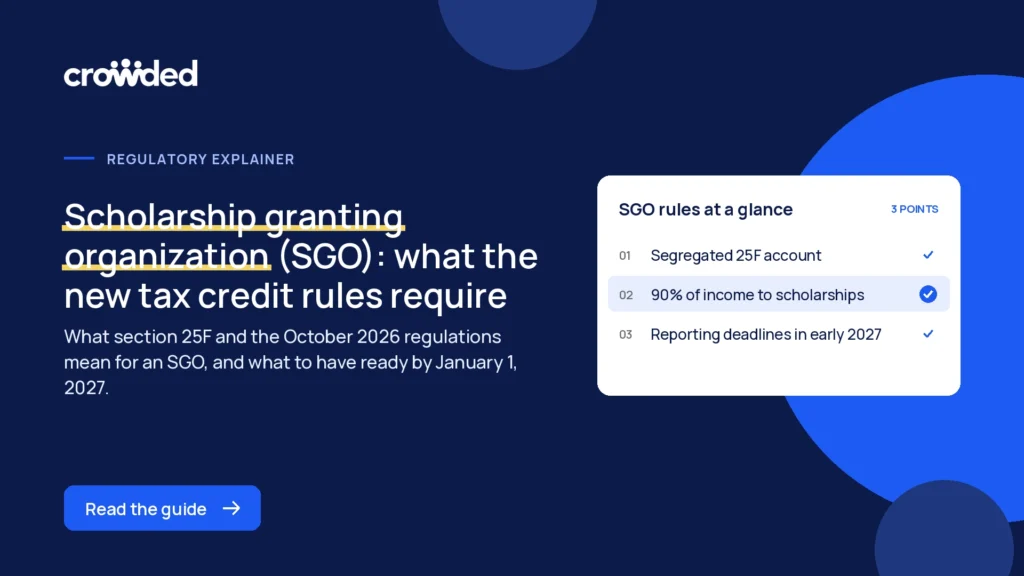
An SGO needs seven things in place: a segregated account, a 90% spending level, qualified-expense awards, its own award decisions, donor acknowledgments, an IRS donor report and an annual audit. The regulations set each one, and each one produces records someone may later review.
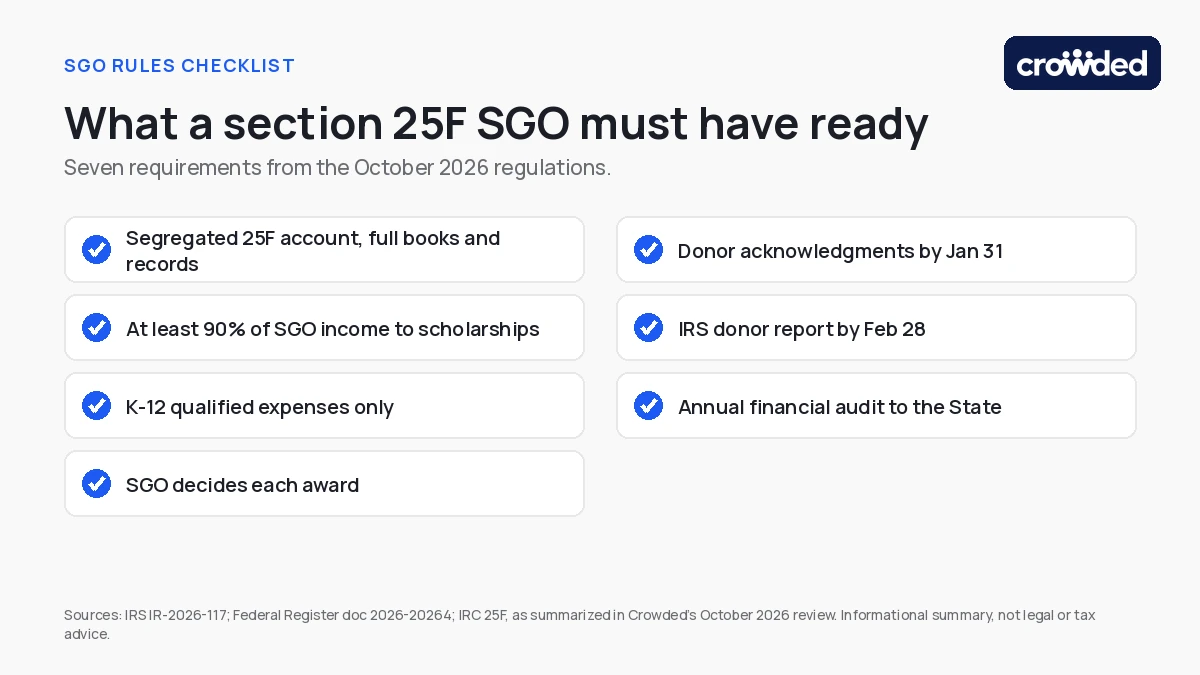
- A segregated §25F account with full books and records. The money from qualifying gifts sits in its own account, and the SGO keeps complete books and records for it.
- At least 90% of SGO income to scholarships. The SGO sends most of what it takes in to students, not to overhead.
- Scholarships for K-12 qualified expenses only. The list of eligible costs is set out in the next section.
- SGO-directed awards. The SGO decides each award.
- Donor acknowledgments by January 31. Each donor receives a written acknowledgment of the gift.
- An IRS donor report by February 28. The SGO reports its donors to the IRS.
- An annual financial audit delivered to the State. A participating state receives the audit.
A segregated account makes the 90% test provable. If the §25F money moves through a general operating account, an auditor has to reconstruct which dollars were scholarship dollars. If the money sits in its own account with a matching ledger, the answer is already in the records.
Verification, audit and removal are the enforcement side of the same rules. Related posts on how a nonprofit single audit works and how IRC §4945 taxable expenditures work for private foundations show how auditors and the IRS look at restricted money.
What Can an SGO Scholarship Pay For?
An SGO scholarship can pay for K-12 qualified expenses: tuition, tutoring, books, curriculum, computers and special-needs services. Anything outside that list is outside the program, so each award needs a record showing which expense it covered.
The SGO directs each award. That means the SGO, not a donor and not a school, decides who is awarded what. Awards can also be split. For example, an SGO can send tuition straight to the school and send the balance to the family for the other qualified expenses.
Split awards are the detail that stresses record-keeping most. One scholarship can create two payments to two different recipients, and both payments belong to the same award in the books. The comparison of grants, scholarships and stipends under IRS rules explains why the label on a payment matters for documentation.
What Are the Key Dates for a Scholarship Granting Organization in 2027?
The first date is January 1, 2027, when the credit and the program start, and the next hard date is February 15, 2027, when state SGO lists are due. The reporting dates in the regulations follow: donor acknowledgments by January 31 and the IRS donor report by February 28.
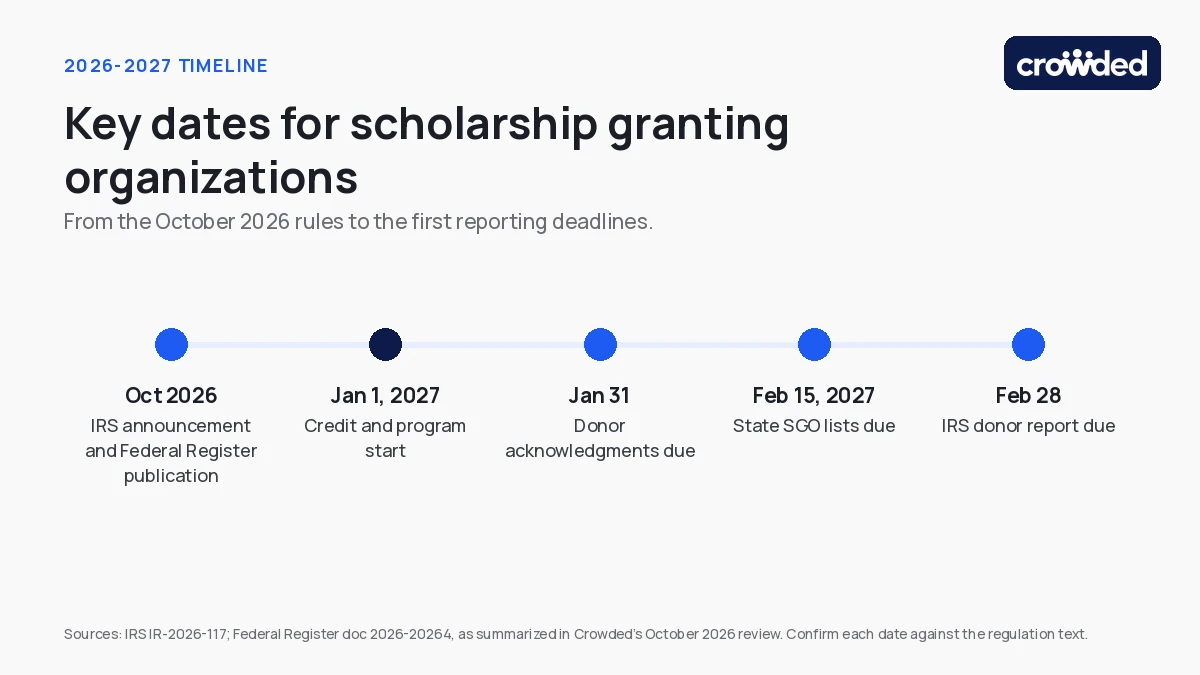
- October 2026: the IRS announces the rules (IR-2026-117) and the regulations appear in the Federal Register.
- January 1, 2027: the credit and the program begin.
- January 31: donor acknowledgments are due.
- February 15, 2027: states submit their SGO lists.
- February 28: the IRS donor report is due.
The regulations also call for an annual financial audit delivered to the State. The summary above does not show which calendar year each recurring date first applies to, so confirm that point in the regulation text before building a calendar.
How Should an Organization Decide Whether to Become a Scholarship Granting Organization?
An organization should decide by testing four things: whether it can hold §25F money apart, whether it can meet the 90% level, whether it can document each award, and whether it can report on time. If any of the four is uncertain, that is the work to finish before January 1, 2027.
- Account structure. Can the organization open and manage a dedicated account for §25F money, with books that stand apart from its other funds?
- Spending level. Does the budget leave at least 90% of SGO income for scholarships?
- Award records. Can staff show, for each award, the student, the qualified expense and where each payment went?
- Reporting capacity. Is someone responsible for donor acknowledgments, the IRS donor report and the annual audit?
Consider a community organization that already pays scholarships from its general operating account. Under the §25F rules, it would need to separate qualifying gifts into their own account, record each award against a qualified expense, and be able to hand an auditor the full trail. None of that is complicated on its own. It is simply easier to build before the first gift than after.
Organizations still sorting out platform choices can read why a scholarship platform does not need a payments license for background on how scholarship money movement is usually structured.
How Crowded Helps an SGO Keep Section 25F Records Separate
Crowded provides the account and payment tools a scholarship granting organization can use to keep its §25F money and records organized. The capabilities below come from Crowded’s October 2026 review of the program.
- A dedicated account for each SGO, so §25F money stays apart from other funds.
- A fund-level ledger with general ledger (GL) mapping, so each award ties back to the books.
- Visa® debit family wallets with merchant category (MCC) and merchant-ID controls, so funds can be limited to approved merchants.
- ACH payments to a school, plus funds sent to a family wallet by API.
- Audit-ready exports your auditor can work from.
See how grantmaking disbursement and tracking works, how fund accounts and spending controls are set up, and what the API integration covers. Crowded does not provide legal or tax advice, and the tools above support an SGO’s records rather than replace its counsel’s judgment.
Get the Records Ready Before January 1, 2027
The §25F rules reward preparation. A segregated account, a ledger that matches each award to a qualified expense and a clear reporting calendar are the pieces an SGO needs ready when the program starts on January 1, 2027.
If your organization is weighing the scholarship granting organization role, you can book a demo to walk through how fund accounts, award payments and exports fit the rules, or open an account to see the setup yourself.
Crowded is compliant money movement and banking for mission-driven organizations — fund accounts, policy-controlled disbursements, and IRS filings in one platform.
* Crowded Technologies Inc is a financial technology company and is not a bank. Banking services provided by i3 Bank; Member FDIC.
* The Crowded Technologies Inc. Visa® Debit Card is issued by i3 Bank pursuant to a license from Visa U.S.A. Inc. and may be used everywhere Visa debit cards are accepted.