Scholarship management platform disbursement helps software providers add payout workflows, recipient verification, fund tracking, reconciliation, and payment visibility without becoming payment companies themselves. Instead of holding or transmitting funds directly, platforms can integrate with banking, payments, or embedded finance partners that support the regulated infrastructure behind scholarship payouts.
TL;DR
- Scholarship platforms are now being judged after approval: sponsors want payout visibility, recipient verification, failure handling, and clean reconciliation.
- Disbursement can add product value without turning the platform into a payments company when supported by the right banking or embedded finance infrastructure.
- The biggest risk is operational fragmentation: spreadsheets, checks, manual ACH fixes, unclear fund ownership, and disconnected reporting.
- Crowded helps turn disbursement into a platform advantage with fund tracking, permissioned controls, payout visibility, and audit-ready records.
- Before choosing a partner, platform builders should evaluate custody, compliance, ownership, reconciliation, failed payments, APIs, and webhook flexibility.
Why Scholarship Platforms Are Moving Beyond Award Management
Scholarship management software is used for application processing, eligibility checks, review scoring, donor portals, award notifications, and reporting dashboards. Now sponsors care about what happens after approval: recipient verification, secure fund movement, payout visibility, failed payment resolution, and restricted fund reconciliation.
That is why scholarship management platform disbursement is becoming a core product requirement. For platform builders, the opportunity is clear: support post-award financial workflows without becoming a licensed payments provider or holding funds directly.
The Product Gap: Awards Are Digital, But Disbursement Is Still Manual
Many scholarship platforms manage applications, reviews, scoring, award letters, and reporting well. But once an award is approved, the workflow often leaves the platform. That is where the burden starts: spreadsheets, checks, separate banking forms, missing recipient details, manual ACH fixes, and Excel-based reconciliation.
The platform may own the scholarship workflow, but not the visibility into money movement. That gap creates problems for every stakeholder:
- Sponsors lack real-time visibility into fund release and settlement.
- Recipients face delays and unclear payout status.
- Finance teams manage reconciliation outside the system of record.
- Operators handle payment exceptions through email, spreadsheets, and support tickets.
- Product teams lose control over a critical part of the user experience.
A modern scholarship platform needs to manage more than award decisions. It needs to support the operational path from approved award to verified payout.
What “Without a Payments License” Means
Adding disbursement does not mean a scholarship platform has to become a regulated financial institution. In many embedded finance models, the platform stays focused on workflow and user experience. At the same time, licensed banking, payments, or infrastructure partners support fund custody, KYC/KYB, payment origination, and access to payout rails.
In simple terms, the platform manages the disbursement experience; the partner infrastructure supports the financial operations behind it.
At a high level, this model may involve:
- A banking or financial partner holding funds
- Sponsor or organization verification
- Recipient identity or payment-detail verification
- ACH, wire, check, or card-based payout options
- Transaction monitoring and failure handling
- Reconciliation data flowing back into the platform
- Dashboards that show payout status and fund movement
The exact structure depends on jurisdiction, fund flows, contractual responsibilities, and legal review. The safer product posture is “we support scholarship disbursement workflows through partner infrastructure.”
How Scholarship Management Platform Disbursement Works
A strong scholarship management platform’s disbursement workflow usually has six layers.
1. Sponsor or Organization Onboarding
Before money moves, the platform needs to know who is funding the scholarship. This may include organization details, authorized users, tax or entity information, bank account data, approval permissions, and program-level funding rules.
The purpose is controlled financial access. Sponsors need to define who can approve payouts, view balances, update recipient information, release funds, and access reports.
2. Fund Holding and Allocation
Funds are typically held through a banking or financial infrastructure partner, then mapped inside the platform to programs, award cycles, sponsors, restricted funds, recipients, or payout schedules.
That matters because scholarship money is often conditional. Teams need to know where funds belong, which awards are approved, which payouts are pending, and what remains unreconciled. A ledger or allocation layer turns disbursement into a trackable workflow.
3. Recipient Verification
Before payout, recipients often need verification through identity checks, bank validation, enrollment confirmation, tax forms, or sponsor-specific requirements. Without built-in workflows, scholarship teams end up collecting sensitive information through forms, email threads, and manual reviews. A stronger model keeps verification configurable inside or alongside the platform.
4. Payout Rail Selection
Scholarship payouts may be made via ACH, wire, digital check, paper check, card-based transfer, or direct institutional payment. Each rail has trade-offs. ACH is cost-effective but can fail. Wires are faster but more expensive. Checks may be necessary, but harder to track. Institutional payments may require verified school routing details.
The platform should support flexible payout orchestration based on program rules, recipient type, amount, timing, and sponsor preference.
5. Reconciliation and Audit Trail
Disbursement is not finished when funds are sent. Finance teams still need to know what was approved, what was released, what settled, what failed, what was returned, and what remains outstanding.
A strong audit trail should capture:
- Award approval
- Payout authorization
- User permissions
- Recipient verification status
- Payment method
- Transaction status
- Failure reason
- Retry or remediation history
- Timestamps
- Exportable reporting data
This is where disbursement becomes more than a payment feature. It becomes a financial operations infrastructure.
6. Failure Handling and Visibility
Payments fail. Accounts close, routing numbers are wrong, recipients mistype details, ACH returns happen, checks go missing, and verification issues need review. A modern disbursement workflow should display the failure reason, next step, retry option, recipient notification status, and resolution history in a single place.
Operators should not need inboxes, spreadsheets, and processor portals to understand what happened.
Why Platform Builders Should Care
Scholarship platforms are becoming systems of record for the full award lifecycle, so the post-award experience now matters as much as applications and review. Embedded disbursement creates a stronger platform moat by integrating intake, approval, fund allocation, payout execution, reconciliation, and reporting into a single workflow.
It reduces manual work for operators, improves visibility for sponsors, creates a cleaner recipient experience, and gives compliance teams a clearer record of who approved, released, received, and resolved every dollar.
The Compliance-Aware Way to Build Disbursement
A compliance-aware disbursement model starts with responsibility mapping. Before building or buying infrastructure, platform teams should define who handles fund custody, sponsor verification, recipient verification, payment origination, transaction monitoring, failed payments, tax workflows, records, audit logs, and support escalation.
That matters because scholarship disbursement may involve fund custody, payment transmission, recipient data, institutional payments, tax reporting, unclaimed property, and privacy requirements.
The platform does not need to own every responsibility directly. But it does need to know how ownership is split across the platform, sponsor, banking partner, processor, and infrastructure provider. Clear ownership reduces ambiguity during implementation, procurement, and compliance review.
What to Look for in a Disbursement Infrastructure Partner
The right infrastructure partner should support more than basic payout execution.
Platform builders should look for capabilities that strengthen the entire post-award workflow:
- Embedded fund tracking
- Sponsor and recipient verification
- Multi-rail payout support
- Permission-based approvals
- Installment payout automation
- Real-time or near-real-time payment status
- Failed payment handling
- Reconciliation exports
- GL or ERP integration
- API and webhook support
- Sandbox testing
- Audit-ready reporting
The best partner should help the scholarship platform preserve its own user experience while abstracting the operational complexity behind the scenes. That means product teams can focus on workflow design, sponsor experience, recipient communication, and platform adoption instead of stitching together disconnected payment tools.
Turn Disbursement Into a Platform Advantage With Crowded
Scholarship platforms need infrastructure that makes fund movement, payouts, reconciliation, and oversight easier to manage inside the product experience. Crowded helps platform builders support that layer without stitching together disconnected banking, payments, and reporting tools.
With clearer fund tracking, permissioned controls, payout visibility, audit-ready records, and fewer manual workarounds, Crowded turns disbursement from a back-office burden into a value-added platform capability.
Scholarship Disbursement Vendor Evaluation Checklist
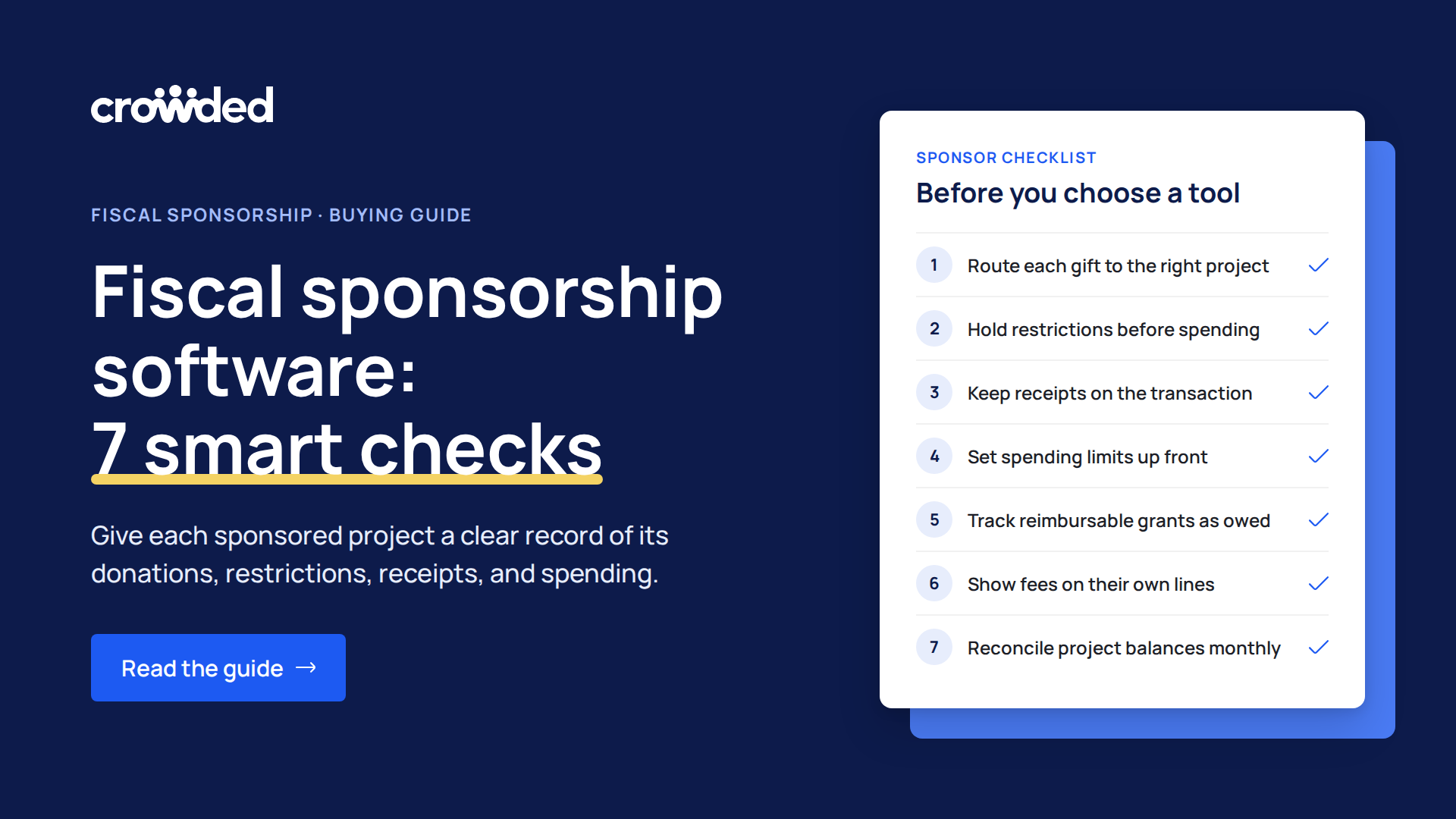
Before choosing a disbursement partner, platform builders need to evaluate more than features and pricing. The questions are about fund custody, compliance, ownership, payout failures, reconciliation, reporting, and API flexibility.
Use the Scholarship Disbursement Vendor Evaluation Checklist to compare vendors across money movement, banking partners, payout visibility, failed payment handling, installment automation, reconciliation, and webhook support. Download the checklist before your next vendor demo or procurement review.
Get the Free Checklist
Disbursement Is Becoming a Platform Expectation
Scholarship software is no longer judged only by applications and reviews. It is judged by how well it helps sponsors release, track, reconcile, and prove the use of funds.
For platform builders, scholarship management platform disbursement adds product value without unnecessary licensing complexity. With the right partner infrastructure, platforms can support payouts, recipient verification, fund visibility, reconciliation, and failure handling while staying focused on the scholarship experience.
Start by mapping what happens after award approval. The biggest opportunity often begins where spreadsheets, payment delays, and reconciliation gaps appear.
Frequently Asked Questions
Can scholarship platforms support multi-sponsor programs?
Yes. The right infrastructure can support segmented fund tracking, permissioned controls, and visibility across multiple sponsors or programs. Crowded helps simplify this through clearer fund oversight and audit-ready records.
Why do APIs matter for scholarship disbursement?
APIs and webhooks help connect scholarship platforms with payout, accounting, CRM, SIS, and reporting systems without manual data entry.
What problems appear as the scholarship payouts scale?
Common issues include failed ACH payments, manual reconciliation, unclear approval trails, delays in recipient verification, and limited payout visibility.
Can platforms support installment payouts?
Yes. Modern disbursement infrastructure can support scheduled or rule-based payouts based on semester dates, enrollment milestones, or sponsor approvals.
What should scholarship platforms prioritize when evaluating vendors?
Prioritize fund visibility, reconciliation, permission controls, failure handling, audit logs, API flexibility, and clear compliance ownership.