

Year end is the one stretch when finance, development and the board all need something from the same set of records. The books close, donors expect receipts, vendors expect 1099s and next year’s budget needs a vote, often within a few weeks of each other.
This guide lists the 10 steps, who owns each one and when it is due. Required dates come from the IRS and other linked sources. Target dates are working dates a finance team can adjust. Organizations whose fiscal year does not end on December 31 should move the close, budget and Form 990 dates to their own year end, while 1099 and W-2 dates follow the calendar year.
What Does the Year End Calendar for Nonprofits Look Like From October to January?
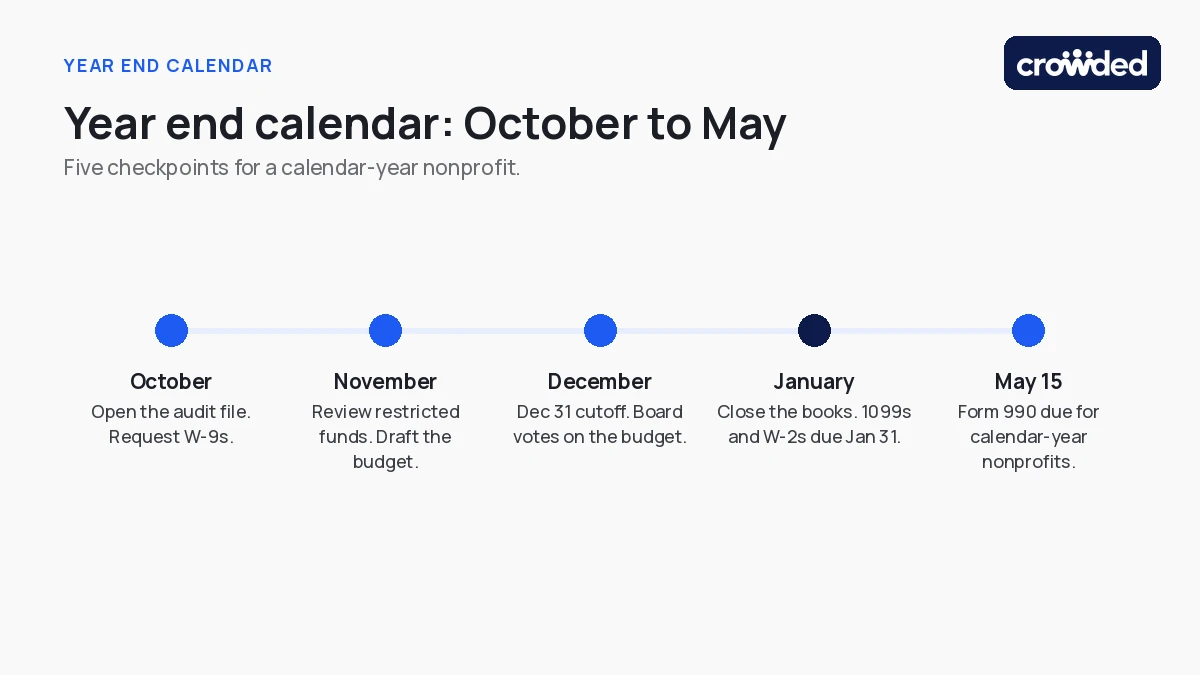
A calendar-year nonprofit does its year end work in four phases: plan in October, review in November, cut off in December and file in January. The Form 990 follows later, on May 15.
| Month | Focus | Steps in play |
|---|---|---|
| October | Plan and collect | Open the audit file (step 7) and request W-9s from vendors (step 4) |
| November | Review | Review restricted funds (step 5) and draft next year’s budget (step 6) |
| December | Cut off | Reconcile through November (step 2), set the December 31 cutoff (step 1) and take the budget to the board (step 6) |
| January | Close and file | Close and reconcile December (steps 1 and 2), send acknowledgments (step 3), file 1099s and W-2s (steps 4 and 10), report to the board (step 8) |
The IRS lists January 31 as the due date for Forms W-2 and 1099-NEC (see the IRS employment tax due dates and the instructions for Forms 1099-MISC and 1099-NEC). When January 31 falls on a weekend, the date moves to the next business day. In 2027, January 31 is a Sunday, so forms for 2026 are due Monday, February 1.
Year End Action Items for Nonprofits: The 10-Step Checklist With Owners and Deadlines
Each of the 10 steps below has one owner and one date. A date marked required comes from the IRS or another linked source, and a date marked target is a suggested working date.
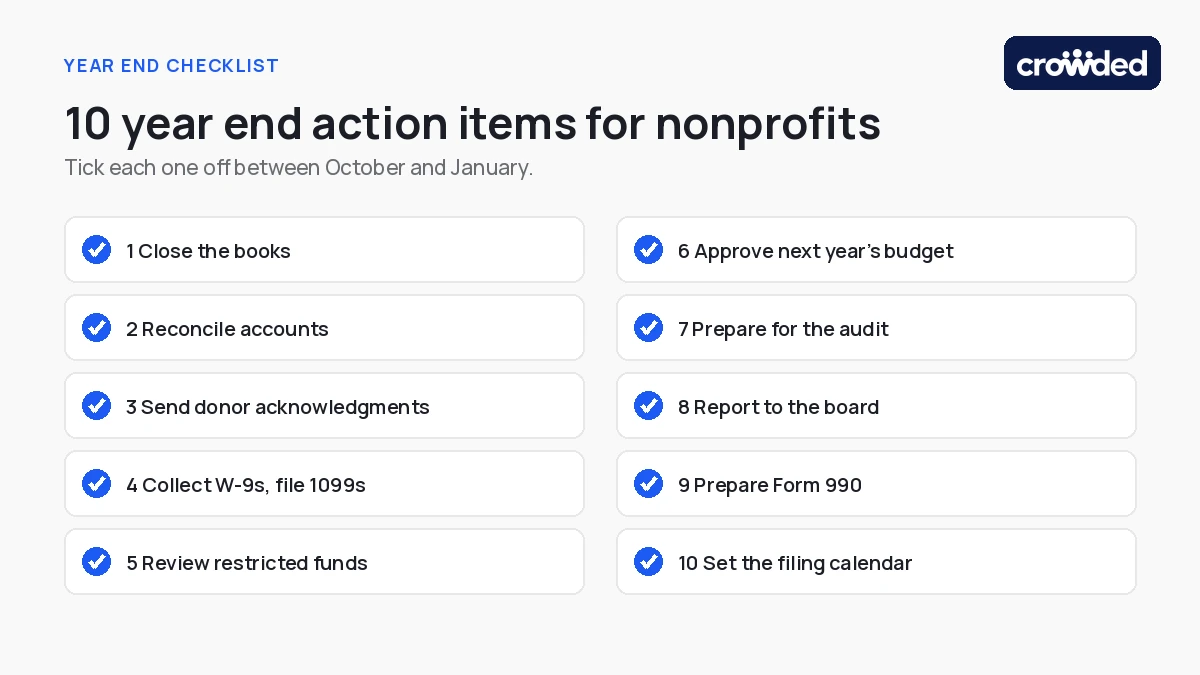
| # | Action item | Owner | By when |
|---|---|---|---|
| 1 | Close the books | Controller or finance lead | Cutoff December 31; closed by January 20 (target) |
| 2 | Reconcile accounts | Staff accountant | Through November by December 15; December by January 15 (target) |
| 3 | Send donor acknowledgments and giving statements | Development lead with finance | January 31 (target) |
| 4 | Collect W-9s and file 1099s | Accounts payable | W-9s by November 30 (target); 1099-NEC January 31 (required) |
| 5 | Review restricted funds | Finance lead with program managers | December 15 (target) |
| 6 | Approve next year’s budget | CFO and executive director, then the board | Board vote in December (target) |
| 7 | Prepare for the audit | CFO | Open the audit file by November 1 (target) |
| 8 | Report to the board | Executive director and treasurer | First board meeting of the new year (target) |
| 9 | Prepare Form 990 | Finance lead | May 15 for calendar-year nonprofits (required) |
| 10 | Set the tax and state filing calendar | Compliance owner or finance lead | Built by January 15 (target); Form 941 and W-2 January 31 (required) |
Steps 1 to 3: Close the Books, Reconcile Accounts and Acknowledge Donors
The first three year end action items for nonprofits turn a year of activity into final, supported numbers and a written record for every donor. They are the foundation for every later step.
Step 1: Close the books
Closing the books means setting a December 31 cutoff, posting every accrual and signing off on a written close checklist. The controller or finance lead owns the close, with a target of January 20. The checklist should list the cutoff, accruals, deferred expenses, payroll, grant revenue and the final journal entries, so the work stays in order while staff are out for the holidays.
Step 2: Reconcile accounts
Reconcile each account to its statement every month, then reconcile December in the first half of January. The staff accountant owns this step. A clean reconciliation shows that the ledger matches the statements, and it is the first document an auditor asks for. Our guide to reconciling the general ledger to each subledger walks through the process step by step.
Consider a restricted grant payment that arrives on December 28. If the close runs before that payment posts, the year end balance and the restricted fund balance both come out wrong. Reconciling through the last business day of the year catches it.
Step 3: Send donor acknowledgments and giving statements
A donor cannot deduct a single gift of $250 or more without a written acknowledgment from the nonprofit, and the donor needs it by the earlier of the date the return is filed or the return’s due date, including extensions. The IRS explains the rule in its guidance on substantiation and disclosure requirements for charitable organizations. Development owns the letters and finance confirms the amounts, with a target of January 31.
Each acknowledgment should include:
- The nonprofit’s name and the date of the gift.
- The cash amount, or a description of donated property without a value.
- A statement of whether the nonprofit provided goods or services in return, with a good-faith estimate of their value when it did.
The IRS also requires a written disclosure when a donor makes a payment of more than $75 that is partly a gift and partly a purchase, such as a gala ticket. One annual giving statement can cover several gifts, as long as it carries the same information.
Steps 4 and 5: File 1099s and Collect W-9s, Then Review Restricted Funds
Steps 4 and 5 protect two groups of people outside the finance team: the vendors who rely on correct tax forms and the donors who rely on their gifts being used as promised.
Step 4: Collect W-9s and file 1099s
A nonprofit files Form 1099-NEC for an independent contractor it paid $2,000 or more for services in a calendar year, due to the recipient and the IRS by January 31. The IRS raised the reporting threshold from $600 to $2,000 for payments made after December 31, 2025, as stated in its instructions for Forms 1099-MISC and 1099-NEC.
Accounts payable should request any missing Form W-9 by November 30 and compare each W-9 to the payment records. A name or taxpayer ID that does not match is much easier to fix in November than on January 30. Our guides to the W-9 form and how to fill it out and to tracking 1099s with compliance software cover the details.
Step 5: Review restricted funds
A restricted fund review confirms that every dollar given for a purpose is still available for that purpose. Under FASB’s Accounting Standards Update 2016-14, nonprofits report net assets in two classes: with donor restrictions and without donor restrictions. The finance lead and program managers should finish the review by December 15.
- Compare balances: match each restricted fund’s balance to the cash set aside for it.
- Release met restrictions: move amounts spent on their purpose from with donor restrictions to without donor restrictions.
- Flag open conditions: list gifts and grants with unmet conditions or deadlines.
- Document the support: keep the grant agreement and spending record for each fund together.
Restrictions also shape the next budget. Our post on budgeting with flexibility inside restricted grants shows how to plan around them.
Steps 6 and 7: Approve Next Year’s Budget and Prepare for the Audit
Steps 6 and 7 look ahead. The budget sets next year’s spending authority, and audit preparation decides how smoothly the auditors work.
Step 6: Approve next year’s budget
The CFO and executive director should draft the budget in November from actuals through October, the restricted fund review and known grant awards. The board votes in December, so spending authority is clear on January 1. A nonprofit budget template gives the draft a consistent structure from one year to the next.
Step 7: Prepare for the audit
Audit preparation should start at least 90 days before fieldwork, with an owner and a due date for each document. The CFO can open the audit file by November 1 and add reconciliations, board minutes, payroll records, grant agreements and restricted fund support as they are finished. Our nonprofit audit checklist of 14 documents lists what auditors request.
Nonprofits that spend $1,000,000 or more in federal awards during a fiscal year that begins on or after October 1, 2024 need a Single Audit, according to the Federal Audit Clearinghouse’s guide on whether an organization must conduct a Single Audit. Federal grant spending in 2026 is worth checking in November, while there is still time to plan for it.
Steps 8 to 10: Report to the Board, Prepare Form 990 and Set the Filing Calendar
The last three year end action items for nonprofits carry the work into the new year: a report the board can act on, the annual return and a calendar that keeps every later deadline visible.
Step 8: Report to the board
The year end board report gives directors the final picture in a form they can act on. The executive director and treasurer should present it at the first meeting of the new year. A useful package includes:
- the year end financial statements and a budget-to-actual comparison;
- restricted fund balances and what was released during the year;
- the status of reconciliations and the audit timeline;
- the approved budget and any variances to watch.
Step 9: Prepare Form 990
Form 990 is due on the 15th day of the fifth month after the end of the tax year, which is May 15 for a calendar-year nonprofit, as described on the IRS page for the annual exempt organization return due date. Starting in January, while the year end numbers are fresh, saves time in spring. Allocating expenses between program and administrative costs is the part that usually takes the longest, and our guide to functional expense allocation on Form 990 explains it.
Form 8868 gives an automatic six-month extension if it is filed by the original due date, and the IRS notes that an extension to file does not extend the time to pay any tax owed (see the IRS page on the extension of time to file exempt organization returns). Our national nonprofit filing calendar of Form 990 due dates lists dates for other fiscal year ends.
Step 10: Set the tax and state filing calendar
A filing calendar lists every federal, state and local deadline for the next twelve months, with an owner for each. The compliance owner or finance lead should build it by January 15. Start with the federal dates: Form 941 for the fourth quarter and Form W-2 are both due January 31, per the IRS employment tax due dates.
Then add state items. Charitable solicitation registration renewals depend on each state where the nonprofit fundraises, and our guide to state charitable solicitation registration explains what to track. For a wider view of the year, use our complete nonprofit compliance checklist.
How Crowded Helps Finance Teams Close the Year With Less Chasing
Year end work goes faster when funds are separate from the start and transactions already match the accounting system. Crowded gives nonprofits a structure that supports several of the year end action items for nonprofits above.
- Fund accounts* keep restricted gifts apart from operating money in a tiered structure, so the restricted fund review in step 5 starts from fund balances. See Crowded’s nonprofit banking for how the structure works.
- Accounting integrations connect transactions made on Crowded to your accounting platform for reconciliation and board-ready reporting, which supports steps 2 and 8. See Crowded’s integrations.
- Read-only permissions for advisors let an outside accountant see activity without the ability to move money.
Start the Year End Close in October, Not January
The 10 steps run in order, and each needs a named owner by October. Calendar-year nonprofits that spread the work across four months reach January with a short list of final tasks instead of a long one.
Work through these year end action items for nonprofits with the table above, adjust the target dates to your own team, and keep the required dates fixed. To see how fund accounts and accounting integrations fit your close, book a demo. A smaller organization that is ready to start can open an account directly.
Crowded is compliant money movement and banking for mission-driven organizations — fund accounts, policy-controlled disbursements, and IRS filings in one platform.
* Crowded Technologies Inc is a financial technology company and is not a bank. Banking services provided by i3 Bank; Member FDIC.