AMS platforms already sit at the center of their clients’ financial lives, but most AMS vendor financial infrastructure still stops at basic payment processing. Dues, event fees, and chapter disbursements may run through the platform, yet members are still left to manage banking elsewhere.
It is a strategic gap, and closing it does not require a bank charter, an internal compliance team, or a multi-year fintech build. It requires the right infrastructure partner.
Here is what that path can look like.
TL;DR
- Your AMS already owns the financial relationship, dues, disbursements, and chapter treasury, yet most platforms stop at payment processing.
- Adding banking accounts, expense cards, and automated disbursements doesn’t require a bank charter; a three-tier BaaS model handles the regulated heavy lifting for you.
- Post-Synapse, sponsor bank quality is non-negotiable; one checklist item separates a safe embedded finance partnership from a $25M liability.
- SaaS platforms with integrated financial services capture 36% of SME acquiring revenues today; that share hits 45% by 2028, and the window is narrowing.
- Multi-chapter account structures, volunteer treasuries, and Form 990 obligations require infrastructure for associations. Crowded is the only embedded finance platform purpose-built for exactly that.
What Does AMS Mean in Finance and Banking?
AMS stands for Association Management System, the platform associations, nonprofits, and membership organizations use to manage member data, dues, events, and related financial operations.
In practice, an AMS supports dues billing, event revenue, non-dues income, and chapter-level financial activity. It serves as the system of record for an association’s financial relationship with its members.
It is also where payments already happen: dues are collected, fees are processed, and disbursements are initiated. That is why embedded finance fits naturally inside an AMS, where financial activity already lives.
The Financial Opportunity AMS Vendors Are Leaving Behind, and What It Costs
Associations do far more than collect annual dues. They manage chapter accounts across multiple locations, disburse funds to local leaders, cover event expenses before revenue comes in, reimburse committee members, and maintain treasury visibility across fragmented sub-entities while staying audit-ready.
AMS platforms handle the record-keeping side well. The banking experience is where things break down. Chapters often use disconnected bank accounts with little headquarters visibility; reimbursements still move slowly; and reporting is stitched together at year-end, long after action would have helped.
That leaves AMS vendors well-positioned to solve the problem. The trust is already there, the financial workflows already run through the platform, and the need for better oversight, digital disbursements, and real-time spend controls is already clear. The missing piece is the AMS vendor’s financial infrastructure, and the BaaS model enables it without a banking license.
You Don’t Need a Bank Charter, Here’s the Model That Makes This Work
Offering banking or payment features does not require an AMS vendor to become a bank. Banking-as-a-Service (BaaS) makes that possible without a charter, a compliance staff, or regulatory licensing.
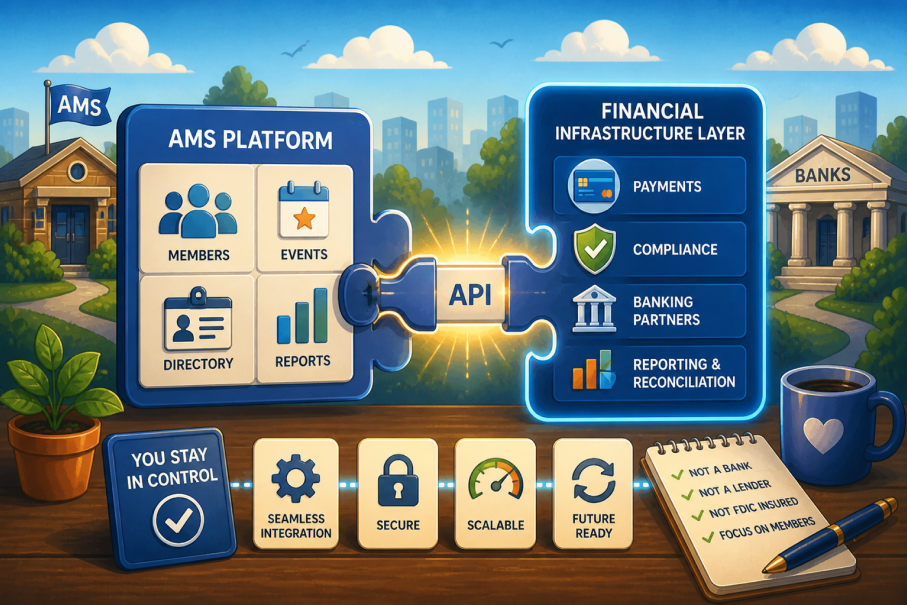
The BaaS model operates across three distinct tiers, and understanding where each layer’s responsibilities begin and end is essential for any AMS vendor evaluating this path.
Tier 1 — The Sponsor Bank
The sponsor bank holds the charter, maintains FDIC deposit insurance, assumes BSA/AML compliance obligations, files Suspicious Activity Reports (SARs), and operates under direct regulatory oversight from the OCC or FDIC. The AMS vendor never touches this layer. That is the point.
Tier 2 — The Infrastructure / BaaS Provider
The BaaS provider is the API layer connecting your AMS platform to the sponsor bank’s regulated rails. This tier handles ledgering, KYC/KYB identity verification, card issuing, ACH origination, and compliance tooling. When a chapter applies to open a digital account, the infrastructure provider runs the compliance checks.
Tier 3 — The AMS Vendor
Your platform owns the user experience, the product surface, and the client relationship. You are responsible for clean data inputs and adherence to program guidelines. You are not responsible for deposits, SAR filings, or banking licensure. That division of labor is fundamental to the model.
One important regulatory note: the 2024 collapse of Synapse led the FDIC and OCC to put greater scrutiny on sponsor bank oversight. The takeaway is that partner selection matters more than ever.
A strong BaaS setup with a reputable sponsor bank and a financially sound infrastructure provider remains a viable model. A weak one carries real risk. Once that structure is in place, your AMS platform can unlock a much broader set of financial features.
How Embedded Banking Partnerships Actually Work for AMS Platforms
These are production-ready features that membership organizations are actively requesting, and that AMS vendors are beginning to deliver through embedded finance partnerships.
- Chapter Banking Accounts: Digital accounts scoped to individual chapters, with a centralized dashboard giving headquarters real-time visibility across all sub-entities. Officer transitions, one of the most operationally fragile moments in chapter financial management, become seamless handovers rather than account re-paperwork exercises.
- Automated Dues-to-Disbursement Flows: Configurable rules replace manual wire transfers and check runs. When dues are clear, disbursement logic executes automatically based on pre-set allocation rules. Finance staff spend their time on exceptions.
- Virtual and Physical Expense Cards: Budgeted Visa debit cards with real-time spend controls, tied directly to your platform’s approval workflows. Volunteer committee chairs get a card with a defined budget. Headquarters sees every transaction in real time. The reimbursement paperwork cycle: submit, approve, wait, cut a check, mail, and disappear.
- Member Wallets and Payment Collection: Dues credits, event refunds, and fee collections managed entirely in-platform. Members interact with a seamless financial experience without ever leaving your product.
- Compliance and Audit-Ready Reporting: Auto-categorized, reconciled, IRS-mapped financial activity that is audit-ready by default.
On the compliance implementation side: KYC/KYB onboarding for chapter banking accounts is handled by the infrastructure provider. Modern BaaS platforms are designed to absorb that complexity.
And on speed to market: a well-documented BaaS integration can take an AMS platform from API sandbox to production in weeks. The build scope is a product integration.
What to Look for in a Compliant Infrastructure Partner
Not every embedded finance provider is built for associations, and not every BaaS partner is equally well-positioned in today’s regulatory environment. Five criteria should guide the evaluation.
- Sponsor bank quality: Ask for the sponsor bank’s name and review its regulatory standing. After 2024, sponsor bank quality is non-negotiable because the entire program depends on it.
- A clear compliance responsibility matrix for KYC, AML, SAR filing, and transaction monitoring should be assigned in the contract. Any ambiguity about where the AMS vendor’s role ends and the provider’s begins creates avoidable risk.
- API-first infrastructure: Look for modular APIs, webhook support, and documentation your team can realistically use. The integration should fit your platform.
- Confirmed FDIC pass-through insurance: If deposits are involved, confirm that pass-through coverage applies and get it in writing. This is too important to leave vague.
- Strong operational support: The right partner offers implementation help, compliance guidance, and ongoing account management.
The model works when the responsibilities are clear: the infrastructure partner handles the regulated heavy lifting, and the AMS vendor owns the product experience.
Why Crowded Is Built Specifically for This Use Case
Most embedded finance infrastructure is built for horizontal SaaS. Associations, especially multi-chapter 501(C)(6) organizations, need more than generic BaaS tooling. They need a financial infrastructure built for chapter autonomy, headquarters oversight, dues collection, spend controls, and ongoing compliance.
Crowded is built specifically for associations. It combines banking, dues, cards, and compliance workflows in one platform designed around how chapter-based organizations actually manage money.
With a Crowded-powered AMS integration, associations can create sub-accounts by chapter, program, or fund, issue budgeted cards with role-based controls, automate dues reconciliation, and maintain a shared HQ view across the network. Crowded also helps finance teams track Form 990 deadlines, centralize compliance documents, and flag issues before they become bigger reporting problems.
For AMS vendors, that means embedding association-ready financial infrastructure instead of adapting generic fintech tools to a more complex operating model.
The Infrastructure Gap Is Closeable, and the Window Is Narrow
AMS vendors are already positioned to become the financial operating system for their clients. The trust is there, the financial workflows are there, and the demand for banking-grade AMS vendor financial infrastructure is already visible in the gaps associations deal with every day.
What has been missing is infrastructure built for this vertical. AMS vendors need infrastructure that understands multi-chapter structures, volunteer-led treasury, IRS requirements, and audit readiness at the product level.
That infrastructure now exists, and the compliance burden no longer rests with the AMS vendor.
See how Crowded helps AMS vendors deliver compliant embedded financial infrastructure for the organizations they already serve.
Frequently Asked Questions
How long does it take an AMS platform to launch embedded banking features?
It depends on your platform and feature scope, but modern BaaS integrations can often move from sandbox to production in a week. The work is usually a product integration, not a full banking build.
Does our engineering team need fintech or banking experience?
Not necessarily. A strong BaaS partner should provide implementation support, compliance guidance, and ongoing account management, so your team can stay focused on the product layer.
What happens to member funds if the infrastructure provider runs into trouble?
This is a critical due diligence question. Always confirm in writing that FDIC pass-through insurance applies to client funds and verify the sponsor bank’s regulatory standing before signing.
Can chapters control their own finances, or does everything stay centralized?
A strong setup should support both. Crowded, for example, allows chapter-level sub-accounts with their own permissions, budgets, and cards, while still giving headquarters centralized visibility.
How are volunteer officer transitions handled?
The best setups tie accounts to the chapter. That makes leadership changes a permissions update rather than a full account reset.
Is this suitable for associations with both national and local tax-exempt entities?
Yes, but only if the infrastructure can support multi-entity reporting and compliance. Crowded is built for that structure, with reporting designed around Form 990 and chapter-level oversight.
What ongoing compliance responsibility does the AMS vendor have after launch?
Regulated work, such as KYC/KYB, AML monitoring, and SAR filing, generally falls to the sponsor bank and the infrastructure provider. The AMS vendor’s role is to provide clean data inputs and to follow program rules.
Can this support non-dues revenue, such as event fees and sponsorships?
Yes. A robust embedded finance setup should support multiple revenue streams and cleanly categorize them for reporting and reconciliation.