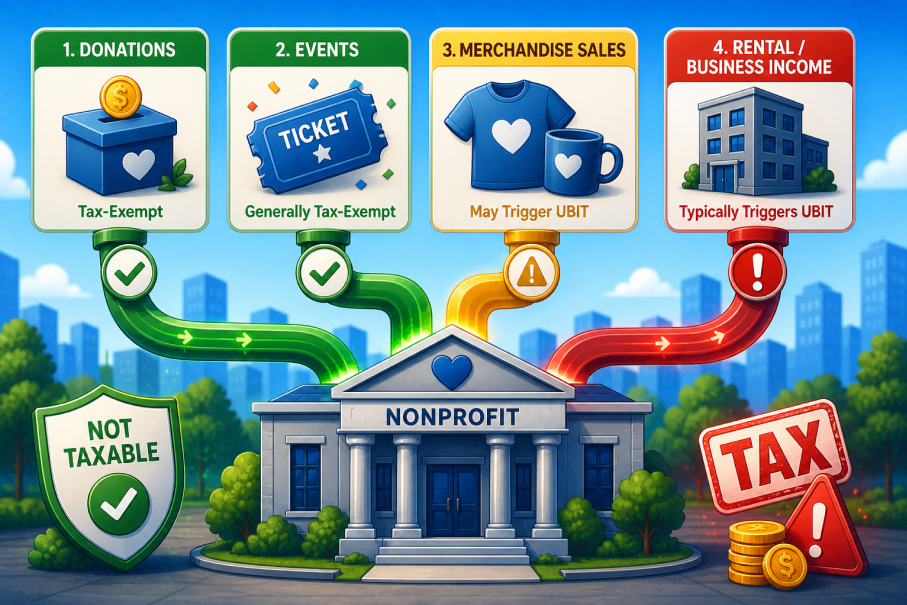
UBIT for nonprofits often goes unnoticed until months later, when a CPA reviews revenue that was miscoded at entry and already mixed with exempt income. Whether your organization is a 501(C)(3), a trade group, a foundation, or another tax-exempt entity, the risk is the same: exposure builds in the books long before Form 990-T is ever prepared.
TL;DR
- UBIT for nonprofits starts at revenue entry. Most exposure is created when income is recorded without tax classification.
- 4 revenue streams drive most risk. Advertising, affinity programs, debt-financed rental income, and sponsorships with return benefits are the primary UBIT triggers across nonprofits.
- Mixed revenue is the core problem. When exempt and taxable income are combined, finance teams are forced to perform manual cleanup, deliver weaker reporting, and respond reactively to compliance issues.
- IRS siloing rules make structure critical. Each unrelated activity must be tracked separately, increasing the need for clean account structures and real-time visibility.
- Better systems reduce UBIT surprises. Platforms like Crowded centralize financial activity and improve classification, helping nonprofits manage UBIT risk before year-end.
What Is UBIT, And Why Does It Matter for Nonprofits
UBIT refers to the tax imposed on income earned from activities that fall outside an organization’s exempt purpose. Under IRC Section 512, income generally becomes unrelated business taxable income, or UBTI, when it meets three tests:
- It is a trade or business
- It is regularly carried on
- It is not substantially related to the organization’s exempt purpose
If all three tests are met, the income is generally treated as UBTI and taxed at the 21% corporate rate. The filing threshold is also low: if a nonprofit earns $1,000 or more in gross unrelated business income during the year, it generally must file Form 990-T, even if deductions reduce the tax owed.
These rules apply broadly across the nonprofit sector, 501(C)(3) charities, membership organizations, foundations, and any other tax-exempt entity that earns income outside its exempt purpose.
The 4 Revenue Streams That Trigger UBIT for Nonprofits
1. Advertising Revenue
Advertising revenue is one of the most common UBIT triggers for nonprofits. The key question is whether the organization is being paid for promotional messaging or a simple acknowledgment.
If a payment includes pricing, endorsements, calls to action, or similar marketing language, it is more likely to be taxable. Neutral acknowledgment, such as a logo, business name, or website, is more likely to remain exempt. The biggest risk often appears in bundled packages that do not clearly separate the two.
2. Affinity Programs (Royalty vs. Service Income)
Affinity programs can create UBIT exposure when an organization earns partner revenue but does more than passively license its name or brand. Royalty income is generally excluded from UBTI, but that exclusion can change when the organization’s role looks more like providing services.
The distinction often comes down to involvement. If the organization simply licenses its name or brand, the income may remain exempt. If it actively promotes the program, runs marketing campaigns, or provides operational support, the payment is more likely to be treated as taxable service income.
3. Rental Income From Debt-Financed Property
Rental income is generally excluded from UBTI, but that exclusion can be limited when the property is debt-financed. Under IRC Sections 512(b)(3) and 514, part of the income may be treated as unrelated debt-financed income and become taxable. This can affect nonprofits that earn income from buildings, event spaces, offices, or other shared-use properties that still carry debt.
4. Sponsorships With Substantial Return Benefits
Sponsorship income is often assumed to be exempt, but its tax treatment depends on the agreement’s structure. Under IRC Section 513(i), payments are generally exempt if the sponsor receives no substantial return benefit.
UBIT exposure arises when sponsors receive exclusivity, promotional value, advertising, or performance-based benefits. If these elements are not clearly separated and priced, the entire payment may be treated as taxable.
Why UBIT for Nonprofits Usually Begins When Revenue Is Recorded
UBIT does not begin at Form 990-T. It starts earlier, when revenue is recorded without a clear tax classification. This can look like:
- Advertising revenue recorded without separating it from exempt sponsorship income
- Sponsorship payments booked without distinguishing a simple acknowledgment from promotional value
- Royalty income was entered without assessing whether the organization also provided services
- Rental income is recorded without evaluating whether the property is debt-financed
- Commercial receipts are grouped into broad revenue categories without identifying unrelated business income
That is why UBIT is often an operational issue before it becomes a filing issue. If exempt and taxable income are not clearly separated, finance teams must sort it out later during Form 990-T preparation.
The risk grows under IRC Section 512(a)(6), which requires each unrelated activity to be tracked separately. Without that structure:
- Taxable and non-taxable revenue can be mixed
- Unrelated activities may not be properly siloed
- Form 990-T preparation becomes more manual
- Reporting becomes more reactive and more error-prone
In most cases, UBIT exposure is created at the moment revenue is recorded, when classification decisions are either made correctly or missed entirely.
How to Identify UBIT Risk in Your Revenue Classification
A practical starting point is to review how revenue is currently classified in your financial system. Start with these questions:
- Is advertising revenue clearly separated from sponsorship income?
- Are sponsorship benefits individually priced in the contract at the time of signing?
- Are affinity program payments truly passive royalties, or does staff provide marketing or operational support?
- Does the organization earn rental income from debt-financed property?
- Are unrelated business activities tracked in separate accounts for IRS siloing purposes?
If any of these answers are unclear, that uncertainty often points directly to where UBIT exposure exists.
How Crowded Helps Nonprofits Manage UBIT Risk Through Better Financial Visibility
UBIT for nonprofits is often less about tax math and more about how financial data is structured from the start. Crowded is a nonprofit financial infrastructure platform that combines banking, payments, expense management, and compliance in one system, giving organizations clearer visibility into how money is collected, tracked, and reported.
In practice, that means:
- Payments and revenue are centralized, including dues, donations, and event collections
- Transactions are tracked in real time, with clearer oversight across accounts, chapters, teams, or programs
- Expenses are managed with built-in controls and documentation, improving audit readiness
- Sub-accounts support multi-entity structures, making it easier to organize financial activity across different parts of the organization.
- Financial data is easier to review and export, enabling cleaner reporting and more efficient compliance workflows.
For nonprofits with complex sponsorship, advertising, and partnership revenue, this structure can make UBIT review more manageable and reduce manual cleanup during Form 990-T preparation.
Why Better Revenue Classification Matters Before Form 990-T
UBIT for nonprofits is rarely created at filing time. In most cases, it starts much earlier, when revenue is received, recorded, and classified. Organizations that manage UBIT well address the issue before the Form 990-T season. They build financial processes that:
- Capture revenue with the right tax context from the start
- Separate unrelated business activity from exempt income
- Reduce the need for manual cleanup at year-end
UBIT is both a tax filing and a financial visibility problem. If your current system cannot clearly show how revenue was earned, classified, and tracked, that is often the first gap to fix.
Frequently Asked Questions
When does UBIT for nonprofits actually begin?
UBIT usually begins when revenue is recorded. If income is entered without proper classification, the exposure is created at the point of entry.
What are the most common UBIT triggers for nonprofits?
The most common triggers are advertising revenue, affinity programs tied to services, debt-financed rental income, and sponsorships with substantial return benefits. These risks often stem from how revenue is structured and recorded.
Why do nonprofits miss UBIT exposure until year-end?
Many nonprofits categorize exempt and taxable income into broad buckets, making it harder to identify UBIT early and forcing manual cleanup during Form 990-T preparation.
How do IRS siloing rules impact UBIT reporting?
IRC Section 512(a)(6) requires each unrelated business activity to be tracked separately. Without proper separation, reporting becomes more complex, manual, and error-prone.
How does Crowded help nonprofits manage UBIT risk?
Crowded helps nonprofits centralize payments, track transactions in real time, and improve financial visibility, making it easier to review, classify, and report revenue accurately.
How can nonprofits reduce UBIT risk before tax season?
The most effective approach is to classify revenue correctly at the point of entry, separate unrelated activities, and maintain a clear financial structure throughout the year. Tools like Crowded support this by improving visibility and reducing reliance on year-end fixes.