

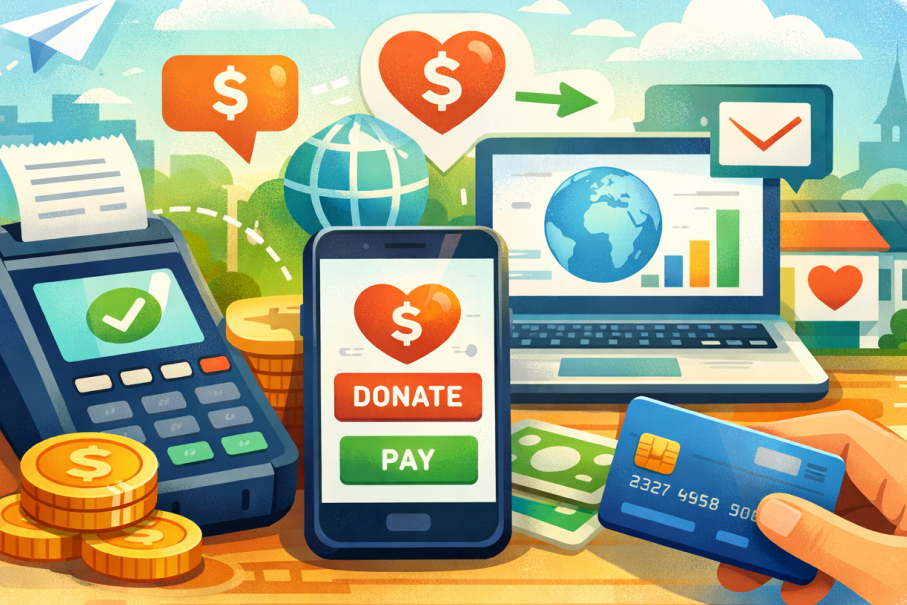
Digital payments have quietly become the backbone of nonprofit operations. The numbers tell a clear story: 63% of donors prefer giving online via card, payment cards account for more than 85% of all donation methods, and nonprofits with digital payment strategies grow 12.7% faster than those without. What was once back-office infrastructure has become a direct driver of mission delivery.
That shift changes how nonprofits need to think about payment processing. The right platform is the system that determines whether restricted funds get properly tracked, whether audits go smoothly, and whether donors keep coming back.
This guide breaks down what nonprofit payment processing actually involves, what to look for in a platform, and which tools stand out in 2026.
TL;DR
- Digital payments now shape donor experience, revenue stability, and operational resilience. The platform you choose determines whether your organization can scale confidently while maintaining compliance and donor trust.
- When payments, expenses, and fund tracking live in separate tools, reconciliation gaps and audit risks multiply. Unified infrastructure, such as Crowded’s centralized payment and fund controls, reduces compliance exposure by design.
- Many processors can record transactions, but few enforce donor intent at the transaction level. Platforms built for nonprofit finance protect restricted funds automatically, reducing legal risk and preserving donor trust.
- Operational overhead, manual reconciliation, audit preparation, compliance remediation, often exceeds transaction fees. A platform with built-in controls and reporting can lower total cost by reducing staff time and risk.
- Small nonprofits may start with simple tools, but multi-program, multi-entity, or compliance-heavy organizations need infrastructure that scales. Solutions like Crowded support complex structures, ensuring oversight grows alongside your mission.
Key Features to Look for in Nonprofit Payment Processing Platforms
These are the ones that reflect actual nonprofit operational realities.
- Fund restrictions and controls are the baseline differentiator. The platform should enforce restrictions. If you need a spreadsheet on top of your payment system to track fund usage, the payment system isn’t doing its job.
- Centralized payment visibility means seeing all transactions, donations, expenses, disbursements, in one place. Fragmented views create blind spots.
- Automated audit trails eliminate the manual documentation burden. Every transaction should be timestamped, categorized, and retrievable without staff effort.
- Multi-entity and chapter support becomes critical as nonprofits grow. Organizations with multiple programs, chapters, or EINs need oversight across all of them without losing the operational independence each unit requires.
- Integrations with CRM and accounting tools ensure your payment platform doesn’t create data silos. Donor records, financial reports, and payment data should flow together.
How We Ranked These Tools
The tools below were evaluated across six criteria: compliance and fund restriction support, multi-entity oversight, audit readiness and reporting, payment flexibility (online, ACH, POS), donor experience, and total operational cost. The last one matters more than it sounds, a low processing fee paired with high reconciliation labor and compliance risk often ends up costing more than a higher-fee platform with built-in controls.
Top Nonprofit Payment Processing Tools (2026)
1. Crowded — Best for Compliance-First Nonprofit Payment Processing
Crowded ranks first because it’s built specifically for nonprofit financial infrastructure. That distinction shows up in the features that matter most for compliance-driven organizations.
The platform enforces restricted fund usage at the transaction level, maintains centralized accounts aligned to EINs, and provides real-time oversight across chapters and programs. Its audit trails are automatic, and it handles both the donation inflow and the expense and disbursement outflow, meaning organizations get a unified view of their full financial picture rather than stitching together reports from multiple tools.
Crowded is best suited to multi-program, multi-entity, and compliance-focused organizations that need more than a payment processor, they need financial infrastructure.
2. Stripe — Best for Flexible Online Payments
Stripe’s strengths are real: highly customizable payment flows, strong global support, and an integration ecosystem that connects to nearly every third-party tool. For nonprofits with technical capacity and complex custom needs, it’s a powerful foundation.
The limitations are equally real. Stripe doesn’t natively enforce fund restrictions, and it doesn’t provide the reporting depth that nonprofit compliance requires out of the box. Organizations using Stripe typically need additional systems to handle fund tracking and audit documentation, which means more complexity.
3. PayPal for Nonprofits — Best for Donor Trust & Quick Setup
PayPal’s name recognition carries real conversion value. Donors who might hesitate at an unfamiliar checkout flow will often proceed without friction if they see the PayPal option. The nonprofit program offers discounted rates and is genuinely easy to implement.
Where it falls short is depth. Reporting capabilities are limited, and workflows can become fragmented as an organization’s payment complexity grows. For small nonprofits processing straightforward donations, PayPal works well. For organizations scaling programs or managing restricted funds, it’s an incomplete solution.
4. Square — Best for Events & In-Person Payments
Square’s POS and mobile payment tools are strong, and its onboarding is fast. For nonprofits that do significant in-person fundraising, galas, community events, chapter tables, Square handles that use case well.
It isn’t designed for nonprofit compliance. Fund tracking, restricted giving, and audit readiness aren’t part of the Square product experience. Organizations using it for in-person payments typically need to pair it with a separate system for financial management.
5. Donorbox — Best for Fundraising Campaigns
Donorbox has built solid functionality around recurring donations and donor management, making it a reasonable choice for organizations focused on campaign-driven fundraising. The interface is designed with donors in mind, and recurring gift setup is straightforward.
It isn’t full financial infrastructure. Organizations using Donorbox for fundraising still need separate systems for expense management, fund restriction enforcement, and compliance reporting. It works well as a fundraising layer; it doesn’t replace an operational platform.
Hidden Costs of Nonprofit Payment Processing
Processing fees are visible. Operational costs aren’t, and they often dwarf what shows up on your monthly statement.
Card processing can exceed 2.9% + $0.30 per transaction depending on platform layers and your specific arrangement. But that number doesn’t capture the staff hours spent reconciling multiple systems, the compliance risk that accumulates when fund tracking is manual, or the cost of audit remediation when records aren’t clean.
The lowest-fee platform is rarely the lowest-cost platform. Total cost includes the infrastructure you have to build around a tool to make it work for your organization’s compliance and reporting requirements.
When Generic Payment Processors Fall Short
A generic processor can move money reliably. It can’t enforce that a restricted grant doesn’t get used to cover operational expenses. It can’t automatically surface a reconciliation-ready audit trail. It can’t give a national organization visibility into financial activity across 30 regional chapters.
These limitations are manageable at a small scale. As nonprofits grow, more programs, more funding sources, more chapters, more complexity, the gaps become operationally expensive. Fragmented tools create fragmented oversight, and fragmented oversight creates compliance exposure.
Infrastructure becomes essential, as organizations scale.
How to Choose the Right Nonprofit Payment Processing Tool
Not every platform that accepts donations is built for nonprofit operations. These questions help separate the two.
- Does the platform enforce restricted funds natively, or does it just record transactions? Recording is passive. Enforcement is what actually protects donor intent and keeps you compliant.
- Can it support multiple EINs? If your organization has chapters or programs operating under separate legal entities, you need oversight across all of them.
- Are audit trails generated automatically? Manual documentation is a liability. Automatic trails mean you’re audit-ready on any given day.
- Does the platform unify donations and expenses? A tool that only handles inflows gives you half the picture. Full financial visibility requires both sides of the ledger in one place.
Red Flags Worth Taking Seriously
If a vendor recommends supplementing their platform with spreadsheets for compliance tracking, that’s a sign the platform wasn’t built for nonprofit operations, it was adapted from something else.
If payments and reporting require separate tools, you’re accepting reconciliation risk as a structural feature of your infrastructure. That risk compounds as your organization grows.
The right platform answers these questions before you have to ask them.
Which Tool Is Right for Your Nonprofit?
The answer depends on where you are and where you’re going.
Small nonprofits processing straightforward donations will find PayPal sufficient for most needs. Event-heavy organizations benefit from Square’s POS capabilities. Nonprofits built around campaign fundraising get real value from Donorbox’s donor-facing features. Organizations with technical capacity and custom workflow requirements have flexibility with Stripe.
For compliance-focused organizations, multi-entity structures, or any nonprofit that has outgrown pieced-together infrastructure, Crowded is built for the operational reality you’re managing.
Payment Processing Is Mission Infrastructure
The framing matters: payment processing isn’t an administrative detail. It’s the system that determines whether donor intent is honored, whether restricted funds stay restricted, and whether your organization can demonstrate compliance without scrambling.
Digital payments now shape donor expectations and revenue stability. The organizations that treat payment infrastructure as mission-critical are the ones positioned to grow without the compliance exposure that catches up with organizations running fragmented systems.
As you evaluate platforms, the core question isn’t which tool has the lowest fees. It’s which platform supports confident growth, the kind where you’re audit-ready on any given day, restricted funds are enforced automatically, and your financial oversight scales with your mission.
Your questions, answered.
Can payment processors help reduce fraud in nonprofit transactions?
Yes, but only if they include controls beyond basic transaction monitoring. Features like role-based approvals, spending limits, and real-time alerts help prevent unauthorized disbursements. Platforms designed for nonprofit finance, such as Crowded, add another layer by tying transactions to fund restrictions and approval workflows, reducing both fraud risk and compliance violations.
How do payment processors affect donor retention rates?
Payment experience directly influences whether donors give again. Fast checkout, trusted payment options, and automated recurring giving improve retention. However, retention also depends on transparency. Platforms that provide clear receipts, fund designations, and reporting, like Crowded’s transaction-level fund tracking, reinforce donor trust and encourage long-term support.
What happens if a nonprofit outgrows its payment processor?
Outgrowing a processor often means adding more tools, which increases reconciliation work and compliance risk. Warning signs include reliance on spreadsheets, manual fund tracking, or separate systems for chapters. Migrating to a unified infrastructure platform like Crowded can eliminate fragmentation by combining payments, fund controls, and multi-entity oversight in one system.
Are ACH and bank transfers better than card payments for nonprofits?
ACH transfers typically have lower fees than card payments, making them cost-effective for large donations or recurring gifts. However, they require stronger verification and reconciliation processes. A platform that centralizes ACH alongside card payments, and automatically categorizes them, reduces administrative burden and ensures consistent reporting.
How do payment processors support grant management workflows?
Most general processors do not support grant tracking. They record deposits but don’t enforce spending rules tied to grant agreements. Nonprofit-focused platforms can tag transactions to funding sources and maintain audit trails, helping finance teams demonstrate compliance during grant reporting and audits.