Choosing among fiscal sponsorship organizations comes down to three things: a sponsor whose mission fits your project, a legal model that matches the control you need, and a fee that covers work you would otherwise handle yourself. In the 2023 Fiscal Sponsor Field Scan, a survey of 100 U.S. sponsors by Social Impact Commons and the National Network of Fiscal Sponsors, fixed fees ran from 5% to 12% of revenue.
Sponsors offering only Model C charged 6% to 8%, and sponsors offering only Model A charged 8% to 12%. The steps below help your project team compare sponsors side by side and pick a long-term partner with confidence.
TL;DR
- Fixed fiscal sponsorship fees ran 5% to 12% of revenue in the 2023 Field Scan, so compare what each fee covers along with the rate.
- Model A sponsors take your project in-house and act as the employer, while Model C sponsors make grants to a self-run group.
- Gifts to a sponsored project are tax-deductible when the sponsor keeps discretion and control over the money, so expect the sponsor to approve spending.
- H.R. 9721, the Fiscal Sponsorship Transparency Act of 2026, would require sponsors to report each sponsored project to the IRS and remains a proposal as of October 2026.
- Sponsors in the 2023 Field Scan accepted two new projects for every one they turned away, so reach out to two or three sponsors at once.
Write a One-Page Brief Before You Contact Fiscal Sponsorship Organizations
A fiscal sponsor is an established 501(c)(3) public charity that accepts tax-deductible gifts and grants for a project that operates under the sponsor’s tax-exempt status. A one-page brief makes every conversation with fiscal sponsorship organizations faster and clearer. Candid’s fiscal sponsorship guide recommends a similar proposal covering your goals, staffing, budget, and how the project advances the sponsor’s mission. Your brief answers five questions:
- Who you serve, and what you will do in the first 12 months.
- Your first-year budget, and where the money will come from: individual donations, foundation grants, government grants, or earned income.
- Which jobs you need the sponsor to handle: donor receipts, bookkeeping, payroll, insurance, and contractor payments.
- Who makes program decisions, and who handles day-to-day money.
- Your long-term plan: becoming your own 501(c)(3), staying sponsored, or wrapping up after a set period.
A clear brief matches each project with the right level of support, so a project that needs payroll lands with a sponsor that runs payroll.
Choose Between Model A and Model C Fiscal Sponsorship
Model C suits a group that already runs itself and mainly needs a way to receive tax-deductible gifts and grants. Model A suits a project that plans to hire staff or wants the sponsor to carry payroll and contracts. Many fiscal sponsorship organizations offer both: in the 2023 Fiscal Sponsor Field Scan, 72% of sponsors practiced Model A, 68% practiced Model C, and 48% offered both.
Model A (direct project) | Model C (preapproved grant) | |
Your legal status | A program of the sponsor | A separate group or entity |
Who employs staff | The sponsor | Your project |
Who signs contracts | The sponsor | Your project |
How money reaches you | The sponsor pays expenses for you | The sponsor makes grants to you |
Fixed fee range at single-model sponsors | 8% to 12% | 6% to 8% |
Your daily control | Shared: the sponsor approves spending | Wide: you spend grant funds under the agreement |
Model A fees sit at 8% to 12% because the sponsor carries the legal and employment work. Under Model C, IRS Revenue Ruling 68-489 allows a charity to grant money to a taxable group as long as the charity retains control of the funds and records showing they went to specific projects that further the charity’s purposes.
For a volunteer-run community project with zero payroll, we recommend Model C. Model A fits projects that plan to hire employees in year one, since Model A sponsors serve as the employer of record. When Model C fits, Crowded Foundation, a 501(c)(3) public charity separate from Crowded, is one sponsor that offers it.
Eight Checks To Compare Sponsors Side By Side
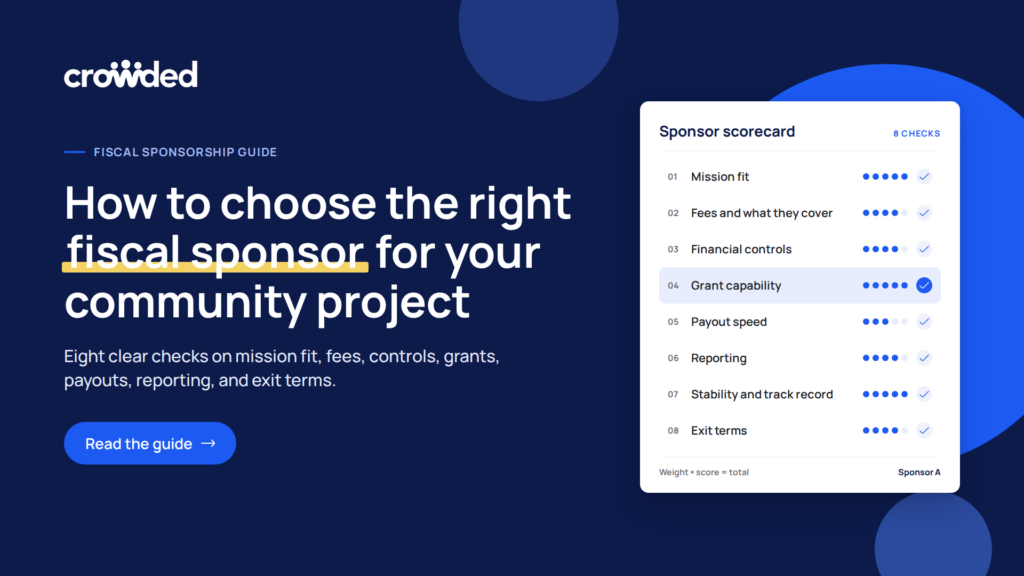
Ask every finalist the same eight questions and write the answers in one place. When fiscal sponsorship organizations answer the same questions, the strongest partner stands out quickly.
1. Mission Fit
The sponsor’s own charitable purpose must cover what your project does, because the sponsor shows the IRS that funding you advances its mission. A specialist fiscal sponsor brings set processes and experience with many projects. A local nonprofit brings community trust and ties to local funders, so ask which funders it already approaches and plan around any overlap.
2. Fiscal Sponsorship Fees and What They Cover
Most fiscal sponsors charge a fixed 5% to 12% of the revenue they receive for your project, according to the 2023 Field Scan, and sponsors offering only Model C sit at 6% to 8%.
Picture a neighborhood food pantry project expecting $50,000 in its first year. Sponsor A charges 7%, or $3,500. Sponsor B charges 10%, or $5,000, and its fee covers general liability insurance and contractor payments. If buying that coverage and payment handling on your own would cost over $1,500 a year, Sponsor B is the smart pick.
Ask whether fiscal sponsorship fees apply to revenue or expenses, whether there is an annual minimum, and which costs sit outside the fee, such as card processing or an annual audit. In the 2023 Field Scan, 58% of sponsors charged a fixed percentage of revenue.
3. Financial Controls
Gifts to a sponsored project are tax-deductible when the sponsor keeps complete discretion and control over the funds, often called variance power, as the DC Bar Pro Bono Center explains. In practice, the sponsor signs off on spending and new contracts. Ask who approves what, at which dollar amounts, and how many days an approval usually takes.
4. Grant Capability
Government grants often reimburse costs after you spend them, so cash flow shapes which grants you can accept. In the 2023 Field Scan, 56% of sponsors expected projects to hold enough cash to cover current expenses, and 27% offered their own credit or a line of credit. Ask which group your sponsor belongs to before you apply.
5. Donation Processing and Payout Speed
Ask how donors can give, if they receive tax receipts automatically, and how many days pass between a gift arriving and your project spending it. Get the disbursement schedule in writing. Ask where donor records live, too: 59% of sponsors in the 2023 Field Scan reported having donor relationship management software, so confirm you can export your project’s donor list at any time.
6. Reporting
Ask for a sample monthly report before you sign. A budget-to-actual report compares what you planned to spend with what you spent, line by line. In the 2023 Field Scan, about three in four sponsors gave projects these reports, and about a third offered projects online access to their own financial records.
7. Stability and Track Record
Read the sponsor’s latest Form 990, the annual return most tax-exempt organizations file with the IRS, plus audited financial statements when available. Ask about cash reserves: 52% of sponsors in the 2023 Field Scan held over three months of cash, and 22% held under one month. Strong reserves protect your project. When International Humanities Center, a sponsor of 200 projects, collapsed in 2012, losses to its projects were estimated at over $1 million, according to the Fiscal Sponsor Directory.
8. Communication and Exit Terms
Send each finalist one detailed question during your review and note how long the answer takes. Then ask what happens to your remaining money, donor list, website, and equipment if you leave. In the 2023 Field Scan, 92% of sponsors used a standard written agreement, so request it early and read the termination section first.
Ask how interest earned on your project’s money is handled, too. Among Field Scan sponsors that answered, 68% kept that interest for their own general operations.
Score Your Finalists On One Weighted Scorecard
A weighted scorecard turns eight sets of answers into one clear choice among fiscal sponsorship organizations. Give each check a weight from 1 to 3 based on your project brief, score each sponsor from 1 to 5, and multiply. Pick the sponsor with the highest total, since the total reflects value across all eight checks. The weights below fit a volunteer-run project that will depend on grants.
Check | Weight (1 to 3) | Sponsor A score (1 to 5) | Sponsor B score (1 to 5) |
Mission fit | 3 | ||
Fees and included services | 2 | ||
Financial controls | 2 | ||
Grant capability | 3 | ||
Payout speed | 2 | ||
Reporting | 3 | ||
Stability and track record | 3 | ||
Communication and exit terms | 2 |
A project planning to hire staff can increase fees and included services, since payroll and insurance become large budget lines once staff joins.
A 2026 Bill Would Add New Reporting For Fiscal Sponsors
H.R. 9721, the Fiscal Sponsorship Transparency Act of 2026, would require 501(c)(3) fiscal sponsors to report every sponsorship arrangement to the IRS each year. The House Ways and Means Committee advanced it by a 23-to-15 vote on July 22, 2026. As of October 2026, the bill remains a proposal and still needs to pass the full House and the Senate.
According to the Joint Committee on Taxation’s description of the bill, fiscal sponsorship organizations would report these details for each arrangement:
- the names of the organizations involved, with individuals excluded
- the amounts made available or transferred during the year
- a description of the activities the money supported
- the officer managing the arrangement
- the start date and any end date
The bill would also tax “improper conduit arrangements,” where a charity passes earmarked gifts to a taxable party and skips its duty of discretion and control. The organization would owe 20% of the amount, and a manager who knowingly agreed would owe 5%, capped at $10,000. The rules would apply to tax years beginning after December 31, 2027.
Supporters describe the bill as a way to hold tax-exempt dollars accountable. Critics, including Independent Sector, say its definition could reach arrangements outside traditional fiscal sponsorship, as Perlman & Perlman summarize. Ask each finalist how it documents discretion and control in practice, and if your project’s name and funding amounts could appear in its public filings.
When To Leave Fiscal Sponsorship and Form Your Own 501(c)(3)
Plan your move to independence once your project can afford its own compliance work and wants faster decisions. Among projects that left a sponsor during the 2023 Field Scan reporting year, 49% became their own 501(c)(3) and 28% moved to another sponsor.
Watch for three signals: a budget large enough to pay a part-time finance lead, funders asking for independent status, and a board ready to govern. Ask fiscal sponsorship organizations about their spin-off process in your first conversation, and plan the exit when you sign the agreement. The agreement should explain how open grants and remaining funds transfer to your new organization.
How Crowded Supports Sponsored Projects and Fiscal Sponsors
Crowded, a compliant money movement and banking platform for mission-driven organizations, supports fiscal sponsorship in two ways. Projects can apply to Crowded Foundation, a separate 501(c)(3) public charity registered with the IRS that offers Model C fiscal sponsorship and reviews applications within 5 business days. Sponsored projects get branded donation pages and tax receipts for eligible donors.
Fiscal sponsorship organizations can use Crowded’s tools to open a fund account for each sponsored project, with spending rules set before money moves. Each sponsored project sees its own balance and transactions as they happen.
Crowded Foundation offers Model C only today, so a project that wants its sponsor to employ staff can look to a Model A sponsor. Crowded works alongside your accounting software and donor CRM.
Apply to Crowded Foundation for Model C fiscal sponsorship, or, if your organization sponsors projects, book a walkthrough of fund accounts for sponsored projects.
This guide shares general information. Please have a qualified legal, tax, or financial advisor review any fiscal sponsorship agreement before you sign.
Crowded Technologies Inc. is a financial technology company and is not a bank. Banking services provided by i3 Bank, Member FDIC.
Frequently Asked Questions
How much do fiscal sponsors charge a community project?
Most charge a fixed 5% to 12% of the revenue they receive for your project, based on the 2023 Fiscal Sponsor Field Scan. Model C sponsors charge 6% to 8%, and Model A sponsors charge 8% to 12%, so compare what each fee includes, such as insurance, payroll, and donor receipts.
Which model fits a volunteer-run project?
Model C fits a volunteer-run project with zero payroll, because your group keeps running itself and receives grants from the sponsor. Model A sponsors fit a project that plans to hire staff, since the sponsor becomes the employer of record and signs contracts.
How does Crowded support fiscal sponsorship?
Crowded, a compliant money movement and banking platform for mission-driven organizations, gives fiscal sponsors a fund account for each sponsored project, with spending rules set before money moves. This follows Crowded’s value of trust: “We are stewards of our clients’ funds.” Projects can also apply to Crowded Foundation, a separate 501(c)(3), for Model C sponsorship.
How quickly does Crowded Foundation review an application?
Crowded Foundation reviews applications within 5 business days, which reflects Crowded’s value of speed: short cycles and quick decisions. Many sponsors route approvals through their board. In the 2023 Field Scan, 72% of sponsors said their board takes part in approving new projects or formally delegates that decision, so ask each finalist for its timeline in writing.
What happens to our money and donor list if we leave a sponsor?
Your fiscal sponsorship agreement sets the terms, so read the termination section first. Ask how open grants, remaining funds, donor records, your website, and equipment transfer, and confirm you can export your donor list at any time. Planning the exit at signing keeps your project in control of its next step.
How does the 2026 bill affect sponsors and their projects?
If it becomes law, H.R. 9721 would require fiscal sponsorship organizations to report each sponsorship arrangement to the IRS for tax years beginning after December 31, 2027. As of October 2026, it remains a proposal, so ask your sponsor how it documents discretion and control today.