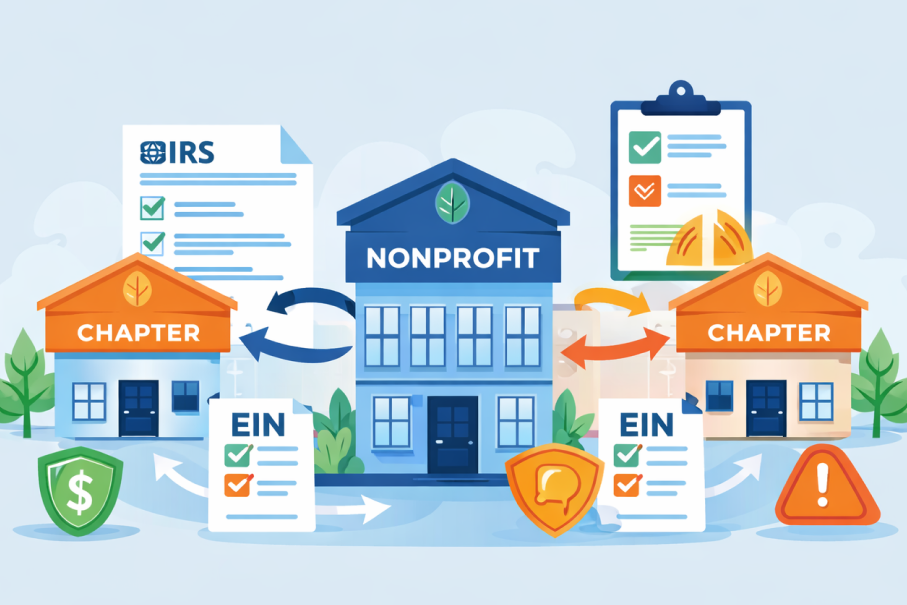
Choosing the right EIN for nonprofits is one of the most consequential structural decisions a nonprofit organization can make, particularly when it operates through chapters, affiliates, or local units. It determines how the IRS assigns legal responsibility for tax filings, financial activity, banking relationships, and compliance outcomes, thereby shaping who ultimately bears the risk when something goes wrong.
Most nonprofit compliance issues related to EINs do not stem from misconduct. They arise when EIN structures no longer reflect how chapters actually operate. This article explains how EINs for nonprofits work, when chapters need separate EINs, how IRS rules apply across nonprofit classifications, and the risks of using the wrong EIN on Form 990.
TL;DR
- An EIN for nonprofits determines which organization the IRS holds responsible for tax filings, financial activity, banking relationships, and compliance outcomes.
- Nonprofit chapters may either operate under a shared EIN with the parent organization or use separate EINs, depending on governance and legal independence.
- Shared EIN structures simplify reporting but concentrate compliance risk at the parent organization level.
- Separate EIN structures isolate liability but increase filing, reporting, and administrative obligations across chapters.
- Compliance issues often arise when EIN usage does not reflect how chapters actually operate, rather than from intentional wrongdoing.
- Using the wrong EIN on Form 990 can lead to rejected filings, inaccurate public records, and increased IRS or banking scrutiny.
- Aligning EIN structure with actual governance and financial control reduces long-term compliance risk and operational disruption.
What Is an EIN for Nonprofits (and Why It Matters)
An Employer Identification Number (EIN) is the federal tax identifier assigned by the IRS to an organization. For nonprofits, the EIN connects the organization to:
- Federal tax filings, including the Form 990 series
- Banking and payment processing accounts
- Payroll and employment reporting
- Grant applications and donor disclosures
- Public charity and regulatory records
An EIN for a nonprofit functions as the IRS’s primary accountability marker for a legal entity.
As nonprofits grow and adopt chapter-based models, this distinction becomes critical. If multiple chapters operate under one EIN, the IRS treats all activity under that EIN as belonging to a single organization, regardless of internal assumptions about autonomy.
How the IRS Uses an EIN to Assign Responsibility
For the IRS, an EIN for nonprofits is how responsibility is assigned. It determines which organization is accountable for filings, disclosures, banking alignment, and compliance outcomes.
The IRS does not evaluate convenience, organizational intent, or informal governance. It evaluates facts. When multiple chapters use one EIN, the IRS treats all financial and operational activity as belonging to one entity.
This is why the EIN structure becomes more important as organizations scale. The more operational independence chapters exercise under a shared EIN, the greater the compliance exposure for the parent organization.
How the IRS Classifies Nonprofit Chapters
The Internal Revenue Service does not classify chapters based on branding, geography, or internal titles. It looks at legal and operational reality.
From an IRS perspective, nonprofit chapters fall into one of two categories:
- Subordinate units of the parent organization
- Legally separate nonprofit organizations affiliated with a parent
This determination depends on:
- Who controls finances?
- Who governs decision-making?
- Whether chapters are separately incorporated?
- Whether chapters maintain their own bank accounts?
- Whether chapters file or should file their own Form 990?
If chapters function independently while using the parent organization’s EIN, the IRS may still hold the parent accountable while treating the chapter as noncompliant. This mismatch is a common source of nonprofit chapter compliance risk.
When Nonprofit Chapters Need Separate EINs
Nonprofit chapters generally need separate EINs when they are legally or operationally independent. This includes situations where:
- A chapter is separately incorporated at the state level
- A chapter has its own board with fiduciary authority
- A chapter controls its own bank accounts and spending
- A chapter enters into contracts independently
- A chapter files, or is required to file its own Form 990
In these cases, using the parent organization’s EIN misrepresents reality. The IRS expects EIN usage to align with legal structure. When it does not, compliance exposure increases rather than decreases.
Separate EINs are not a preference in these scenarios. They are a structural requirement.
Shared EIN Structures for Nonprofit Chapters
How a Shared EIN Structure Works
Under a shared EIN structure, the parent nonprofit holds a single EIN and all chapters operate under that identifier. Chapters do not file separate federal tax returns. Their financial activity is consolidated into the parent organization’s Form 990.
This structure assumes centralized governance, financial oversight, and compliance enforcement.
Pros and Cons of a Shared EIN for Nonprofit Affiliates
A shared EIN nonprofit structure can be effective when chapters operate as true extensions of the parent organization.
Pros include:
- Centralized reporting and filings
- Unified donor and public-facing identity
- Reduced administrative burden
Cons and risks include:
- Parent organization absorbs all compliance failures
- One chapter’s error affects the entire organization
- Increased IRS expectations around oversight
When financial controls are weak or chapters operate independently, a shared EIN becomes a liability rather than a simplification.
Separate EIN Structures for Nonprofit Chapters
How Separate EINs Work?
Under a separate EIN structure, each chapter applies for its own EIN and files its own Form 990. Each chapter maintains independent banking relationships and compliance responsibilities.
The parent organization may still provide branding, guidance, or affiliation, but legal responsibility is distributed.
Benefits and Tradeoffs of Separate EINs
Separate EINs:
- Isolate compliance failures
- Clarify accountability
- Reflect operational independence accurately
However, they also:
- Increase filing and reporting requirements
- Create uneven compliance maturity across chapters
- Require stronger coordination to manage reputational risk
This structure is common in federated nonprofits and networks with autonomous chapters.
Group Exemption and EIN Structure
Group exemption allows subordinate organizations to be recognized under a parent organization’s tax-exempt status. Important clarifications about group exemption EIN structure:
- Subordinates may still have separate EINs
- Group exemption does not eliminate filing obligations
- Parent organizations are expected to maintain oversight records
- Financial activity must still be reported accurately
Group exemption simplifies recognition. It does not reduce accountability.
How to Consolidate Multiple EINs in a Nonprofit Organization
Some nonprofits accumulate multiple EINs through mergers, chapter growth, or historical structuring decisions. Consolidation may involve:
- Dissolving subordinate entities
- Merging chapters into the parent organization
- Transitioning reporting under a single EIN
This process requires careful planning. Using the wrong EIN during transition periods can create filing errors, public record inconsistencies, and audit risk. Consolidation reduces long-term complexity but increases short-term compliance sensitivity.
Risks of Using the Wrong EIN on Form 990
Using the wrong EIN on Form 990 is not a clerical issue. Common consequences include:
- IRS rejection of filings
- Revenue and expenses attributed to the wrong entity
- Inaccurate public charity records
- Increased scrutiny during audits and grant reviews
In multi-chapter organizations, EIN errors often surface years later, when correction is difficult and highly visible. This is a major source of nonprofit chapter compliance risk.
Why EIN Structure Affects Banking and Financial Operations
Banks rely on EINs to determine account ownership, authorized signers, and regulatory responsibility. When EIN structures do not align with operational reality, organizations may face delayed onboarding, restricted transactions, or frozen accounts.
These issues frequently arise during:
- Banking partner changes
- Leadership transitions
- Compliance or audit reviews
Clear alignment between EINs, governance, and financial operations reduces disruption.
How Crowded Supports Compliance Across Same-EIN and Separate-EIN Structures
Crowded is built for nonprofits and associations that operate either under a single EIN or across multiple EINs, and need financial visibility that matches how responsibility is actually assigned.
For organizations using a shared EIN, Crowded helps central teams:
Maintain real-time visibility into chapter-level activity within one legal entity
Enforce consistent controls, approvals, and spending rules across chapters
Produce clean, consolidated records that support accurate Form 990 reporting
Preserve audit trails and access continuity as chapter leadership changes
For organizations with chapters operating under separate EINs, Crowded supports:
Entity-level visibility across multiple legal nonprofits without commingling funds
Clear separation of accounts, reporting, and responsibility by EIN
Central oversight of filing status, financial activity, and compliance signals
Consistent workflows that reduce risk while respecting chapter autonomy
Choosing the Right EIN for Nonprofits Is a Risk Decision
An EIN for nonprofits determines accountability. The IRS does not evaluate convenience, growth stage, or intent. It evaluates facts.
When EIN usage matches how governance and finances truly function, long-term compliance risk is reduced. When it does not, problems tend to surface later as filing failures, banking issues, or IRS scrutiny.
Choosing the right structure early prevents those outcomes.
Your questions, answered.
Can a nonprofit change its EIN structure without notifying the IRS?
No. Any structural change that affects which EIN is used for filings, banking, or reporting must be reflected in IRS filings. Using a different EIN without properly documenting the change can result in rejected returns or inconsistent public records.
Does having the same EIN mean chapters can freely share bank accounts?
Not necessarily. Even under a shared EIN, banks may require separate accounts, authorized signers, or internal controls. EIN structure determines IRS accountability, but banking requirements are set by financial institutions and risk policies.
Can a nonprofit temporarily use a parent EIN while a chapter applies for its own?
This is risky. Temporary EIN use often creates misaligned records that are difficult to correct later, especially if revenue or expenses are reported during the interim period. Short-term convenience can create long-term compliance issues.
Can two legally separate nonprofits ever share one EIN?
No. Each legally distinct organization must have its own EIN. Sharing an EIN between separate legal entities is a compliance violation, even if the organizations are closely affiliated or share leadership.
Is an EIN required before opening a nonprofit bank account?
In most cases, yes. Banks typically require an EIN to open accounts in a nonprofit’s name. Using the wrong EIN during account setup can cause delays, account freezes, or future reconciliation problems.
Does an EIN structure affect state-level compliance?
Indirectly, yes. While EINs are federal identifiers, they are often used in state filings, registrations, and charitable solicitation records. Misalignment at the federal level can cascade into state compliance issues.
How can nonprofits manage EIN oversight across multiple chapters or entities?
By maintaining centralized visibility into EIN usage, banking activity, governance roles, and Form 990 reporting across all chapters. The risk usually comes from misalignment, not the EIN model itself. Platforms like Crowded help leadership monitor financial activity and accountability across entities without forcing a shared or separate EIN structure.