

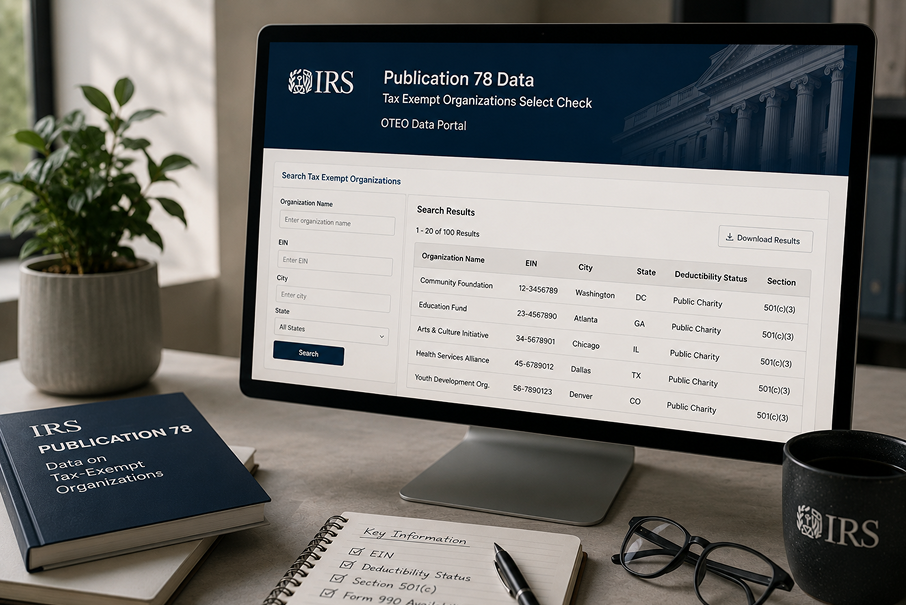
If you are asking, “What is Publication 78?” the short answer is this: IRS Publication 78 was the historical list of organizations eligible to receive tax-deductible charitable contributions. In 2026, the printed publication is no longer the main way people verify charity status; the IRS now maintains Publication 78 data through its online Tax Exempt Organization Search tool, known as TEOS.
For donors, grantmakers, and nonprofit operators, Pub 78 still matters because the phrase is used as shorthand for deductibility verification. But it should not be treated as the only compliance check.
TL;DR
- Publication 78 is no longer a printed IRS list; in 2026, its data is available in the IRS TEOS tool.
- Donors, grantmakers, and nonprofit finance teams use Pub 78 data to verify whether an organization is eligible to receive tax-deductible contributions.
- A Pub 78 listing is not a full compliance green light. Teams should also check EIN accuracy, revocation status, and recent 990-series filings.
- Nonprofits can lose tax-exempt status after three consecutive years of missed IRS filings, which can delay donations, grants, and partnerships.
- Crowded* helps nonprofits maintain cleaner financial records, approval trails, and audit-ready documentation, so public IRS checks better align with internal operations.
What Is Publication 78?
Publication 78 was the IRS’s cumulative list of organizations that could receive tax-deductible contributions under Section 170. Historically, donors used it to confirm whether gifts to a charity were deductible for federal tax purposes. Today, “Publication 78” usually refers to the Pub 78 data available inside TEOS.
Publication 78 answers one narrow question: Can this organization receive tax-deductible charitable contributions?
That is different from asking whether an organization is operationally healthy, currently filing on time, properly governed, or financially transparent. A nonprofit may appear in Pub 78 data because it has received IRS recognition that its contributions may be deductible. But donors and finance teams should still check supporting records, including revocation history, Form 990 filings, and the organization’s legal name and EIN.
What Is Publication 78 Used For?
Publication 78 is mainly used to verify charitable deductibility. Donors use it before giving. Grantmakers use it before awarding funds. Nonprofits use it to confirm that their public IRS record reflects the correct status. The IRS TEOS tool lets users check Pub 78 data, automatic revocation records, Form 990-series returns, Form 990-N filings, and determination letters in one place.
Common Use Cases for Donors and Nonprofits
- A donor may search Pub 78 data before making a major year-end gift.
- A foundation may check TEOS before approving a grant payment.
- A nonprofit finance team may search its own EIN before a campaign, audit, fiscal sponsorship review, or partnership launch.
- A national organization may check chapter records to confirm whether local entities are still reflected correctly in IRS systems.
Publication 78 vs. TEOS: What Changed?
Publication 78 was once associated with a printed IRS list. The IRS discontinued the paper version in 2011 and now maintains the list through TEOS.
Before | After |
Publication 78 was known as a printed or downloadable IRS list. | Pub 78 data is now available through TEOS. |
Users mainly checked the deductibility status. | Users can also check Form 990 filings, Form 990-N records, automatic revocation, and determination letters. |
Verification was more static. | TEOS provides users with access to multiple IRS datasets in a single search environment. |
“Publication 78” sounded like a document. | In 2026, it usually means the IRS Pub 78 dataset inside TEOS. |
The key shift is that Pub 78 is no longer the whole verification process. It is one dataset within a broader IRS search tool.
How to Verify a Charity Using Publication 78 Data in TEOS
The safest workflow is to search by EIN first, then confirm the legal name, deductibility status, revocation history, and filing records.
Step 1: Search by EIN When Possible
The EIN is the cleanest search input because nonprofit names can vary. For example, a donor may know a charity by its public brand name, while the IRS record uses its legal corporate name. Searching by EIN reduces false matches.
Operational example: If “Helping Hands Community Fund” appears in marketing materials, but the IRS record says “Helping Hands Community Foundation Inc.,” the EIN helps confirm that both names refer to the same entity.
Step 2: Search by Legal Name if You Do Not Have the EIN
If you only have the name, search using the most exact legal name available. Avoid relying on abbreviations, campaign names, local nicknames, or DBA names unless you also confirm the EIN.
Operational example: A donor searching for “Hope Center” may find several organizations in different states. The correct record depends on EIN, city, state, and legal name.
Step 3: Check Pub 78 Deductibility Data
After finding the organization, check whether it appears in Pub 78 data as eligible to receive tax-deductible contributions. This is the core Publication 78 check.
Step 4: Check Automatic Revocation Records
Do not stop at Pub 78 data. The IRS automatically revokes tax-exempt status when most exempt organizations fail to file required Form 990-series returns or notices for three consecutive years under IRC §6033(j). The IRS updates the automatic revocation list monthly.
Operational example: A nonprofit may have an old determination letter but still appear on the automatic revocation list because it missed filings for three consecutive years.
Step 5: Review Form 990 or 990-N Filing Records
Most tax-exempt organizations must file an annual return or notice, often Form 990, 990-EZ, 990-PF, or 990-N, depending on size and organization type. This helps donors and operators understand whether the organization has recent public filing activity.
Publication 78 vs. IRS Business Master File
TEOS and the IRS Exempt Organizations Business Master File are related, but they are not the same tool.
Item | TEOS / Pub 78 Data | IRS EO Business Master File |
Main purpose | Public search for exempt status, filings, deductibility, revocation, and letters | Bulk IRS dataset with information from the Business Master File |
Best for | Donors, grantmakers, nonprofit operators, quick verification | Data teams, researchers, compliance platforms, and large-scale record matching |
Format | Search tool and downloadable datasets | CSV files by state and region |
Includes deductibility check | Yes, through Pub 78 data | Can include exemption and related IRS record information |
Best operational use | Verifying one organization before giving, granting, or onboarding | Monitoring many organizations across a portfolio or chapter network |
The IRS describes the EO BMF Extract as a cumulative file containing the most recent IRS information for organizations that have received tax-exempt determinations.
Why Publication 78 Still Matters in 2026
Publication 78 still matters because donors and institutions need a fast, IRS-grounded way to confirm deductibility. For nonprofit operators, it also matters because external stakeholders may check the organization’s status before approving grants, donations, partnerships, fiscal sponsorship arrangements, or vendor relationships.
A missing, mismatched, or revoked IRS record can delay funding even when the organization’s mission work is legitimate.
How Crowded Helps Nonprofits Keep Compliance Records Cleaner
Crowded does not replace IRS verification or legal compliance work. But centralized nonprofit financial infrastructure can reduce the operational mess that often leads to poor records, unclear documentation, and last-minute audit stress.
For nonprofits with chapters, restricted funds, multiple admins, or distributed teams, Crowded supports clearer financial operations through centralized visibility, permissioning, documentation retention, and audit-ready transaction organization.
That matters because Pub 78 and TEOS verification are public-facing checks. Internally, nonprofits still need clean records that explain where funds came from, how funds moved, who approved payments, and which entity or chapter activity they belong to.
When finance and compliance operations live in a single, well-organized system, nonprofit teams are better prepared to handle donor questions, grant reviews, board reporting, and annual filing workflows.
* Crowded Technologies Inc is a financial technology company and is not a bank. Banking services provided by i3 Bank; Member FDIC. The Crowded Technologies Inc. Visa® Debit Card is issued by i3 Bank pursuant to a license from Visa U.S.A. Inc. and may be used everywhere Visa debit cards are accepted.
There are no fees associated with account opening, but transaction fees may apply; please refer to the Crowded Business Deposit Account Agreement for more details on account transaction fees.
Frequently Asked Questions
Can a nonprofit be state-registered but IRS-revoked?Can a nonprofit open an FBO account directly?
Yes. State registration and federal tax exemption are separate. A nonprofit may be active with the state but revoked by the IRS for missed filings.
Why do grantmakers still check IRS records?
Grantmakers verify deductibility, legal name, EIN, and revocation status before releasing funds, even for nonprofits they already know.
Can outdated IRS records delay donations?
How often should nonprofits check TEOS?
Why is this harder for chapter-based nonprofits?
Chapters often have separate admins, accounts, and records. Crowded helps centralize visibility, permissions, and documentation across entities.
Does Crowded replace IRS verification?
No. TEOS is still the IRS source. Crowded helps nonprofits keep cleaner internal records, approval trails, and audit-ready documentation.
Can banks or platforms check Publication 78?
Yes. Banking partners, payment processors, and fundraising platforms may review IRS records during onboarding or compliance checks.