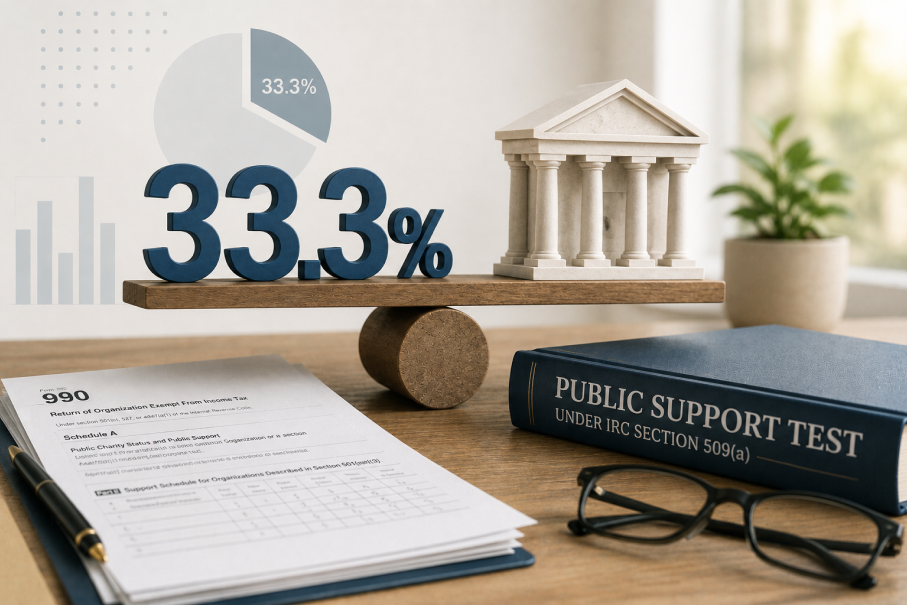
The nonprofit public support test is an IRS calculation that determines whether a tax-exempt organization qualifies as a public charity under IRC §509(a)(1) or §509(a)(2). It measures whether support comes from a broad public base rather than concentrated private sources. Most nonprofits must show at least 33⅓% public support over a rolling five-year period on Form 990 Schedule A.
If an organization falls below the required threshold, the IRS may classify it as a private foundation. That change can trigger stricter compliance rules, excise taxes, donor deduction limits, and heavier reporting obligations.
Public charity status is not permanent. It depends on ongoing support patterns, donor concentration, grant structure, and accurate Schedule A reporting. A single oversized donor, declining grassroots support, or misclassified revenue can create compliance risk long before leadership notices.
TL;DR
- The nonprofit public support test determines whether an organization keeps public charity status or risks private foundation classification.
- Most nonprofits must show at least 33⅓% public support over a rolling five-year period on Form 990 Schedule A.
- Large donors, misclassified grants, investment income, and weak revenue tracking can quietly lower public support ratios.
- The 2% donor limit and 10% facts-and-circumstances test are where many boards misunderstand the rules.
- Cleaner financial visibility, enabled by platforms like Crowded*, can help nonprofits track support patterns before Schedule A becomes a compliance problem.
What Is the Nonprofit Public Support Test?
The nonprofit public support test is an IRS calculation used to determine whether an organization qualifies as a public charity or may be treated as a private foundation under IRC §509. It measures whether support comes from a broad public base or from a small group of concentrated funders.
The Two Main Public Support Tests Nonprofits Encounter
Most nonprofits use one of two Schedule A tests:
- 509(a)(1) public support test: Used by charities that rely mainly on donations and government or public grants.
- 509(a)(2) public support test: Used by organizations with significant program revenue, membership income, admissions, or related earned income.
The main difference is how each test treats earned revenue, donor concentration, and investment income.
Where the Public Support Test Appears on Form 990
The nonprofit public support test appears on Form 990 Schedule A. It reviews support patterns across a rolling five-year period using the IRS “normally receives” standard. Because the calculation spans multiple years, public support issues often build quietly before they appear during Schedule A preparation.
What Is the 33⅓% Public Support Rule?
Under the nonprofit public support test, organizations generally must show that public support equals at least 33⅓% of total support over a rolling five-year period.
Formula: Public Support ÷ Total Support = Public Support Percentage
The IRS uses this multi-year “normally receives” standard to account for temporary fluctuations while still identifying long-term donor concentration risk.
Example over five years:
- $500,000 from individual donors
- $250,000 from government and public grants
- $250,000 from investment income
- Public support: $750,000
- Total support: $1,000,000
- Public support percentage: 75%
Because the organization exceeds the 33⅓% threshold, it passes the nonprofit public support test.
What Counts as Public Support Under IRS Rules
Public support may include:
- Individual donations
- Government and public grants
- Membership fees
- Broad-based fundraising revenue
- Diverse donor contributions
- Program service revenue under 509(a)(2)
The IRS generally favors revenue tied to broad public participation.
What Usually Does NOT Count as Public Support
Some revenue may be excluded fully or partially from the numerator, including:
- Investment income
- Excess donor concentration
- Certain unrelated business income
- Contributions above donor caps
- Revenue unrelated to exempt activities
This is where many nonprofits miscalculate Schedule A ratios.
How Do You Calculate Public Support on Form 990 Schedule A?
The nonprofit public support test compares qualifying public support against total support over a rolling five-year period. The basic formula is: Public support ÷ total support = public support percentage.
The numerator includes qualifying public support. The denominator includes total support, such as contributions, grants, revenue, and investment income. Because each revenue category may be treated differently, many nonprofits monitor Schedule A calculations throughout the year instead of waiting until filing season.
How the 2% Donor Limit Works in Practice
Under the 509(a)(1) test, contributions from one donor above 2% of total support may be excluded from the public support numerator. For example, if total support is $1,000,000, the 2% threshold is $20,000. If one donor gives $200,000, only $20,000 may count as public support. The remaining $180,000 still stays in total support, which can lower the organization’s public support percentage.
How the 509(a)(2) Public Support Test Differs
Organizations with program service revenue, such as museums, schools, hospitals, cultural institutions, and membership groups, often use the 509(a)(2) test. Program revenue may count as public support, but investment income is more limited, and revenue classification becomes especially important.
Many nonprofits use rolling calculators to track donor concentration, grant classification, multi-year revenue trends, and Schedule A scenarios. Without clean financial visibility, these calculations become harder to monitor and easier to misstate.
What is the 10% Facts and Circumstances Test?
Failing the 33⅓% public support threshold does not automatically end public charity status. Some nonprofits may still qualify if they receive at least 10% public support and can prove they operate like a publicly supported organization.
The IRS may consider ongoing fundraising, community representation, public-facing programs, an independent governing body, and other evidence that the nonprofit serves a broad public, even if it does not meet the main threshold.
The 10% facts-and-circumstances test is not automatic protection. The IRS evaluates the organization’s fundraising practices, governance, public activities, and documentation, so strong records and clear reporting are essential.
What Happens If a Public Charity Fails the Public Support Test?
- If a nonprofit consistently fails the public support test, the IRS may reclassify it as a private foundation, creating stricter compliance, reporting, tax, and reputational risks.
- Private foundation status can trigger self-dealing restrictions, mandatory distribution rules, excise taxes, different donor deduction limits, and heavier reporting obligations.
- New nonprofits generally receive temporary flexibility during their first five years, but they should still track donor concentration and support composition early to avoid future Schedule A issues.
- Certain unusual grants may be excluded from the public support calculation when they are large, unexpected, nonrecurring, and unlikely to create ongoing donor dependence. This prevents one-time gifts from distorting public support ratios.
What Nonprofit Boards Often Miss About the Public Support Test
Most public support tests risks build gradually. Donor concentration, misclassified revenue, inconsistent records, and limited financial visibility can weaken an organization’s Schedule A position long before filing season.
Disconnected donation, grant, banking, and reconciliation records make Schedule A harder to prepare and more prone to error. Without clean tracking, nonprofits may miss donor concentration issues, misclassify support, or discover compliance risks too late.
How Crowded Helps Nonprofits Maintain Cleaner Support Tracking
Crowded helps nonprofits centralize financial visibility across fundraising, payments, and operational workflows.
For organizations monitoring the nonprofit public support test, centralized infrastructure can simplify:
- Donor tracking
- Revenue categorization
- Multi-entity oversight
- Audit-ready exports
- Reconciliation between fundraising and compliance records
That operational visibility becomes especially important when preparing Form 990 Schedule A calculations across multiple years.
To Conclude
Public charity status concerns the financial structure, transparency of governance, and composition of support over time. The nonprofit public support test ultimately measures whether an organization genuinely operates with broad public backing rather than concentrated private influence.
Organizations that monitor donor concentration, grant structure, and revenue composition early are far more likely to avoid last-minute Schedule A surprises, reporting inconsistencies, and avoidable IRS scrutiny.
Modern nonprofit finance infrastructure helps nonprofits maintain cleaner records, stronger oversight, and more reliable compliance workflows before public support problems emerge.
* Crowded Technologies Inc is a financial technology company and is not a bank. Banking services provided by i3 Bank; Member FDIC. The Crowded Technologies Inc. Visa® Debit Card is issued by i3 Bank pursuant to a license from Visa U.S.A. Inc. and may be used everywhere Visa debit cards are accepted.
There are no fees associated with account opening, but transaction fees may apply; please refer to the Crowded Business Deposit Account Agreement for more details on account transaction fees.
Frequently Asked Questions
Can a nonprofit pass the public support test one year and fail it later?
Yes. Because the test uses a rolling five-year period, donor concentration, grant changes, or revenue shifts can weaken the ratio over time.
Do recurring donors help public support percentages?
Yes. A broad recurring donor base can strengthen public support by reducing dependence on a few major funders.
Can donor-advised fund grants affect the test?
Yes. Donor-advised fund grants can complicate donor concentration analysis and should be reviewed carefully during Schedule A preparation.
Why monitor donor concentration year-round?
Public support risks build gradually. Year-round tracking helps nonprofits avoid last-minute Schedule A surprises.
Can fragmented systems create Schedule A errors?
Yes. Disconnected donation, grant, banking, and fundraising records can lead to misclassified revenue or missed donor concentration risks. Crowded helps centralize financial visibility for cleaner tracking.