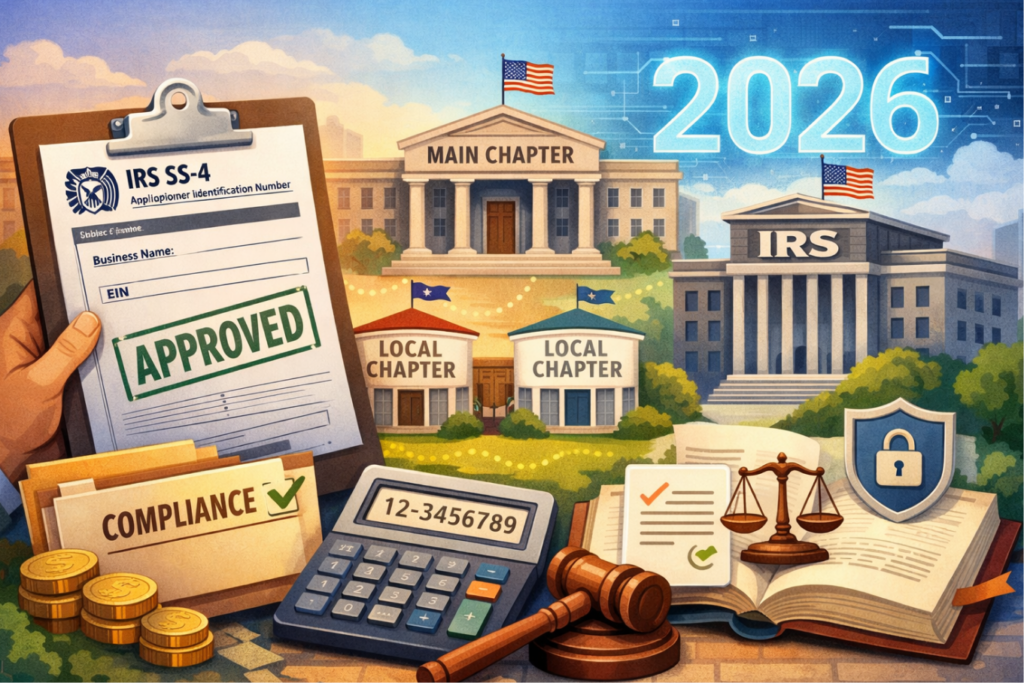
Most associations begin informally, a professional network, an industry coalition, or a local chapter of a national organization. That works until the moment you need to open a bank account, collect dues, or file taxes. At that point, the IRS requires a nonprofit EIN, and how it’s structured can shape your compliance workflows for years.
TL;DR
- Every association needs a nonprofit EIN before opening a bank account, collecting dues, hiring staff, or filing taxes
- Your EIN structure (centralized, per-chapter, or hybrid) directly determines your compliance risk and financial oversight model
- An EIN is not tax-exempt status, associations need both, and the EIN comes first
- Multi-chapter and federated associations that skip a deliberate EIN strategy often face IRS penalties, governance disputes, and oversight gaps that take years to fix
- Crowded helps associations structure accounts across chapters, maintain centralized visibility, and stay compliant as they scale
What Is a Nonprofit EIN?
A nonprofit EIN (Employer Identification Number) is a unique nine-digit tax identifier issued by the IRS to recognize an organization for tax and reporting purposes, the organizational equivalent of a Social Security number for entities. Every association needs one before it can open a bank account, collect dues, hire employees, report payroll taxes, or apply for tax-exempt status under the IRS 501(c) series.
Do Associations Need a Nonprofit EIN?
Yes, and in most cases, sooner than you think. An EIN is required before your association can:
- Open a bank account
- Hire staff or report payroll taxes
- Apply for 501(C) tax-exempt status
- File IRS Form 990 annual returns
This applies across all common association types: trade associations, professional associations, chambers of commerce, membership organizations, and nonprofit networks.
Note: Trade associations qualifying under 501(C)(6), recognized as tax-exempt business leagues, still require an EIN for all IRS filings and ongoing compliance reporting.
How EIN Structure Affects Association Governance
Associations face a structural decision most nonprofits never encounter: whether chapters share the headquarters EIN or hold their own.
Single EIN (Centralized)
HQ controls the tax ID and all finances.
- ✅ Centralized oversight and simplified tax filings
- ❌ Limited chapter autonomy; heavier HQ administration
Separate EINs Per Chapter
Each chapter holds its own tax ID.
- ✅ Local financial independence; streamlined chapter operations
- ❌ Multiple Form 990 filings; greater compliance complexity
Hybrid Structure
Some nonprofits combine both models, certain chapters operate under the national EIN while larger or incorporated chapters maintain their own. The right structure depends on your governance model, chapter size, and how much financial independence chapters need.
How Associations Apply for a Nonprofit EIN
Applying for a nonprofit EIN is straightforward when you follow these four steps.
Step 1 — Form the legal entity. Associations can be structured as nonprofit corporations, trusts, or unincorporated associations. Your legal structure must be in place before applying.
Step 2 — Complete IRS Form SS-4. This is the official IRS application for a tax ID. You’ll need your organization’s legal name, address, and responsible party information.
Step 3 — Choose your application method.
- Online (fastest, recommended)
- Fax submission
- Mail submission
- Phone (for international applicants only)
Step 4 — Receive your EIN. Most online applications receive confirmation within minutes. Fax and mail applications take longer.
When Associations Need Multiple EINs
Multi-chapter associations often need more than one EIN. Specifically, when:
- Chapters are incorporated as separate legal entities
- Chapters maintain independent bank accounts
- Chapters file their own tax returns
Structure vs. EIN Strategy
Association Structure | Recommended EIN Approach |
National association with local branches | Single EIN (HQ-controlled) |
Nonprofits with incorporated chapters | Multiple EINs (one per chapter) |
Professional society with regional affiliates | Hybrid structure |
Each chapter seeking its own tax-exempt recognition from the IRS will also need a separate EIN before submitting that application.
EIN vs. Tax-Exempt Status for Associations
One of the most common misconceptions: an EIN does not equal tax-exempt status. They serve completely different purposes.
Item | Purpose |
EIN | Tax identification number |
501(C) Status | IRS classification granting tax exemption |
Form 990 | Annual reporting requirement for tax-exempt orgs |
An association must obtain its nonprofit EIN before it can apply for 501(C) recognition. Having an EIN means the IRS can identify your organization.
Compliance Risks Without a Clear EIN Strategy
Associations with chapters regularly encounter compliance problems when EIN ownership is undefined. Common triggers include:
- Chapters opening independent bank accounts without coordination
- Multiple entities improperly sharing a single EIN
- Unclear ownership of the EIN when leadership turns over
- Missed Form 990 filings at the chapter level
Consequences can include:
- IRS filing errors and penalties
- Delayed or denied tax-exempt recognition
- Governance disputes between HQ and chapters
- Financial oversight gaps that are difficult to unwind
How Financial Infrastructure Supports Association Compliance
For large associations, compliance failures often trace back to fragmented financial infrastructure rather than bad intentions.
Common gaps:
- HQ lacks real-time visibility into chapter finances
- Dues collection happens outside centralized systems
- Bank accounts are opened without headquarters oversight
- Chapter reporting is inconsistent or delayed
Purpose-built financial infrastructure addresses these gaps by providing centralized account management, standardized compliance workflows, and real-time visibility across all entities, regardless of how many EINs are in play.
How Crowded Supports Financial Oversight for Associations
As associations grow into multi-chapter structures, maintaining visibility across accounts tied to different EINs becomes increasingly complex for HQ teams.
Crowded provides financial infrastructure purpose-built for associations and nonprofit networks. Organizations using Crowded can structure accounts across chapters, maintain centralized financial visibility, and support consistent compliance workflows as they scale, without relying on informal reporting from chapter treasurers or fragmented banking setups.
If your association is navigating multi-EIN complexity, explore how Crowded supports association financial oversight.
The EIN Is the Foundation of Association Compliance
A nonprofit EIN is more than a tax ID, it is the foundation of your association’s financial identity. For organizations with chapters, affiliates, or structures, the way EINs are assigned shapes:
- Chapter governance and autonomy
- Financial oversight at every level
- Compliance risk and reporting obligations
Key Takeaways:
- Every association needs a nonprofit EIN before banking, hiring, or filing
- Chapter structures require a deliberate EIN strategy, centralized, separate, or hybrid
- An EIN is not the same as tax-exempt status; both are required
- Fragmented EIN management is a leading source of association compliance risk
- Purpose-built financial infrastructure reduces that risk at scale
Establishing the right EIN structure early helps associations scale without creating administrative complexity down the road.
Your questions, answered.
Can an association lose its EIN?
An EIN is permanent and never expires. However, if your association dissolves and re-forms as a new legal entity, it must apply for a new EIN. Always keep it on file, the IRS uses it to track your organization’s entire filing history.
Does an unincorporated association need an EIN?
Yes. Even without formal incorporation, an association needs a nonprofit EIN to open a bank account, collect dues, or hire staff. The IRS doesn’t require incorporation to issue one, but a responsible party, typically an officer or founder, must be listed on Form SS-4.
What happens if a chapter uses the wrong EIN on a filing or bank account?
It can trigger mismatched IRS records, penalty notices, and delayed tax-exempt recognition, often taking months to correct. Crowded helps associations maintain structured account oversight so EIN mismatches are caught before they become compliance problems.
Is there a fee to apply for a nonprofit EIN?
No. The IRS charges nothing to apply via Form SS-4. Be cautious of third-party websites charging for EIN registration, they are not affiliated with the IRS, and the application is always free when submitted directly.
Can a chapter be covered under the national organization's group exemption?
Yes. Some national associations hold a group exemption ruling that covers affiliated chapters under the parent’s 501(C) status. However, each chapter typically still needs its own EIN to operate independently, even under the group exemption.
What EIN should an association use for payment processing or payroll?
Each legal entity must use only its own EIN for financial accounts and payroll systems. Mixing EINs across platforms creates audit risk and muddies reporting. Crowded keeps chapter accounts properly segmented by EIN, reducing this risk across multi-chapter organizations.
How often does an association need to update its EIN information with the IRS?
You don’t re-apply, but you must notify the IRS when key details change, such as a new responsible party or legal structure, typically via Form 8822-B. Keeping records current ensures IRS correspondence reaches the right people.