Form 990-N Explained: Thresholds, Gross Receipts, and Common Mistakes
Managing compliance across dozens, or hundreds, of chapters creates unique oversight challenges that standalone nonprofits rarely face. For chapter networks and federated organizations, the challenge is maintaining centralized oversight when each chapter files independently.
Form 990-N exists to keep small tax-exempt organizations visible to the IRS without complex reporting. It’s simple by design. But for federated structures, that simplicity creates hidden risk: chapters can silently outgrow eligibility while headquarters operate without real-time financial visibility.
This guide explains what Form 990-N is, who must file it, how the $50,000 threshold works, and how central organizations can maintain oversight to prevent compliance gaps and protect group exemption status.
TL;DR
- Form 990-N (the 990-N e-Postcard) is an annual filing required for small tax-exempt organizations to maintain IRS recognition.
- Most organizations with gross receipts of $50,000 or less can file Form 990-N instead of Form 990-EZ or Form 990.
- Gross receipts include all money received, often include donations, grants, dues, fundraising proceeds, and restricted funds.
- Form 990-N is due 4½ months after the end of your fiscal year (May 15 for calendar-year organizations) and cannot be extended.
- Missing the filing three years in a row results in automatic revocation of tax-exempt status.
- Even inactive or volunteer-run nonprofits must file if they remain legally active.
- Organizations that grow beyond the threshold must transition to Form 990-EZ or Form 990.
- Simple habits, tracking receipts year-round, keeping records updated, and setting reminders, prevent most compliance issues.
- Chapters can silently outgrow 990-N eligibility if headquarters isn’t monitoring receipts across all affiliates.
- Central organizations often discover compliance issues only during audits, board reviews, or restructuring efforts.
What Is Form 990-N?
Form 990-N is a simplified annual filing required by the Internal Revenue Service for small tax-exempt organizations. Instead of submitting detailed financial statements, eligible organizations file a short electronic notice confirming their continued existence and eligibility.
The 990-N e-Postcard was introduced in 2008 after Congress determined that many small nonprofits were falling off the IRS radar entirely. The goal was accountability without administrative burden.
Form 990-N is different from:
- Form 990-EZ, which requires summarized financial reporting
- Form 990, which includes full financial disclosures and schedules
If your organization qualifies for 990-N, you do not submit financial statements, but accuracy still matters. For organizations with multiple chapters or affiliates, this becomes especially important, when dozens or hundreds of local chapters file separately, even a simple form like 990-N requires coordination to ensure each entity maintains its tax-exempt status.
Who Needs to File Form 990-N?
Organizations generally must file Form 990-N if they meet all of the following:
- Recognized as tax-exempt under Section 501(C)
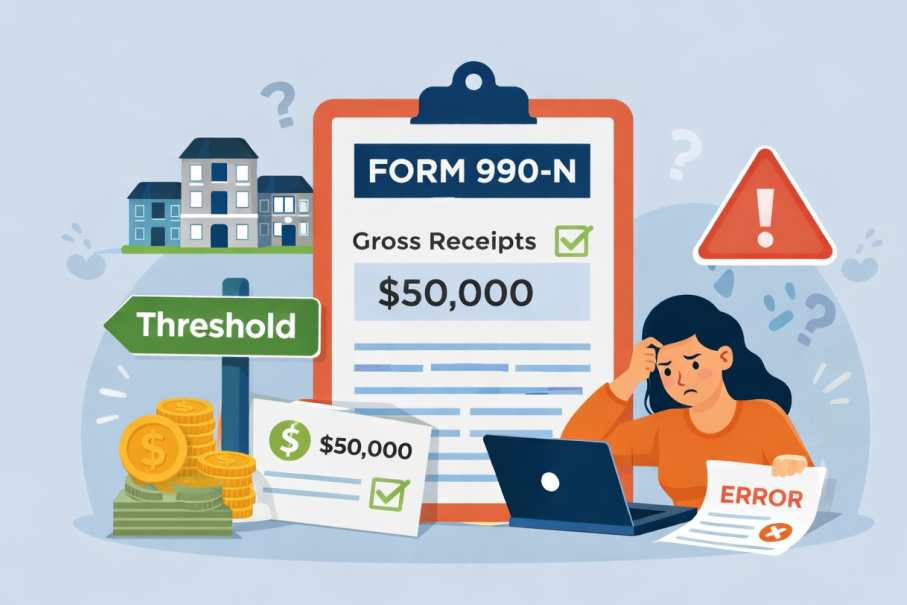
- Normally have gross receipts of $50,000 or less
- Are not required to file Form 990 or Form 990-EZ
This includes many:
- Small charities
- Local associations
- Volunteer-run nonprofits
- Community groups
Important distinction: Independent organizations with their own tax-exempt determination letter must file Form 990-N. Chapters covered under a parent organization’s group exemption may file separately or be included in the parent’s group return, depending on the parent’s structure.
Some organizations are exempt from filing altogether, which we’ll cover later.
Understanding the Gross Receipts Threshold
For chapters under a national umbrella, the gross receipts threshold causes the most confusion. Chapters often cross $50,000 without headquarters knowing until it’s too late. Monitoring what counts across your network simplifies compliance.
What Counts as Gross Receipts?
Gross receipts are all amounts received by your organization during the year, before expenses. For nonprofit tax filing purposes, this includes:
- Donations and contributions
- Program service revenue
- Fundraising event proceeds
- Membership dues
- Investment income
- Grants received
- Sponsorship income
Gross receipts are not the same as profit. Even if money passes through your organization temporarily, it may still count.
The $50,000 Threshold Explained
To qualify for Form 990-N, your organization’s normal annual gross receipts must be $50,000 or less. “Normally” allows some flexibility:
- New organizations may estimate first-year receipts
- Existing organizations may use a multi-year average
- One unusually high year does not automatically disqualify you
If your organization consistently exceeds the threshold, you must transition to Form 990-EZ or Form 990.
A chapter that’s filed 990-N for years might receive a one-time $60,000 grant and exceed the threshold without HQ knowing. Many teams discover this the following year, after the chapter has missed the correct filing deadline.
Calculating Your Organization’s Gross Receipts
A practical way to calculate gross receipts:
- List all income sources for the year
- Add amounts received before expenses
- Include restricted and unrestricted funds
- Do not subtract refunds, fees, or costs
Common mistakes include excluding grants or counting only net fundraising proceeds. Accurate tracking throughout the year makes this step far easier at filing time.
For one organization, this is manageable. For 40–200 chapters, it’s nearly impossible without a centralized system. Chapters don’t always report income spikes, so HQ can’t catch eligibility changes before they become problems.
Why Centralized Visibility Matters
Chapters often outgrow 990-N eligibility without anyone noticing. A single fundraiser or gift can push them over the threshold. Without a flagging system, chapters may file the wrong form or miss filing, risking penalties and loss of tax-exempt status.
Proactive monitoring across your chapter network ensures that when a chapter’s receipts approach or exceed $50,000, headquarters can step in, provide guidance, and ensure the correct form is filed on time.
Common Mistakes to Avoid When Filing Form 990-N
Many organizations lose good standing not because they intended to ignore filing requirements, but because they misunderstood them. For national nonprofits with chapters, these mistakes multiply across the network, often because of coordination gaps, inconsistent interpretation, or unclear assignment of responsibility. These common mistakes explain where nonprofits most often run into trouble when filing Form 990-N.
Mistake #1: Missing the Filing Deadline
Failing to file for three consecutive years triggers automatic revocation of tax-exempt status. This happens without warning.
For multi-chapter organizations, this risk compounds when:
- Headquarters assumes local chapters are monitoring their own deadlines
- Chapters believe headquarters is tracking everything centrally
- No one owns a master calendar showing which entities file when
Once revoked:
- Donations may no longer be tax-deductible
- Grant eligibility may be affected
- Reinstatement requires a formal application
Prevention for networks: Assign one person or team to maintain a centralized filing calendar that tracks every chapter’s deadline, form type, and filing status.
Mistake #2: Miscalculating Gross Receipts
Common errors include:
- Confusing net income with gross receipts
- Excluding in-kind contributions incorrectly
- Ignoring pass-through funds
In chapter networks, gross receipts miscalculations often happen when:
- Chapters inconsistently interpret whether pass-through funds from headquarters count toward their threshold
- Local treasurers apply different standards for counting in-kind donations
- Chapters fail to account for one-time fundraising events that push them over $50,000
Errors may force a future correction or improper form selection—and in networked organizations, one chapter’s mistake can signal systemic training gaps.
Mistake #3: Filing the Wrong Form
Some organizations cannot file Form 990-N, including:
- Organizations exceeding the receipts threshold
- Organizations required to file Form 990 or 990-EZ
- Certain entities with significant assets
Churches are generally exempt from filing altogether.
This is one of the most common errors in chapter-based nonprofits: a chapter exceeds $50,000 in gross receipts (perhaps due to a successful fundraiser or large grant) but still files the e-Postcard out of habit or because “we always file 990-N.”
Prevention: Train chapter leaders to calculate gross receipts annually before selecting a form. Implement a pre-filing review process where chapters notify headquarters if receipts approach the threshold.
Mistake #4: Using Incorrect or Outdated Information
Problems often arise from:
- Wrong EIN
- Old mailing addresses
- Outdated officer information
- Legal name mismatches
For networks with multiple EINs, confusion escalates when:
- Chapters don’t know their own EIN or confuse it with the parent organization’s number
- Leadership turnover leaves no institutional memory of login credentials or IRS records
- Legal name changes (mergers, rebranding) aren’t reflected in filings
Always verify records before submitting. In multi-chapter structures, maintain a central database with each chapter’s EIN, legal name, current officers, and mailing address, and update it at least annually.
Mistake #5: Assuming Filing Isn’t Required
Even small, inactive, or newly formed organizations may still need to file. State filings do not replace federal requirements.
In chapter networks, the assumption problem looks like this:
- A small chapter with minimal activity assumes they’re too small to matter
- Newly chartered chapters assume they’re covered under the parent’s exemption
- Dormant chapters assume “no activity” means “no filing requirement”
All of these are wrong. Each separately incorporated chapter with its own EIN must file, regardless of size, activity level, or relationship to headquarters.
Mistake #6: Not Keeping Proper Records
While 990-N is simple, organizations must still maintain:
- Financial records
- Contribution documentation
- Governance records
Records should generally be kept for at least three to seven years.
For chapter-based organizations, record keeping failures are often structural:
- Chapters lack standardized bookkeeping systems
- Volunteer treasurers use personal methods that aren’t transferable
- Records are lost during leadership transitions
- There’s no backup when a key volunteer leaves unexpectedly
Solution: Provide chapters with a simple recordkeeping template and require annual submission of basic financials to headquarters for continuity and audit protection.
The Compounding Effect in Networks
Individual mistakes are fixable. But in a networked nonprofit, these errors compound:
- One chapter misses a deadline → others assume it’s optional
- One chapter files the wrong form → the interpretation spreads
- One chapter loses records → there’s no backup to reconstruct history
The solution is creating systems at the network level that catch errors before they become patterns and ensure consistent, correct filing across every entity in your organization.
Special Situations and Exceptions
Form 990-N rules don’t apply uniformly to every organization or every stage of growth. Exemptions, changes in gross receipts, and first-year status can all affect what, and when, you need to file.
Organizations Exempt from Filing Form 990-N
Some organizations do not file any Form 990, including:
- Churches and certain religious organizations
- Governmental entities
- Organizations included in group returns
The Hidden Risk for Central Organizations Managing Chapters Filing 990-Ns
While individual chapters handle their own 990-N filings, central organizations face a unique challenge: you’re accountable for compliance you can’t directly control.
When chapters operate as independent 501(C)(3) entities, their filing obligations, and failures, remain their legal responsibility. But reputational damage, revoked tax-exempt status, and donor concerns don’t stay contained at the chapter level. They ripple upward.
The visibility gap is real:
- You may not know which chapters filed on time until it’s too late
- Chapters change leadership, lose institutional knowledge, and miss deadlines
- The IRS doesn’t notify central offices when affiliates lose their status
- By the time you discover a problem, reinstatement fees and paperwork have already begun
What oversight actually requires:
- Clear communication of filing deadlines across your network
- Centralized tracking of chapter compliance status
- Early warning systems before automatic revocation kicks in
- Documentation that shows your organization supported chapter compliance
The challenge isn’t just about meeting a filing requirement, it’s about maintaining structural integrity across a distributed organization where each affiliate’s compliance affects the whole network’s credibility.
What Happens If Your Gross Receipts Exceed $50,000?
If growth pushes receipts above the threshold:
- File Form 990-EZ if eligible
- File Form 990 if receipts or assets exceed EZ limits
Planning ahead helps avoid last-minute surprises.
What Happens When Form 990-N Is Missed
Missing a Form 990-N filing is not a minor administrative issue. Because the IRS uses consecutive filings to confirm an organization’s continued eligibility, missed submissions trigger automatic consequences that affect federal status, state compliance, and day-to-day operations. Understanding this chain helps organizations act early and avoid long-term disruption.
Automatic Revocation of Tax-Exempt Status
If an organization fails to file Form 990-N for three consecutive years, its tax-exempt status is automatically revoked. The IRS removes the organization from its list of recognized tax-exempt entities without issuing a warning or reminder.
Once revocation occurs:
- Donations may no longer be tax-deductible
- Grant eligibility may be suspended or lost
- Public charity status is no longer recognized
- Fundraising activities may be limited or paused
Revocation applies even to small, inactive, or volunteer-run organizations.
How Organizations Regain Tax-Exempt Status
Losing tax-exempt status does not permanently end an organization, but reinstatement requires formal action. Most organizations must reapply by filing Form 1023 or Form 1024, depending on their exemption type.
Reinstatement typically involves:
- Submitting a new exemption application
- Paying IRS user fees
- Requesting retroactive reinstatement, if eligible
- Waiting several months for IRS review and approval
During this period, the organization operates without federal tax-exempt recognition.
How Revocation of Chapters Creates Reputational and Governance Issues for the Central Organization
When affiliate chapters lose tax-exempt status due to missed 990-N filings, the parent organization faces reputational damage and governance challenges that extend beyond the individual chapter.
Reputational harm is immediate. Donors and grantmakers may question the central organization’s oversight capacity. Even a few revocations can signal systemic weakness, eroding trust and reducing contributions across the network.
Governance consequences follow when boards demand explanations for preventable lapses. Auditors may require new controls and reporting structures. The parent organization’s own exempt status could face scrutiny if regulators view the affiliate network as part of its responsibility.
Problems often surface externally first, when an auditor flags a revocation, a donor questions deductibility, or a board member checks the IRS database. By then, grants may be voided and fundraising disrupted.
The central organization must manage reinstatement across multiple entities while maintaining its own compliance, creating disproportionate administrative burden even from a small number of revoked chapters.
State-Level Compliance and Operational Impact
Federal revocation often triggers automatic consequences at the state level, many states rely on IRS determination letters for charitable registration and tax exemption.
When a chapter loses 501(C)(3) status:
- State charitable solicitation registration may lapse
- Fundraising activities could be restricted or prohibited
- The chapter may become subject to state income or sales taxes
For headquarters, this creates a visibility problem: chapters can drift out of compliance in multiple jurisdictions simultaneously, often without triggering any direct notification to the parent organization. By the time HQ discovers the issue, reinstatement requires federal and state filings, compounding both cost and administrative burden.
Best Practices for Form 990-N Compliance
Staying compliant with Form 990-N doesn’t require complex systems, but it does require consistency. A few simple habits can prevent missed filings, calculation errors, and last-minute scrambles each year.
- Create a filing calendar. Set reminders well before the deadline and clearly assign responsibility to a staff member, officer, or board role. Treat the 990-N as a recurring obligation.
- Track gross receipts throughout the year. Monitor income monthly rather than waiting until filing season. This makes it easier to confirm eligibility and recognize early when receipts are approaching the $50,000 threshold.
- Review organization information annually. Confirm that your legal name, EIN, mailing address, and principal officer details match IRS records. Small discrepancies are a common cause of filing errors.
- Keep basic records even though the form is simple. Maintain financial records, contribution documentation, and governance materials in case questions arise later.
- Consider professional help when circumstances change. A CPA or enrolled agent can confirm eligibility, identify errors before filing, and guide transitions if your organization grows beyond Form 990-N.
For organizations with chapters: Headquarters should maintain a chapter compliance tracker, monitor chapter receipts quarterly, track which chapters have filed, and standardize financial reporting across chapters to ensure consistent oversight and timely filings organization-wide.
These practices help small nonprofits stay compliant without adding unnecessary administrative burden, and reduce the risk of issues that can be costly to fix later.
Building 990-N Readiness Into Everyday Operations
For chapter-based organizations, most Form 990-N problems don’t come from misunderstanding the form itself.
They come from not having reliable visibility into the activity behind it.
Central teams often struggle to confidently answer fundamental questions:
- Which chapters are still under the $50,000 threshold?
- Which are approaching it and may need to file a different form next year?
- Which chapters were filed on time last year?
- Which are inactive but still legally listed under the group exemption?
- Where have leadership changes created reporting gaps?
When that information lives across spreadsheets, emails, and disconnected tools, eligibility decisions become guesswork. And when the IRS, an auditor, or a board asks how oversight is being maintained, it becomes difficult to demonstrate that the structure is actually working as intended.
This is especially critical for organizations overseeing chapters under a group exemption structure, where the central organization is expected to exercise real, ongoing oversight—not just rely on self-reporting.
Where Structure Supports Compliance
Organizations that stay consistently compliant tend to build oversight into their systems, rather than relying on memory or manual tracking.
That typically means:
- Centralized visibility into financial activity by chapter
- Clear tracking of gross receipts trends over time
- Records that persist through treasurer turnover
- Role-based access that reflects how your governance structure actually works
- Automated alerts when chapters approach thresholds or filing deadlines
Tools built for nonprofit financial operations can reduce friction by keeping chapter activity and organization records aligned in one place. Platforms like Crowded support this kind of visibility by centralizing the information that directly affects compliance.
When chapter gross receipts, transaction history, and organizational details are accessible in real time, filing becomes routine rather than reactive. The goal is to make compliance a natural outcome of how the organization already operates, and to give central leadership the documentation they need to demonstrate effective oversight.
Conclusion
Form 990-N may be simple, but it carries real consequences. Understanding the gross receipts threshold, filing on time, and keeping accurate records protects your organization’s tax-exempt status and credibility.
For small nonprofits, compliance requires consistency. Set reminders, track receipts carefully, and review your information each year. When questions arise, professional guidance can prevent costly mistakes.
For large networks, the real risk isn’t forgetting to file, it’s not knowing when chapters outgrow eligibility. Chapters that cross $50,000 and keep filing 990-N face the same penalties as those who don’t file at all. Oversight is the challenge, not the form itself.
Staying compliant with Form 990-N is one of the easiest ways to safeguard your organization’s future. Bookmark this guide, add the deadline to your calendar, and treat the 990-N e-Postcard as a routine part of responsible nonprofit management.
This article is for informational purposes only and does not constitute tax or legal advice. Consider consulting a qualified professional for guidance specific to your organization.
Your questions, answered.
What If I Received a Revocation Letter But Think It's a Mistake?
Contact the IRS Tax Exempt and Government Entities Customer Service at (877) 829-5500. Common mistakes include:
- You were filing under a group exemption and shouldn’t have been listed
- You submitted your returns but the IRS didn’t record them
- Your organization is actually exempt from filing (some religious organizations)
If you were listed in error and can provide proof, the IRS will remove you from the list.
Do Religious Organizations Need to File?
Most churches and church-affiliated organizations are exempt from filing Form 990. However, church-affiliated nonprofits that operate separately (like schools or hospitals) may need to file. When in doubt, check with the IRS or a tax professional.
What If We're a Subordinate in a Group Exemption?
If you’re part of a group ruling and the parent organization files a group return on your behalf, you don’t need to file separately. However, if you were auto-revoked, you’ll need to apply for reinstatement individually and cannot simply rejoin the group exemption.
Can We Operate While Waiting for Reinstatement?
Yes, but you’re operating as a taxable entity during this period. You’ll owe income taxes on net income, and donations won’t be tax-deductible until your status is reinstated.
What If We Want to Close Our Nonprofit Instead?
If your organization is no longer active and you don’t plan to continue, you should formally dissolve. File a final Form 990 checking the “terminating” box and follow your state’s dissolution procedures. This prevents future compliance issues.
How Can We Reduce the Risk of Auto Revocation Across Chapters?
Auto revocation usually happens when filings go unmonitored. HQ teams should maintain a centralized list of chapter EINs and confirm annual Form 990 submissions across entities. Tools like Crowded offer multi-chapter dashboards and group exemption management, which help centralize filing visibility and reduce the chance that missed filings go unnoticed.
Does Crowded Help With Filing and Compliance?
Yes. Crowded provides AI-powered Form 990 preparation and IRS-certified e-filing for 990-N, EZ, and full Form 990s. It also includes compliance management features and centralized chapter tracking, which can help HQ teams stay on top of annual filing requirements.
Can Crowded Help Prevent Auto Revocation?
While no tool can guarantee prevention, structured visibility and regular filing are key. By centralizing financial and compliance data, offering annual 990 e-filing, and giving HQ teams visibility into chapter status through a Chapter Tracker, Crowded helps organizations build routines and oversight that reduce the risk of missed filings and potential auto revocation.