Wondering the difference between a nonprofit vs not for profit you’re not alone. These terms are often used interchangeably, but they have distinct legal and functional differences — especially when it comes to tax status, structure, and purpose.
In this blog, we’ll explore what defines a nonprofit organization and how it differs from a not for profit. We’ll also highlight the key distinctions between the two and help you determine which structure may be best suited for your mission and goals.
TL;DR
- Nonprofit and not-for-profit both refer to organizations that don’t distribute profits to owners, but the terms have different typical uses and legal implications. Nonprofit usually describes organizations formed for charitable, educational, religious, or public benefit purposes and can get formal tax-exempt status (like 501(c)(3) in the U.S.).
- Not-for-profit often refers to clubs or groups that operate without profit motive but may not seek formal tax-exempt status. Not-for-profits typically serve members’ interests rather than a broad public purpose.
- Both types reinvest any surplus into their mission rather than paying owners or shareholders. The difference lies mainly in legal structure, tax treatment, and public fundraising ability.
- Nonprofits commonly register with the government and comply with specific reporting and governance rules to maintain tax benefits. Not-for-profits may be more informal and focus on activities like hobby clubs, social groups, or member-based services.
- Choosing one label affects eligibility for grants, donations, and tax status, so clarity in structure and purpose matters before forming or registering the organization.
What Is a Nonprofit Organization?
A nonprofit organization is an entity that operates for a charitable, religious, educational, or scientific purpose. Its primary goal is to serve the public good, not to generate profits for private individuals.
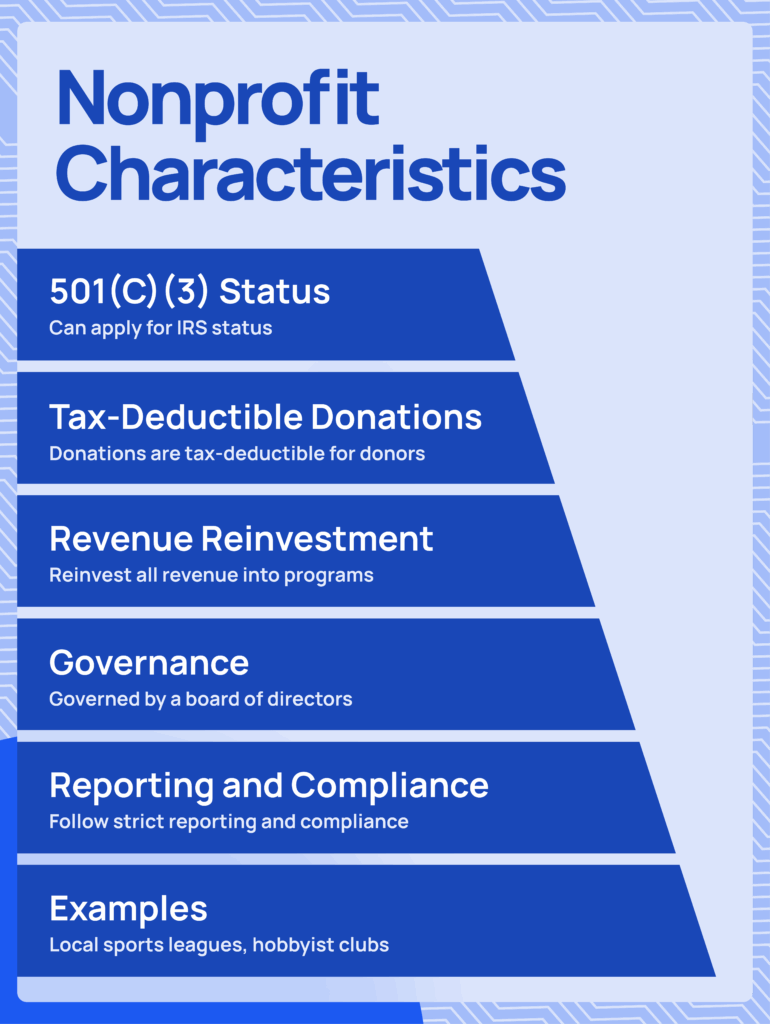
Characteristics of a Nonprofit:
- Can apply for 501(c)(3) status with the IRS
- Donations are tax-deductible for donors
- Must reinvest all revenue into programs and services
- Often governed by a board of directors
- Required to follow strict reporting and compliance rules
Examples of nonprofits:
Charities, foundations, educational institutions, religious organizations
What Is a Not For Profit Organization?
A not for profit organization also doesn’t distribute profits to owners or shareholders, but its purpose is often more limited in scope. It typically serves a specific group of members or community interests, rather than the general public.
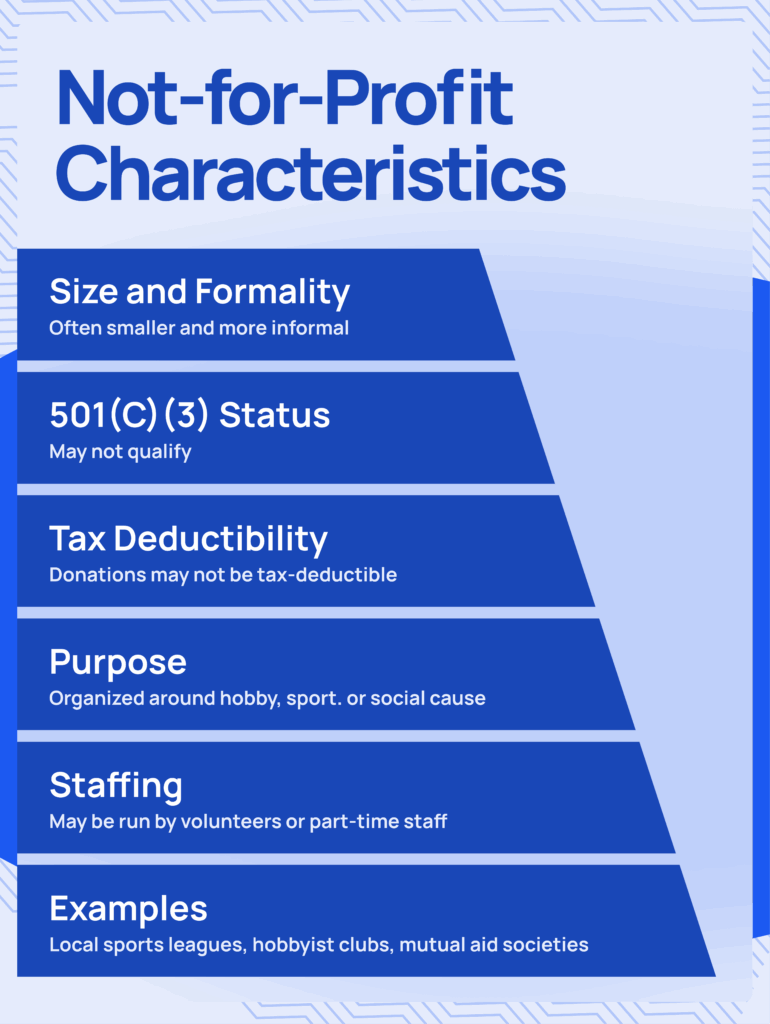
Characteristics of a Not For Profit:
- Often smaller and more informal
- May not qualify for 501(c)(3) status
- Donations may not be tax-deductible
- Often organized around a hobby, sport, or social cause
- May be run by volunteers or part-time staff
Examples of not for profits:
Local sports leagues, hobbyist clubs, mutual aid societies
Which Is Right for You?
If your organization aims to serve the public interest—like feeding the hungry, protecting the environment, or offering education—you’re likely better off registering as a nonprofit and pursuing 501(c)(3) status.
On the other hand, if your focus is more on providing benefits to members of a specific group—such as a social club or recreational team—a not for profit model may be more appropriate.
Understanding Nonprofit vs Not for Profit
While nonprofit and not for profit organizations share the goal of serving others rather than making money, the legal and operational differences between them matter—especially when it comes to tax status, fundraising, and compliance.
Before choosing a structure, consider your mission, who you’re serving, and how you plan to raise funds. Understanding these terms ensures you’re setting up your organization for long-term success and compliance.
How Crowded Supports Nonprofits and Not For Profits
Whether you’re launching a charitable nonprofit or running a small not for profit club, managing finances and staying compliant with tax regulations can be overwhelming—especially with limited time and staff. That’s where Crowded comes in.
Crowded is a modern financial platform built specifically for mission-driven organizations. It helps both nonprofits and not for profits handle the day-to-day operations that often slow teams down, including:
- Banking and financial management tailored to organizations that don’t operate for profit
- Built-in compliance tools to help 501(c)(3)s stay in good standing with the IRS
- Automated reporting and donation tracking, which are essential for transparency and fundraising
- Secure, dedicated accounts for different programs, projects, or chapters
For nonprofits, Crowded streamlines the complex responsibilities that come with tax-exempt status and donor management. For not-for-profits, it offers a simple, reliable way to manage funds without needing a traditional business banking setup.
If you’re unsure about which structure your organization falls under, or you need support setting up the right systems, Crowded’s platform and resources—like their guide to nonprofit tax exemption—can help you start with confidence.
Your questions, answered.
Can a not-for-profit become a nonprofit?
In some cases, a not-for-profit organization can restructure to meet the requirements of a nonprofit and apply for 501(c)(3) status. However, this process involves changes to governance, purpose, and IRS compliance standards.
Are donations to not-for-profits tax-deductible?
Generally, donations to not-for-profits are not tax-deductible unless the organization qualifies under a specific IRS exemption category, such as 501(c)(7). In contrast, donations to nonprofits with 501(c)(3) status are usually tax-deductible for donors.
Do nonprofits and not-for-profits have to pay taxes?
Nonprofits with 501(c)(3) status are exempt from federal income tax and often from state taxes as well. Not-for-profits may be exempt depending on their classification (e.g., 501(c)(7), 501(c)(4)) but may still need to pay certain taxes or fees.
Which is better: a nonprofit or a not-for-profit?
It depends on your mission. If your goal is to serve the public good and seek donations or grants, a nonprofit structure is likely the better choice. If you’re focused on a member-based purpose (like a club or hobby group), a not-for-profit model may be more suitable.