Every major financial decision your association makes — from selecting a banking platform to choosing an accounting provider — should start with structure and transparency.
A Request for Proposal (RFP) ensures exactly that. It’s more than a document; it’s a standardized framework that helps your team gather bids, compare vendors objectively, and make confident, compliant decisions.
This guide explains what an RFP is, outlines the essential components of a strong proposal, and includes a free request for proposal template specifically tailored for association finance teams.
TL;DR
- An RFP helps associations clearly define what they need before approaching vendors. This reduces vague proposals and misaligned expectations from the start.
- Using a structured template makes vendor responses easier to compare. Everyone answers the same questions, which simplifies evaluation.
- Clear scope, timelines, and requirements minimize back-and-forth during selection. Vendors know upfront what success looks like.
- RFPs create accountability by documenting what vendors commit to deliver. Those commitments become the baseline for performance.
- A consistent RFP process leads to better vendor fit and long-term results. It supports smarter, more defensible decision-making.
What Is a Request for Proposal?
A Request for Proposal, often abbreviated as RFP, is a formal document issued by an organization to invite vendors to submit proposals for a specific service or solution.
At its core, an RFP does three things:
- Clarifies needs. You define your financial or operational goals.
- Creates consistency. Vendors submit responses using the same structure.
- Encourages transparency. Everyone evaluates options on the same terms.
In the context of association finance, an RFP keeps procurement aligned with your mission and governance standards — minimizing risk while maximizing accountability.
Request for Proposal Definition (in Association Terms)
In associations, the request for proposal definition extends beyond procurement—it’s about fiduciary stewardship. When headquarters or chapters issue an RFP, they’re not just comparing prices; they’re protecting member dues, ensuring compliance, and promoting fairness.
A strong RFP typically:
- Defines specific outcomes (e.g., unified reporting, automation, EIN consolidation).
- Lists mandatory technical and compliance requirements.
- Outlines evaluation criteria to guide scoring and discussion.
- Establishes timelines and deliverables to keep decisions moving.
Format of an RFP: Key Sections to Include
The right RFP format helps vendors provide clear, detailed, and comparable responses. Here’s a structure that works particularly well for association finance projects:
- Introduction & Background — Briefly describe your association’s mission, membership structure, and current financial systems.
- Project Overview — Define the challenge (e.g., fragmented chapter finances, manual reimbursements).
- Scope of Work — List essential services and integrations, such as sub-accounts, compliance tracking, or 990 reporting.
- Proposal Requirements — Specify what vendors must include (pricing models, implementation plans, references).
- Evaluation Criteria — Detail how proposals will be scored (cost, functionality, compliance, and support).
- Submission Details — Provide deadlines, submission format, and contact information.
- Terms & Conditions — Outline data security, confidentiality, and audit expectations.
Following a consistent RFP format makes it easier to compare proposals side-by-side — and to justify your final decision to your board or finance committee.
Your Free Request for Proposal Template
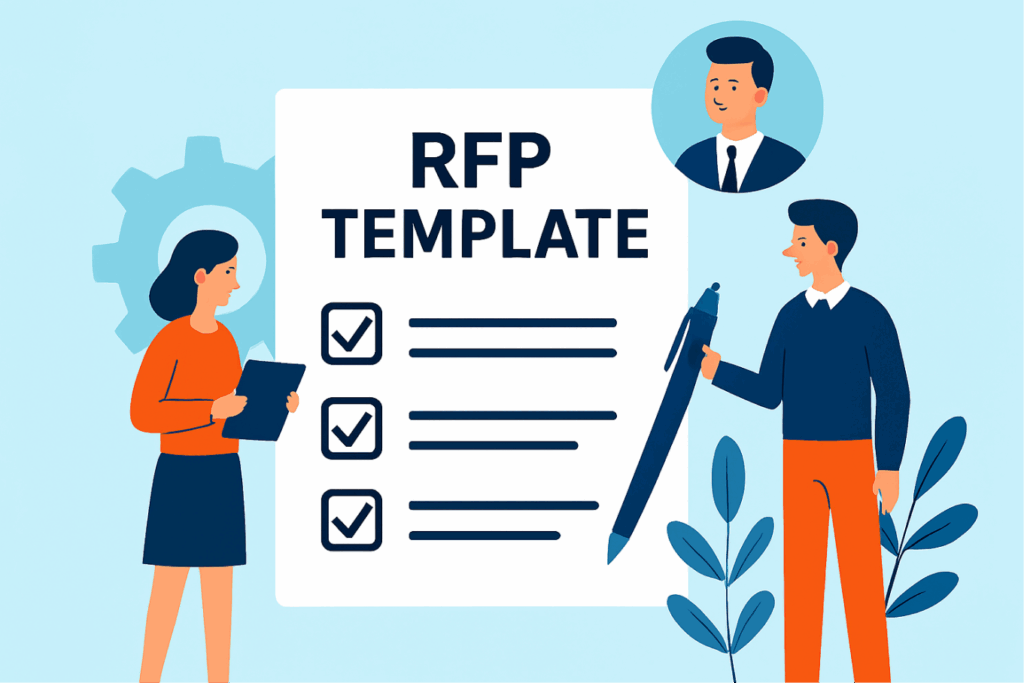
To make the process effortless, we’ve designed a free, editable RFP template tailored for associations managing complex finances across multiple chapters, funds, and programs.
Inside, you’ll find:
- Editable sections for project scope, compliance requirements, and integrations
- Weighted scoring framework to compare vendors objectively
- Example questions for due diligence and follow-up
- Pre-filled prompts designed for finance, accounting, and payments platforms
Each section is written with association finance in mind — so you can adapt it in minutes, not hours.
Get the Template
RFP Sample (Preview of the Template)
Here’s a quick look at the structure you’ll find inside the downloadable document:
Section 1: Association Overview
- Mission, membership size, chapters, and financial governance model
Section 2: Goals and Objectives
- Gain real-time visibility into chapter balances
- Automate reporting and 990 tracking
- Reduce manual reimbursements
Section 3: Scope of Work
- Sub-accounts by chapter, program, or fund
- Budgeted Visa® cards with spending controls
- ACH transfers and automated reconciliation
- AMS or QuickBooks integrations
Section 4: Evaluation Criteria
- FDIC coverage and security standards
- Implementation timeline and onboarding support
- Total cost of ownership
This RFP sample offers both clarity and flexibility — you can expand or condense sections based on project size and board expectations.
How to Draft a Request for Proposal
If you’d rather start from scratch, follow this proven five-step framework:
- Define your financial challenge. Are you consolidating accounts, automating payments, or upgrading compliance tools?
- Clarify goals and KPIs. Decide what success looks like.
- Gather requirements. Include both “must-have” and “nice-to-have” features.
- Set evaluation criteria. Assign weights to cost, functionality, support, and security.
- Distribute and evaluate. Send your RFP to multiple vetted vendors, then score results using a consistent rubric.
Even if your team doesn’t have a dedicated procurement specialist, this method ensures structured, defensible decision-making.
Why 501c6 Association Finance Teams Choose Crowded
When you’re evaluating vendors through an RFP, Crowded should be part of the shortlist.
Crowded is the complete financial platform for associations — combining:
- FDIC-insured digital banking (up to $3M coverage)
- Sub-accounts for chapters, programs, and funds
- Budgeted Visa® cards with built-in spending controls
- Automated reporting and IRS-ready tracking
- Seamless AMS and accounting integrations
With Crowded, 501c6 associations replace fragmented systems with a unified financial infrastructure that delivers transparency, compliance, and control — without sacrificing local autonomy.
[See How Crowded Simplifies Association Finance →]
Final Thoughts
An RFP isn’t just a procurement form — it’s a governance tool.
It creates clarity, safeguards funds, and empowers your team to make decisions grounded in fairness and financial responsibility.
Use the free downloadable RFP template above to bring transparency and accountability to your next vendor search — and set a new standard for financial excellence in your association.
Your questions, answered.
What is a Request for Proposal (RFP)?
A Request for Proposal (RFP) is a formal document associations use to invite vendors to propose solutions for a defined need. It creates clarity, consistency, and transparency throughout the vendor selection process.
Why do associations use RFPs for financial or technology projects?
Associations use RFPs to protect member dues, maintain compliance, and evaluate vendors objectively. An RFP ensures decisions align with governance standards while minimizing financial and operational risk.
What should an association include in an RFP?
A strong RFP typically includes: organizational background, project goals, scope of work, technical/compliance requirements, proposal instructions, evaluation criteria, and terms & conditions. This structure helps vendors submit comparable responses.
How do you write an RFP for association finance?
Start by defining your financial challenge, outlining goals/KPIs, gathering “must-have” requirements, setting a scoring rubric, and distributing the RFP to multiple vendors. This ensures a structured and defensible decision process.
Why should Crowded be considered in an RFP for association finance?
Crowded is built specifically for associations and multi-chapter organizations. It offers:
FDIC-insured digital banking
Sub-accounts by chapter, program, or fund
Budgeted Visa® cards with spending controls
Automated reporting and IRS-ready tracking
Seamless AMS/accounting integrations
These capabilities align directly with the requirements most associations include in their RFPs.