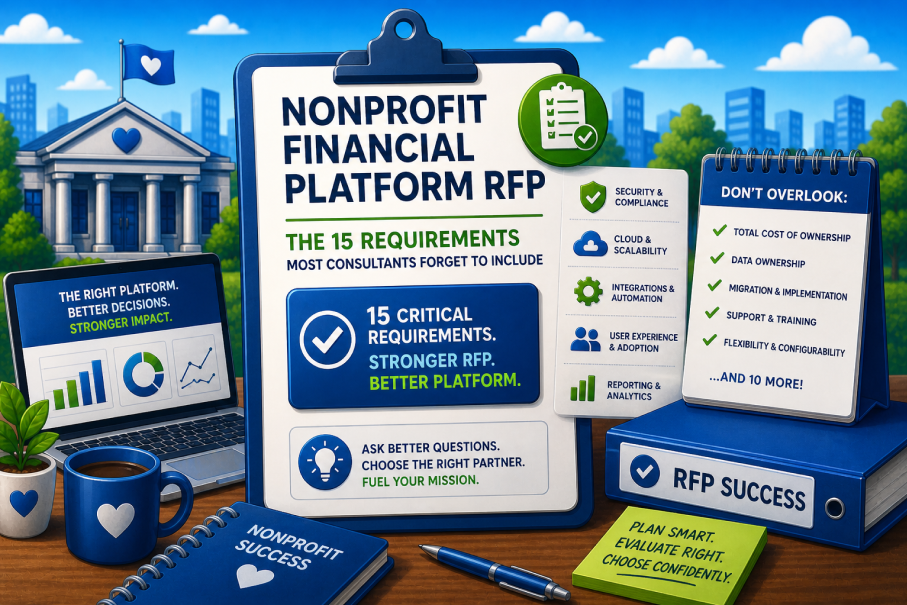
A standard nonprofit financial platform RFP template gets you most of the way there, but the last 20% is where decisions often go wrong.
Many RFPs were built for commercial ERP buyers and only lightly adapted for nonprofits. The result is familiar: a platform gets selected, goes live, and then falls short on fund accounting, multi-chapter permissions, or IRS compliance because the right questions were never asked.
The 15 requirements below are what separate platforms that truly work from those that create audit risk, compliance gaps, and years of manual fixes.
TL;DR
- Most nonprofit RFPs miss the real requirements. Many are adapted from commercial ERP templates and overlook core nonprofit needs, such as fund accounting, compliance, and entity structure.
- The biggest gaps fall into four areas. Compliance and entity structure; grant controls; reporting and transparency; and operations and vendor risk.
- Native matters are more than configurable. A built-in feature is not the same as a workaround or a third-party add-on, especially during an audit or compliance review.
- Data portability is non-negotiable. Without a contract-backed export clause, switching platforms can become expensive, risky, and operationally painful.
- Purpose-built platforms have the advantage. Crowded was designed for nonprofit operations from day one, with banking, payments, IRS verification, and 990 workflows in one system.
What Is the RFP Process in Consulting: And Why Does It Break Down for Nonprofits?
A Request for Proposal (RFP) is a formal document used to solicit vendor bids. In consulting-led engagements, consultants typically manage the process and evaluate vendors against defined requirements.
The issue is structural. Most RFP frameworks were built for commercial software buyers. Critical needs like group exemption oversight, restricted fund tracking, and 990-ready reporting are often missing or treated as optional. That gives vendors room to offer workarounds instead of real solutions.
Grant compliance is where this gap becomes most visible. It requires strict adherence to federal rules, fund accounting standards, and detailed documentation. Platforms not designed for this from the start often rely on customization, add-ons, or manual processes, which introduce audit risk.
The 15 requirements below separate platforms that actually support nonprofit operations from those that create compliance issues the moment they go live.
The 15 Requirements Most Consultants Leave Out of a Nonprofit Financial Platform RFP
For enterprise nonprofits, federations, and multi-chapter associations, these are the requirements that determine whether a platform actually works.
Group 1: Compliance & Entity Structure
1. Group Exemption Compatibility
The platform must support IRS group exemption structures for parent organizations and subordinate chapters. For federations and associations under a central determination letter, this is essential.
2. Multi-Entity Account Structure
Enterprise nonprofits need sub-accounts for each chapter, team, or program, with separate controls, spending limits, and card access, all in one central dashboard. Permissions should limit local users to their own entity.
3. IRS Status Verification at Disbursement
The platform should verify a recipient nonprofit’s 501(c)(3) status in real time before funds are sent. This helps prevent payments to organizations that have lost tax-exempt status.
4. 990-Ready Reporting
The system should produce financial data already structured for Form 990 reporting, including functional expense allocations, and ideally support e-filing for 990-N, 990-EZ, and Form 990.
5. Native Fund Accounting
The platform must support true fund accounting, with separate treatment of unrestricted and restricted funds. If it relies on class or dimension workarounds.
Group 2: Grant & Expenditure Controls
6. Grant Lifecycle Management
Grant agreements should be linked directly to the general ledger, with automatic spending blocks when a grant expires or reaches its budget limit.
7. Automated Release of Restricted Funds
The platform should automatically release restricted funds based on time, milestones, or invoice triggers. Manual releases are a red flag.
8. Uniform Guidance Compliance
For federal awards, the system should support 2 CFR 200 requirements natively, including cost tracking, subrecipient monitoring, and SEFA reporting.
9. Indirect Cost Allocation Engine
The platform should allocate shared overhead through rules-based logic and support scenario modeling to improve reimbursement accuracy.
Group 3: Reporting & Transparency
10. Real-Time Functional Expense Reporting
The platform should generate the Statement of Functional Expenses in real time, without manual Excel work.
11. Program-Level P&L with Revenue Attribution
Restricted revenue should be tied directly to the programs it supports, alongside direct and allocated expenses.
12. Immutable Audit Trails
No transaction should be deletable. The system must keep a complete audit log of every change across all sub-ledgers.
Group 4: Operations & Vendor Risk
13. Conditional Workflow Approvals
Approval workflows should route transactions based on fund type, amount, or risk level.
14. In-Kind Donation Tracking
The platform should track and recognize in-kind contributions in a GAAP-compliant way, without relying on separate spreadsheets.
15. Data Portability
Vendors should guarantee full export of ledger data, attachments, and audit logs in a non-proprietary format at contract end, with no extra cost.
How to Score These Requirements in Your Nonprofit Financial Platform RFP
When evaluating vendor proposals against your nonprofit financial platform RFP, the key distinction is whether they ship out of the box. Use a simple scoring framework:
Requirement Category | Native/Built-In | Configurable Add-On | Requires Third Party |
Score Weight | 3 points | 1 point | 0 points |
Any proposal that requires extensive customization to meet requirements in Group 1 (Compliance & Entity Structure) should be flagged as non-compliant. These are structural requirements. A vendor who leads with “we can build that” on group exemption compatibility or fund accounting architecture is telling you their platform wasn’t designed for your organization.
Download the Nonprofit Financial Platform RFP Checklist
Applying these 15 requirements manually across multiple vendor proposals takes time your procurement process doesn’t have.
The Nonprofit Financial Platform RFP Checklist puts every requirement above into a structured evaluation format, organized by category, pre-weighted by compliance risk, and ready to send to vendors or share with your board.
Use it to:
- Score vendor responses against native vs. configurable vs. third-party capability
- Flag non-compliant proposals before they reach the final round
- Document your evaluation process for audit and governance purposes
- Align your team and consultants on what “good” actually looks like
The checklist is free. The cost of selecting the wrong platform is not.
Get the Free Template
Why Crowded Was Built for These Requirements
Most nonprofit financial platforms were not built with nonprofit compliance in mind from the start. Many began as general-purpose accounting tools, commercial banking products, or payment processors, with nonprofit-specific needs added later through integrations, workarounds, paid add-ons, or manual maintenance.
Crowded was designed for a different operating reality: multi-chapter nonprofits, federations, and associations that need local financial access without losing control at the headquarters level.
Crowded brings the most important financial and compliance functions into one CFO suite:
- Banking, payments, and spending controls
- Chapter-level sub-accounts with granular permissions
- Real-time IRS status verification
- Centralized 990 workflows for 990-N, 990-EZ, and full Form 990
- Group exemption management through the Chapter Tracker dashboard
That matters because multi-chapter organizations need more than disconnected tools. They need to know who controls each account, where funds sit, whether local activity is compliant, and which filings are due.
So when an RFP asks whether a capability is native or retrofitted, Crowded’s answer on nonprofit-specific requirements is clear: built in from day one.
Choosing the Wrong Nonprofit Financial Platform Starts With a Weak RFP
The gap in most nonprofit financial platform RFPs is the 15 requirements outlined above, which reflect how nonprofit finance actually works: restricted funds with compliance strings attached, federated structures that require simultaneous centralization and decentralization, and reporting obligations that differ fundamentally from commercial accounting.
The most successful nonprofit organizations recognize that compliance is about building systems that support sustainable mission delivery. Consultants who surface these requirements early in the nonprofit financial platform RFP process protect their clients from costly mid-implementation surprises. Platforms that meet them natively are rare. Identifying them before the contract is signed is what separates a successful procurement from an expensive lesson.
Your questions, answered.
How long does the RFP process usually take?
For enterprise nonprofits and multi-chapter associations, it usually takes 10 to 16 weeks from issuance to vendor selection. Rushing often leads to missed compliance requirements that only show up after implementation.
What is the difference between a nonprofit financial platform and standard accounting software?
Standard accounting tools are built for for-profit finance. Nonprofit platforms are built for fund accounting, grant management, Form 990 reporting, and other compliance needs. Crowded also combines banking, payments, and compliance into a single system.
How many vendors should be invited to respond?
A strong range is four to six vendors. That gives enough competition without overwhelming the evaluation process.
Can a nonprofit use a general-purpose banking platform instead?
Yes, but it usually creates more manual work. Most general platforms do not support restricted funds, group exemption structures, or 990 workflows, so teams end up relying on extra tools and spreadsheets.
What if a vendor scores well but fails on data portability?
Treat that as a dealbreaker. If a vendor cannot guarantee full export of your financial data and audit logs in a usable format, the organization faces long-term lock-in risk.