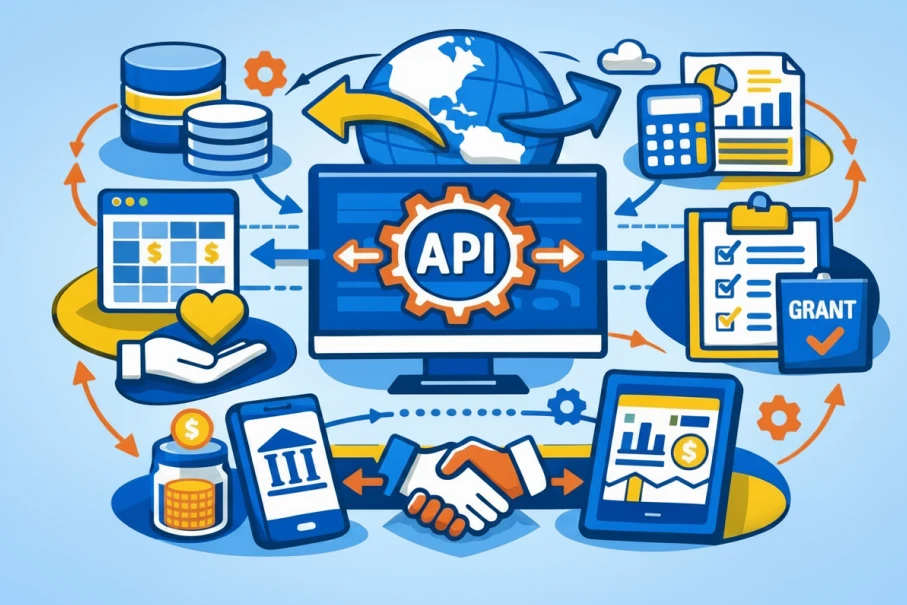
Nonprofit finance API integrations are the connective tissue between donor systems, accounting platforms, payment processors, and banking infrastructure, allowing financial data to move automatically, securely, and in real time without manual intervention. In 2026, platforms that lack nonprofit finance API integrations lose visibility, compliance control, and ultimately, trust.
Across the nonprofit ecosystem, AMS vendors, grant platforms, and SaaS providers, the stack is still stitched together too often with spreadsheets, CSV uploads, and delayed reconciliations. The cost is a compliance risk, reporting inaccuracies, and missed opportunities to act on real-time financial data.
The question is no longer whether to implement nonprofit finance API integrations, but rather how to do so. It’s which ones are table stakes and which ones define category leaders.
TL;DR
- Nonprofit finance API integrations are now baseline infrastructure. If your platform still relies on manual reconciliation or disconnected systems, you’re already behind on compliance, reporting accuracy, and scalability.
- Five API categories are non-negotiable: banking, accounting sync, payments, disbursements, and tax verification. These integrations eliminate operational friction and ensure fund-level accuracy across every transaction.
- The real gap is interoperability. Most platforms have the pieces but lack real-time data flow between them, creating hidden risks in audits, reporting, and multi-entity oversight.
- Differentiator APIs (like spend controls, grant tracking, and AI monitoring) drive retention and platform stickiness. They embed financial workflows directly into your product, making switching costly and adoption deeper.
- Crowded* delivers the entire financial layer in one integration, so you don’t have to build it. For AMS vendors and nonprofit SaaS platforms, this means going live in weeks, with compliance, payments, and reporting already built in.
Why Nonprofit Finance API Integrations Are Non-Negotiable in 2026
Nonprofit finance API integrations are now the foundation of platform interoperability, enabling systems to communicate in real time while preserving fund restrictions, program tags, and compliance logic.
APIs (Application Programming Interfaces) make this possible. Unlike legacy EDI (Electronic Data Interchange), which is batch-based and rigid, APIs are real-time, flexible, and built for modern SaaS ecosystems. In 2026, EDI is a workaround. APIs are the infrastructure.
Four API types power nonprofit finance API integrations:
- Open APIs – Public access (Plaid, Stripe)
- Partner APIs – Platform-to-platform integrations
- Internal APIs – Power internal workflows
- Composite APIs – Combine multiple services into one call
In practice, nonprofit finance API integrations look like this: a donation is entered into a CRM, categorized correctly, synced to the general ledger, and reflected in dashboards without human intervention.
The Table-Stakes Nonprofit Finance API Integrations
These nonprofit finance API integrations are non-negotiable. Without them, platforms cannot scale or maintain compliance.
1. Open Banking & Bank Data API (FDX-Aligned)
- What it does: Provides real-time access to balances, transactions, and account verification via providers like Plaid or Yodlee.
- Why it’s non-negotiable: Manual reconciliation is no longer viable. FDX-aligned data access has become the standard for real-time financial visibility.
- Use case: A nonprofit platform reconciles grant disbursements instantly on an end-of-month lag.
2. Accounting / Fund Accounting Sync API
- What it does: Creates bi-directional sync between CRMs and accounting systems like Sage Intacct or QuickBooks Nonprofit.
- Why it’s non-negotiable: Fund accounting requires strict tracking of restricted vs. unrestricted funds. Without nonprofit finance API integrations at this layer, compliance breaks.
- Use case: A restricted donation automatically maps to the correct fund and program in the general ledger.
3. Payment Processing & Donation API
- What it does: Handles donations, recurring payments, refunds, and reconciliation through platforms like Stripe or PayPal.
- Why it’s non-negotiable: Webhook-driven updates eliminate reconciliation delays and ensure real-time financial accuracy.
- Use case: A canceled recurring gift instantly updates both CRM and accounting records.
4. Disbursement / Mass Payments API
- What it does: Automates payments across ACH, wire, and global rails for grants, stipends, and reimbursements.
- Why it’s non-negotiable: Manual payment workflows collapse at scale. Modern nonprofit finance API integrations must include automated tax form handling and validation.
- Use case: A milestone triggers payments to 50 grantees, fully automated, fully compliant.
5. Tax Status & Identity Verification API
- What it does: Verifies tax-exempt status, retrieves IRS Form 990 data, and performs KYC/AML checks.
- Why it’s non-negotiable: Real-time compliance verification is now expected. Manual checks cannot scale as the platform grows.
- Use case: A disbursement is automatically blocked if a nonprofit has lost its tax-exempt status.
The Differentiator Layer of Nonprofit Finance API Integrations
These nonprofit finance API integrations define market leaders.
Differentiator API | What It Unlocks |
Grant Lifecycle API | Tracks multi-year restricted funds and compliance |
Donor CRM API | Full donor lifecycle synced with financial data |
Embedded Spend API | Program-level cards with budget controls |
Reporting API | Real-time dashboards and financial health metrics |
AI Automation API | Forecasting, anomaly detection, and compliance alerts |
Platforms that implement these nonprofit finance API integrations reduce churn, increase retention, and embed themselves deeper into customer workflows.
Table Stakes vs. Differentiators in Nonprofit Finance API Integrations
API Category | Table Stakes | Differentiator |
Bank data/reconciliation | ✅ | |
Accounting sync | ✅ | |
Payment processing webhooks | ✅ | |
Mass disbursements + tax forms | ✅ | |
Tax status verification | ✅ | |
Grant lifecycle tracking | ✅ | |
Embedded spend cards | ✅ | |
Real-time dashboards | ✅ | |
AI forecasting & anomaly detection | ✅ |
How Crowded Delivers Nonprofit Finance API Integrations Out of the Box
For AMS vendors and nonprofit platforms, building nonprofit finance API integrations internally requires banking partnerships, compliance infrastructure, fraud systems, and regulatory oversight, often taking 12–18 months before launch.
This is where most platforms stall.
Crowded solves this by delivering a complete financial infrastructure layer through a single integration. Instead of assembling multiple providers, platforms can embed nonprofit finance API integrations directly into their product.
- FDIC-insured sub-accounts for multi-entity nonprofits
- Real-time webhooks for transaction-level visibility
- Built-in IRS compliance monitoring and reporting
- Embedded spend management with program-level controls
- Flexible monetization through financial activity
Nonprofit Finance API Integrations Are the New Baseline
In 2026, nonprofit finance API integrations are no longer optional infrastructure; they are the baseline for scale, compliance, and platform credibility. Five API categories define the operational minimum. Another layer defines market leaders.
For AMS vendors, grant platforms, and nonprofit SaaS providers, the fastest path forward is embedding them.
See how Crowded powers nonprofit finance API integrations or book a demo to explore the platform in action.
* Crowded Technologies Inc is a financial technology company and is not a bank. Banking services provided by i3 Bank; Members FDIC. The Crowded Technologies Inc. Visa® Debit Card is issued by i3 Bank pursuant to a license from Visa U.S.A. Inc. and may be used everywhere Visa debit cards are accepted.
Frequently Asked Questions
What are nonprofit finance API integrations in simple terms?
Nonprofit finance API integrations connect systems such as donor CRMs, accounting platforms, payment processors, and banking infrastructure, enabling financial data to flow automatically in real time. Instead of exporting spreadsheets or reconciling manually, platforms operate on a shared, synchronized financial layer.
Why are nonprofit finance API integrations critical for compliance?
Because compliance depends on consistency across systems, fund restrictions, donor intent, and IRS reporting classifications must match across the entire system from CRM to general ledger to reporting dashboards. Platforms like Crowded enforce this at the infrastructure level, so compliance is built into how transactions are recorded and categorized.
What happens if a platform doesn’t implement these integrations?
Without nonprofit finance API integrations, teams rely on manual reconciliation, delayed reporting, and fragmented data. This leads to errors in fund tracking, delayed audits, and increased compliance risk, especially for multi-entity nonprofits that manage chapters, programs, or restricted funds.
Are all nonprofit finance API integrations equally important?
No. Some are table stakes, such as banking data, accounting sync, payments, disbursements, and tax verification. Others, like grant lifecycle tracking or embedded spend controls, are differentiators that improve operational efficiency and platform retention. Crowded delivers both layers through a single integration, removing the need to prioritize tradeoffs.
How do nonprofit finance API integrations improve reporting accuracy?
They eliminate timing gaps and data mismatches. When transactions are synced in real time across systems, financial reports reflect actual activity. This is especially critical for board reporting, audit preparation, and tracking restricted fund usage across programs.
What role does real-time data play in nonprofit finance today?
Real-time data is now the baseline. Finance teams and platform operators are expected to act on current financial positions. Nonprofit finance API integrations enable this by syncing transactions, balances, and classifications instantly across systems.
How does Crowded simplify nonprofit finance API integrations for platforms?
Crowded provides a unified financial infrastructure layer that combines banking, payments, disbursements, compliance, and reporting into a single API. Instead of integrating multiple vendors, platforms can embed everything at once, with built-in support for fund accounting, multi-entity structures, and IRS compliance workflows.
Can nonprofit finance API integrations support multi-chapter or multi-entity organizations?
Yes, and this is where they matter most. Multi-entity nonprofits require visibility across chapters, programs, and funds. Crowded’s architecture supports FDIC-insured sub-accounts and centralized oversight, enabling platforms to manage distributed financial activity without losing control or alignment with compliance requirements.
How do these integrations reduce operational workload for finance teams?
They eliminate repetitive tasks such as CSV uploads, manual reconciliations, and duplicate data entry. With nonprofit finance API integrations in place, workflows such as donation tracking, disbursement processing, and reporting run automatically, freeing finance teams to focus on oversight and strategy.
What’s the fastest way for a platform to implement nonprofit finance API integrations?
Building internally can take 12–18 months due to banking partnerships, compliance requirements, and engineering complexity. Platforms that embed infrastructure providers like Crowded can go live in weeks, gaining immediate access to a fully integrated financial layer without building it from scratch.