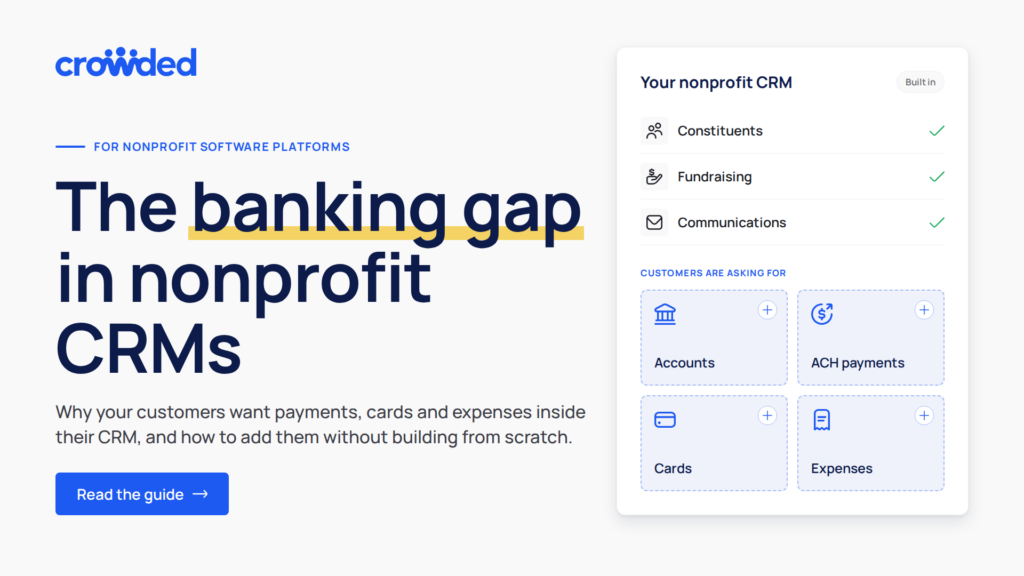
The growing conversation around nonprofit CRM limitations banking reflects a major shift in customer expectations. Most nonprofit CRM platforms were built to manage relationships, fundraising, volunteer engagement, and communications, but organizations increasingly expect those same platforms to support financial workflows as well.
Customers are no longer asking only for better donor records or campaign reporting. They want to pay vendors, issue reimbursements, manage chapter finances, and monitor spending without leaving the CRM. For many software providers, these requests sit outside the platform’s original product vision, yet they continue to appear on product roadmaps.
The challenge is that nonprofit operations have evolved. Organizations want fewer disconnected systems and more unified workflows that bring financial and operational activities together. As embedded finance becomes more common across SaaS, nonprofit customers increasingly expect the same connected experience from the software they already trust.
TL;DR
- Nonprofit CRM customers are increasingly asking for banking, cards, expense management, grant disbursements, and real-time financial visibility.
- These requests expose a growing product gap: traditional CRMs were built for relationships and fundraising.
- Building banking in-house can require significant engineering, compliance, security, and partnership resources, diverting teams from the core CRM roadmap.
- Embedded banking enables nonprofit software platforms to accelerate the addition of financial capabilities while improving product value, adoption, and retention.
- Crowded helps nonprofit CRMs close these gaps with nonprofit-focused accounts, payments, cards, controls, and multi-entity financial infrastructure.
Why Nonprofit CRM Limitations Banking Has Become a Growing Product Challenge
The nonprofit technology landscape has changed significantly over the past decade.
Organizations once accepted using separate systems for donor management, banking, accounting, expense reporting, and payments. Today, that fragmented approach creates unnecessary work for already lean teams. Finance staff spend time reconciling transactions across platforms, executive directors switch between multiple dashboards, and chapter leaders rely on spreadsheets to manage local finances.
As organizations look to simplify operations, their expectations of CRM platforms have expanded.
Instead of asking, “Can this CRM manage donors?” they’re asking broader operational questions, such as:
- Can we pay vendors directly from the platform?
- Can staff submit expense reimbursements here?
- Can chapter leaders receive controlled spending cards?
- Can grants be approved and distributed without exporting data?
- Can we monitor financial activity alongside constituent information?
- Can our finance and operations teams work from the same platform?
These requests reflect a broader shift in nonprofit software. Customers increasingly value connected workflows over disconnected feature sets.
The rise of embedded finance has also influenced these expectations. Across many industries, software platforms now allow users to manage payments, banking, and expenses without leaving the application. Nonprofit organizations are beginning to expect the same level of convenience from the software they use every day.
For CRM providers, this creates both an opportunity and a challenge. Customers clearly want more financial capabilities, but delivering regulated financial services requires expertise that extends well beyond traditional CRM development.
The Financial Capabilities Nonprofit CRM Customers Now Expect
When discussing nonprofit CRM financial features, it’s important to recognize that customers aren’t asking for banking services just because they’re new. They’re asking because these capabilities solve everyday operational problems.
Here are the financial capabilities that increasingly appear in customer conversations.
Banking That Matches Organizational Structure
Many nonprofit organizations don’t operate from a single bank account.
Associations oversee chapters. Fiscal sponsors manage multiple sponsored projects. Foundations administer numerous funds. National nonprofits coordinate regional offices.
Customers increasingly want banking structures that reflect how their organizations actually operate, including:
- Organization operating accounts
- Program or project accounts
- Chapter-specific accounts
- Restricted fund accounts
- Designated purpose accounts
Instead of forcing finance teams to manage separate banking relationships outside the CRM, customers want financial accounts that align with their organizational structure.
Embedded Payments Without Leaving the CRM
Payment workflows are becoming an expected part of nonprofit software.
Organizations increasingly ask for the ability to:
- Send ACH payments
- Transfer funds
- Pay vendors
- Process reimbursements
- Move money between projects
- Disburse grants
Without these capabilities, users often export data into separate banking portals, increasing administrative work and creating additional opportunities for manual errors.
Expense Management That Supports Daily Operations
Expense management has evolved beyond simple reimbursement forms.
Today’s nonprofit organizations increasingly expect:
- Receipt capture
- Expense categorization
- Multi-step approval workflows
- Budget visibility
- Reimbursement tracking
- Spend controls
Rather than managing expenses across multiple systems, finance teams want connected workflows that reduce manual reconciliation while improving oversight.
Physical and Virtual Cards for Distributed Teams
Many nonprofit organizations operate through regional offices, chapters, volunteers, or program managers.
To support distributed spending, customers increasingly request:
- Physical debit cards
- Virtual cards
- Department spending cards
- Volunteer cards
- Merchant restrictions
- Spending limits
- Approval controls
These capabilities allow organizations to delegate spending while maintaining financial accountability.
Grant and Fund Disbursements
For foundations, fiscal sponsors, and grantmaking organizations, moving money is a core operational workflow.
Customers increasingly want software that supports:
- Grant approvals
- Fund disbursements
- Payment tracking
- Audit trails
- Allocation reporting
- Approval history
Managing grants across disconnected systems slows operations and complicates financial reporting.
Chapter Financial Management
Chapter-based organizations often face some of the most complex financial challenges.
Associations, Greek organizations, faith-based nonprofits, and multi-location organizations typically need:
- Separate financial accounts
- Local spending authority
- Permission-based access
- Organization-wide visibility
- Centralized oversight
Without dedicated financial infrastructure, chapter reporting often depends on spreadsheets, email approvals, and manual reconciliation.
Real-Time Financial Reporting
Modern nonprofit leaders increasingly expect financial information to be available alongside operational data.
Rather than waiting for month-end reports, organizations want real-time visibility into:
- Account balances
- Budget performance
- Expenses
- Payment status
- Grant utilization
- Chapter spending
- Cash position
Connected reporting helps finance leaders make faster decisions while reducing the time spent gathering information from multiple systems.
Why Most Nonprofit CRMs Weren’t Designed to Become Financial Platforms
The growing demand for financial capabilities doesn’t mean nonprofit CRMs were built incorrectly.
It simply reflects the fact that CRM platforms and financial infrastructure were designed to solve different problems.
Traditional nonprofit CRMs excel at:
- Constituent management
- Fundraising
- Donor engagement
- Volunteer management
- Marketing automation
- Relationship tracking
Banking infrastructure, however, introduces a layer of complexity entirely different from the others.
Supporting financial services requires secure money movement, banking partnerships, Know Your Customer (KYC) and Know Your Business (KYB) verification, payment processing, ledger infrastructure, fraud prevention, card issuing, reconciliation, compliance monitoring, and ongoing regulatory oversight.
These are highly specialized capabilities that extend well beyond the responsibilities of a traditional CRM.
Understanding these nonprofit CRM limitations and banking challenges helps explain why many platforms continue to rely on external financial providers rather than building regulated banking services internally.
Why More CRM Platforms Are Choosing Embedded Banking Instead of Building It
For many nonprofit software companies, building banking functionality from scratch seems appealing at first.
In reality, it often requires years of engineering investment, significant compliance expertise, ongoing maintenance, and long-term banking partnerships.
Beyond the technical work, product teams must also consider:
- Regulatory obligations
- Fraud monitoring
- Customer onboarding
- Security requirements
- Payment operations
- Continuous platform maintenance
Every engineering sprint dedicated to financial infrastructure is time not spent improving fundraising, donor engagement, reporting, automation, or customer experience.
That’s why many SaaS platforms are adopting embedded banking rather than building their own banking systems.
Embedded banking allows software companies to integrate regulated financial capabilities directly into their platforms while remaining focused on the products they know best.
Rather than becoming financial institutions, CRM providers can extend their platforms with financial workflows that customers increasingly expect.
Expand Your CRM’s Financial Capabilities Without Building Banking From Scratch
For nonprofit CRM providers, the objective isn’t to become a bank.
It’s to create a unified experience that lets nonprofit organizations manage relationships and financial operations without constantly switching between disconnected systems.
Crowded provides embedded financial infrastructure purpose-built for nonprofit software platforms, making it possible to integrate financial capabilities directly into an existing CRM experience instead of rebuilding banking infrastructure from the ground up.
Depending on a platform’s needs, Crowded Embedded Banking can support capabilities such as:
- Digital nonprofit bank accounts
- Embedded ACH payments and transfers
- Physical and virtual cards
- Built-in expense management
- Approval workflows
- Permission-based financial controls
- Chapter and multi-entity financial management
- Grant and fund disbursement support
- Real-time financial visibility
- Developer-friendly APIs
- Embeddable financial components
By embedding these capabilities into their products, nonprofit CRM providers can expand the value of their platforms while continuing to focus on fundraising, constituent engagement, volunteer management, and other core CRM functionality.
Instead of stitching together multiple financial providers, platforms can deliver a connected experience that helps customers manage banking, payments, expenses, approvals, and financial oversight from one place.
The Future of Nonprofit Software Is More Connected Financial Infrastructure
The conversation around nonprofit CRM limitations in banking isn’t about replacing CRM platforms with banking software.
It’s about recognizing how nonprofit organizations increasingly want to work.
As operational complexity grows, customers expect fewer disconnected systems and more unified experiences. They want software that supports fundraising, relationships, payments, expenses, financial oversight, and reporting without forcing staff to move between multiple applications.
For nonprofit CRM providers, meeting these expectations doesn’t necessarily require becoming a financial institution. It requires delivering financial workflows that fit naturally within the customer experience.
Platforms that reduce operational friction will be better positioned to increase engagement, strengthen customer retention, and become indispensable partners to the nonprofit organizations they serve. Embedded banking makes that evolution possible without requiring CRM providers to build regulated financial infrastructure from scratch.
Frequently Asked Questions
Can a nonprofit CRM replace accounting software?
No. A CRM manages relationships and fundraising, while accounting software handles financial records, statements, and compliance.
What is embedded banking for nonprofit software?
Embedded banking enables nonprofit platforms to offer accounts, payments, cards, and expense tools directly within their software.
How can embedded banking improve CRM retention?
It reduces the need for separate tools, creates a more complete workflow, and can make the CRM more valuable to customers.
Does adding banking features make a CRM a bank?
No. CRM platforms can work with embedded banking providers that supply the regulated financial infrastructure.
What should CRM providers look for in an embedded banking partner?
Look for flexible APIs, security, compliance support, scalability, and nonprofit-specific capabilities. Crowded helps platforms embed financial workflows without building banking infrastructure from scratch.
Can embedded banking support chapters and complex nonprofit structures?
Yes. Crowded can support separate accounts, permission-based access, and centralized visibility across chapters, projects, and entities.