A nonprofit audit checklist is a structured list of financial records, governance documents, internal controls, grant files, reconciliations, and compliance evidence needed for an audit of a nonprofit organization’s finances. For large nonprofits, the checklist should assign owners, entities, due dates, storage links, and risk levels to enable operational audit prep.
TL;DR
- A nonprofit audit checklist helps CFOs and finance leaders move audit prep from last-minute document chasing to a controlled, owner-driven process.
- Large nonprofits rarely fail audits because documents do not exist; they struggle because records are scattered across chapters, systems, and teams.
- The most important audit materials include financial statements, reconciliations, Form 990, board minutes, payroll records, grant agreements, restricted fund evidence, and internal control documentation.
- Preparing for a nonprofit audit should start at least 90 days before fieldwork, with clear owners, deadlines, PBC tracking, and centralized storage.
- Crowded helps multi-entity nonprofits strengthen audit readiness by improving visibility, fund-level control, and financial oversight before auditors arrive.
The Audit Doesn’t Start When Auditors Arrive
The audit does not begin when the auditors send the PBC list. It begins months earlier, when the CFO realizes the chapter bank reconciliations live in three folders, grant agreements are split across programs and finance, board approvals are buried in meeting packets, and no one can confirm whether every entity’s payroll tax records are complete.
That is where audit risk actually lives. Large nonprofits rarely struggle because they have no documents. They struggle because they cannot consistently, quickly, and completely produce the right documents across chapters, affiliates, programs, and restricted funds.
A strong nonprofit audit checklist turns audit prep from a scramble into a system. It helps finance leaders see what exists, what is missing, who owns it, and where risk is concentrated before the auditors ask.
What Happens If a Nonprofit Fails an Audit?
A failed or delayed audit can create financial, operational, and compliance consequences that extend far beyond the audit report.
Financial Impacts
Grantors, lenders, government agencies, and major donors may delay or restrict funding if audited financial statements are late, incomplete, or contain material findings. A foundation waiting on clean financials may pause disbursements. A government contract may require additional documentation before reimbursement.
Operational Impacts
Finance teams lose weeks rebuilding records, chasing chapters, reconciling accounts, and explaining inconsistencies. Board members may question whether management has enough visibility into the organization’s financial position.
Compliance Impacts
For a 501(C)(3), audit issues can create exposure around Form 990 reporting, restricted fund treatment, related-party transactions, and governance disclosures. The audit itself does not replace Form 990, but a weak audit support can reveal the same documentation gaps that later affect tax reporting.
In other words, the audit finding is usually the symptom. The real issue is often fragmented financial operations.
What Is Included in a Nonprofit Audit?
A nonprofit audit usually reviews financial statements, supporting records, controls, governance documentation, and compliance evidence.
Nonprofit Financial Audit
A nonprofit financial audit examines whether the organization’s financial statements are fairly presented in accordance with applicable accounting standards. Auditors review revenue, expenses, assets, liabilities, net assets, reconciliations, estimates, and disclosures.
Compliance Audit
A compliance audit reviews whether the nonprofit complied with specific rules governing grants, donor restrictions, contracts, laws, or internal policies.
Single Audit
A Single Audit applies to organizations that spend a required threshold of federal awards during the fiscal year. It focuses on both financial reporting and federal program compliance.
The 5 C’s of Audit Findings
The 5 C’s help explain audit issues:
- Criteria: What rule, policy, or standard applied?
- Condition: What actually happened?
- Cause: Why did it happen?
- Consequence: What risk or impact resulted?
- Corrective action: What must change?
The 7 Elements of Audit
At a high level, auditors assess planning, risk, evidence gathering, testing, documentation, reporting, and follow-up. For nonprofit finance teams, this means the audit is about proving the organization has reliable systems.
The Nonprofit Audit Checklist — 14 Documents Commonly Missing
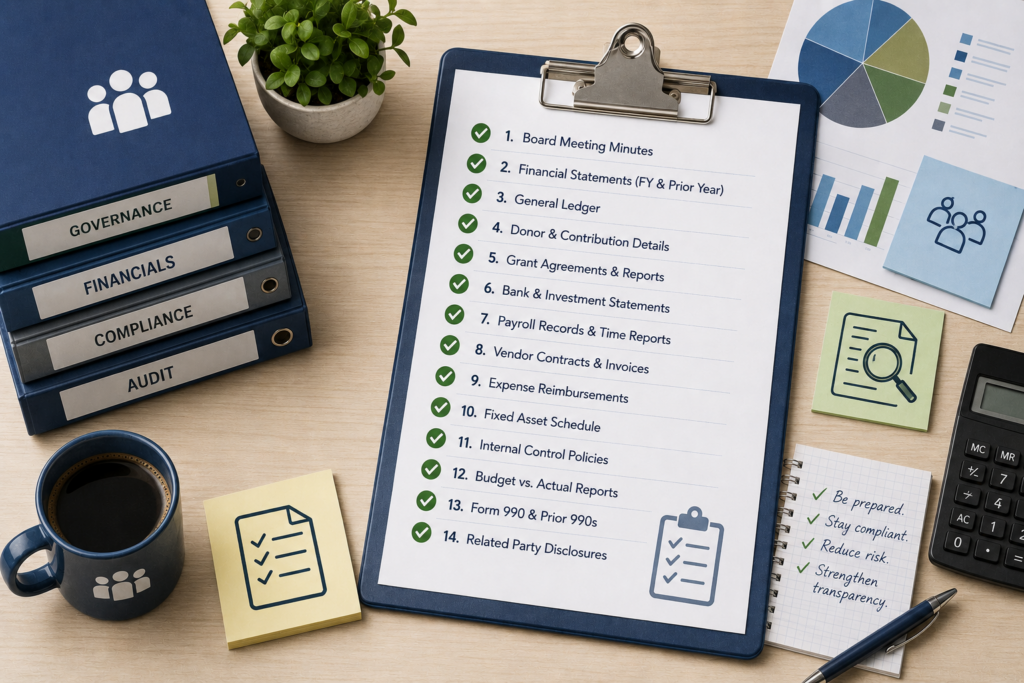
The Crowded checklist template is designed to track 14 core audit documents across owners, departments, entities, or chapters, fiscal years, storage links, review status, and risk level. It also includes tabs for internal controls, audit timelines, PBC requests, and restricted funds/grants tracking.
A. Core Financial Statements and Ledgers
- Prior-year audited financial statements: Auditors ask for these to compare balances, confirm prior-year adjustments, and understand unresolved findings.
- General ledger and full trial balance: The backbone of the audit. Auditors use it to trace transactions, test balances, and tie entity-level activity to consolidated financials.
- Bank statements and reconciliations: Auditors need proof that cash balances are complete and accurate across all accounts, including chapter, sweep, reserve, and money-market accounts.
B. Governance and Tax Records
- Board-approved budget vs. actuals: Auditors review whether financial performance aligns with approved plans and whether major variances were monitored.
- Filed IRS Form 990 for the prior year: Auditors use Form 990 to compare public tax reporting with audited financials, governance disclosures, and program expense classifications.
- Organizational chart and entity structure: For multi-entity nonprofits, this confirms which chapters, subsidiaries, affiliates, and related entities should be included.
- Board and committee meeting minutes: Auditors review approvals for budgets, loans, compensation, restricted fund actions, conflicts of interest, and major financial decisions.
C. Payroll, Payables, Receivables, and Vendors
- Payroll records and payroll tax returns: These support compensation expense, employee classifications, tax filings, and benefit-related liabilities.
- Accounts payable aging and vendor list: Auditors use this to test liabilities, vendor concentration, related parties, and year-end cutoff.
- Accounts receivable aging and pledges receivable: This supports collectability, allowance estimates, donor commitments, and revenue recognition.
D. Grants, Restricted Funds, and Investments
- Grant award letters and executed agreements: Auditors need these to verify restrictions, allowable costs, performance periods, reporting terms, and revenue treatment.
- Investment and endowment statements: These support fair value, compliance with endowment restrictions, spending policy, and investment disclosures.
E. Assets, Leases, and Long-Term Obligations
- Fixed asset schedule and depreciation detail: Auditors test additions, disposals, useful lives, depreciation expense, and capitalization policy compliance.
- Lease agreements and ASC 842 schedules: Auditors need lease contracts and right-of-use asset/liability schedules to confirm proper recognition and disclosure.
Step-by-Step Timeline for Preparing for a Nonprofit Audit
- 90 Days Before the Audit: Assign an audit liaison, confirm the engagement letter, distribute the checklist, update fixed assets, and begin inter-entity reconciliation.
- 60 Days Before the Audit: Complete bank reconciliations, prepare trial balances by entity, compile grant files, reconcile investments, and finalize restricted versus unrestricted net asset rollforwards.
- 30 Days Before the Audit: Submit PBC items, schedule fieldwork, conduct an internal controls walkthrough, and resolve missing owner assignments.
- During the Audit Period: Give auditors clean portal access, respond to requests through a single tracker, and avoid side-channel document delivery.
The centralization insight is simple: audit prep fails when every department has its own system. A strong checklist centralizes evidence, ownership, status, and risk level into a single operating view.
Turning Audit Prep Into Continuous Readiness
Audit prep should be the byproduct of clean financial operations. When audit documents are missing, diagnose the system cause:
- Are chapter accounts reconciled monthly?
- Are restricted funds tagged at the transaction level?
- Are approvals stored with the transaction?
- Are grant agreements connected to spending activity?
- Are PBC requests tracked centrally?
- Are internal controls tested before the audit?
A nonprofit internal controls checklist helps, but only if the controls are backed by real evidence.
How Crowded Supports Audit Readiness
Crowded helps nonprofits build stronger financial infrastructure across banking, payments, spending controls, and compliance visibility.
For multi-chapter nonprofits, Crowded’s sub-account structure and permissioning help finance teams separate activity by chapter, fund, or program while maintaining centralized oversight. That matters during an audit because the finance team can see where money moved, who approved it, and how activity connects to the organization’s broader financial picture.
Crowded also supports more audit-ready operations by helping nonprofits reduce spreadsheet dependency, strengthen controls around cash movement, and maintain cleaner visibility across distributed entities.
The goal is to make audit readiness part of everyday financial management.
Free Checklist Template
Download Crowded’s Nonprofit Audit Prep Checklist Template to organize your audit documents, owners, deadlines, and risk levels in one place.
Inside, you’ll get:
- A 14-document audit checklist
- Internal controls tracker
- 90/60/30-day audit timeline planner
- PBC request log
- Restricted funds and grants tracker
- Sample pre-filled rows for finance teams
Use it to assign owners, track readiness status, document storage links, and identify high-risk gaps before auditors arrive.
Get the Free Template
Audit Readiness Is a System
A nonprofit audit checklist is more than a list of documents. It is a test of whether your finance operation can produce evidence quickly, consistently, and with confidence.
For CFOs, controllers, and finance directors at large nonprofits, the real goal is to build a system that ensures audit readiness is in place before anyone asks.
Your questions, answered.
How do you audit readiness across multiple chapters?
Standardize charts of accounts, reconciliation schedules, document storage, and approval workflows across every chapter. Crowded helps centralize chapter-level visibility through sub-account structures and shared oversight.
What is a PBC request list?
A PBC list is the auditor’s formal request for documents, schedules, and supporting records. Nonprofits should track each item by owner, due date, status, and file link to avoid delays.
How do restricted funds complicate audits?
Auditors need proof that restricted funds were used in accordance with donor or grant terms. Crowded supports clearer fund-level visibility, helping teams track activity with stronger oversight.
What internal control failures do auditors often find?
Common issues include missing approvals, weak segregation of duties, late reconciliations, unclear spending authority, and poor restricted fund tracking. These usually point to system gaps.
How should nonprofits store audit documents?
Use one centralized system with consistent naming conventions, access controls, version tracking, owner assignments, and updated storage links for faster retrieval.