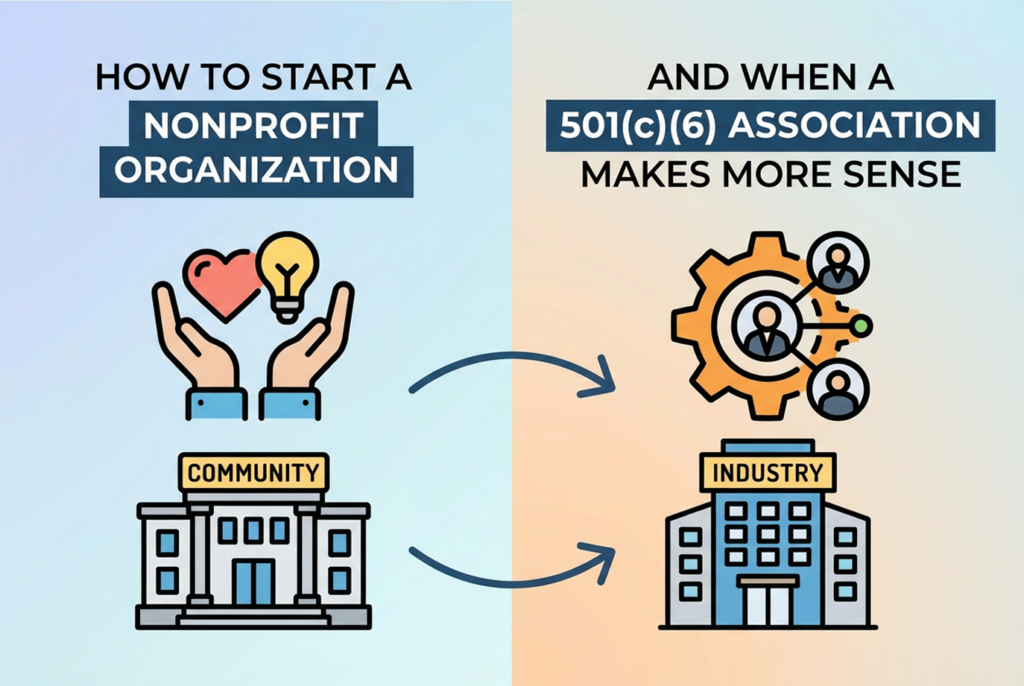
Starting a nonprofit organization is often the first step for groups that want to operate formally, collect money, and represent a shared purpose. What many founders don’t realize is that associations are a type of nonprofit organization—but they follow different rules than charitable nonprofits.
Most professional groups, trade organizations, and membership bodies are best formed as associations, commonly structured under IRS section 501(c)(6) rather than 501(c)(3).
This guide explains how to start a nonprofit organization with an association structure, outlines the steps of association formation, and clarifies how associations differ from charitable nonprofits so you can choose the right path from the start.
TL;DR
- A 501(C)(6) association is a nonprofit membership organization structured to advance a common business, trade, or professional interest rather than serve the general public.
- To start one, you generally follow these core steps:
- Define your purpose and membership, who you serve and the value you bring.
- Choose a legal structure, most incorporated as a state nonprofit corporation.
- File Articles of Incorporation with your state with member-focused purpose language.
- Create strong bylaws covering membership, dues, voting, and governance.
- Appoint a board of directors or officers to govern the association.
- Obtain an EIN (Employer Identification Number) for banking and IRS filings.
- Apply for IRS tax-exempt status, typically using Form 1024 for 501(C)(6).
- Maintain state and federal compliance with annual reports and governance rules.
- Unlike a 501(C)(3) charity, a 501(C)(6):
- Serves its members’ business interests rather than the general public.
- Doesn’t offer tax-deductible donations.
- Can engage in lobbying and advocacy more freely.
- Relies mainly on dues, sponsorships, and events for revenue.
- Starting with the correct nonprofit structure ensures compliance and long-term sustainability.
What Is a Nonprofit Organization?
A nonprofit organization is a legal entity formed for purposes other than generating profit for owners or shareholders. Nonprofits reinvest surplus revenue into their mission rather than distributing it as profit.
Nonprofit organizations include many different IRS classifications, such as:
- 501(c)(3) charitable organizations
- 501(c)(6) trade and professional associations
- Other membership-based nonprofit entities
When people talk about how to start a non profit, they are often referring to the structure broadly—not a single tax category.
What Is an Association?
An association is a nonprofit organization formed to advance a shared professional, trade, or industry interest on behalf of its members.
Associations typically:
- Serve members rather than the general public
- Are funded by dues, sponsorships, and events
- Provide education, standards, advocacy, or networking
- Represent an industry or profession
Most associations are classified as 501(c)(6) nonprofit organizations, which distinguishes them from charitable nonprofits.
Are Associations Nonprofits?
Yes—associations are nonprofits, but they are not charitable nonprofits.
This distinction matters because associations:
- Do not offer tax-deductible donations
- May engage in advocacy and lobbying
- Operate for member benefit, not public charity
- Follow different IRS and compliance rules
Understanding this difference is critical before filing any paperwork.
How to Start a 50c6 Association: Step by Step
The early steps to start a nonprofit organization and to start an association look very similar. The difference lies in purpose, tax classification, and compliance.
1. Define the Purpose and Membership
Clearly define:
- Who the organization serves (members vs the public)
- The shared interest or industry being represented
- How value will be delivered to members
If the primary audience is members, the nonprofit should be structured as an association.
2. Choose a Legal Structure
Most nonprofit associations incorporate as a nonprofit corporation at the state level.
This is the same legal entity type used by charitable nonprofits, which is why the processes are often confused.
3. File Articles of Incorporation
File articles of incorporation with your state that include:
- The organization’s legal name
- Purpose language focused on member or industry benefit
- A dissolution clause appropriate for a nonprofit association
This step formally establishes the nonprofit organization.
4. Create Association Bylaws
Bylaws are especially important for associations. They typically address:
- Membership eligibility and classes
- Dues structure
- Voting rights
- Board authority and elections
Strong bylaws are foundational to effective association governance.
5. Appoint a Board of Directors or Officers
Nonprofit associations require formal governance.
The initial board:
- Adopts the bylaws
- Approves filings
- Oversees financial and legal compliance
Board composition often reflects the profession or industry represented.
6. Obtain an EIN
An Employer Identification Number (EIN) is required to:
- Open bank accounts
- File IRS forms
- Hire staff or contractors
This step applies to all nonprofit organizations.
7. Apply for IRS Tax-Exempt Status
This is where association formation diverges from starting a charitable nonprofit.
- Associations typically apply for 501(c)(6) status using IRS Form 1024
- Charitable nonprofits apply for 501(c)(3) status using Form 1023
The IRS classification determines what activities are allowed and how revenue is treated.
8. Register and Maintain State Compliance
Nonprofit associations must:
- File annual state reports
- Maintain good standing
- Follow governance and financial rules
Associations often have simpler fundraising compliance than charitable nonprofits because they rely on dues rather than donations.
Association vs Charitable Nonprofit: Key Differences
Topic | Association (501(c)(6)) | Charitable Nonprofit (501(c)(3)) |
Primary focus | Members | General public |
Main revenue | Dues, events, sponsorships | Donations, grants |
Advocacy | Allowed | Limited |
Donations deductible | No | Yes |
Best for | Trade & professional groups | Charitable causes |
How Crowded Supports Associations From Incorporation to Operations
Starting an association involves more than filing paperwork. From incorporation to day-to-day operations, associations need systems that reflect member-based revenue, governance requirements, and long-term sustainability.
Crowded is a financial platform built specifically for associations and membership organizations—including 501(c)(6) trade and professional associations—and supports organizations from the very beginning.
With Crowded, associations can:
- Incorporate their association directly through Crowded
Crowded offers incorporation services to help associations form correctly from day one, including guidance on entity setup and tax-exempt status—without navigating the process alone. - Collect membership dues and payments in one place
Accept dues, event registrations, sponsorships, and other payments without relying on disconnected tools. - Structure finances by chapter, committee, or program
Use sub-accounts to mirror your association’s real-world structure, making it easier to track funds and report to leadership. - Maintain board-ready financial visibility
Give treasurers and board members clear insight into balances, spending, and activity without manual reconciliation. - Simplify compliance and leadership transitions
Centralized financial records and role-based access reduce risk during officer handovers and audits. - Operate digitally from day one
Open accounts, manage payments, and oversee finances without physical branches or legacy banking friction.
For new associations, forming the entity correctly and setting up the right financial infrastructure early prevents costly rework later. By supporting both incorporation and ongoing financial management, Crowded helps associations move from idea to operation with clarity and confidence.
Final Takeaway
Learning how to start a nonprofit organization doesn’t always mean forming a charity. Associations are nonprofit entities, but they exist to serve members, represent industries, and provide collective value—not to operate as public charities.
Starting with the correct nonprofit structure ensures the organization can operate effectively, remain compliant, and grow without unnecessary restrictions.
Understanding association formation from the beginning is one of the most important decisions a founding group can make.
Your questions, answered.
What’s the difference between starting a nonprofit and starting an association?
Starting a nonprofit organization usually refers to forming a 501(c)(3) charity, which serves the public and can receive tax-deductible donations.
Starting an association typically means forming a 501(c)(6), which serves members, collects dues, and can engage in advocacy.
Can I use the term “nonprofit” if I’m starting an association?
Yes. “Nonprofit” is an umbrella term that includes associations. The important distinction is the IRS classification (501(c)(6) vs 501(c)(3)) and how the organization operates.
Are donations to associations tax-deductible?
No. Contributions to most associations are not tax-deductible as charitable donations. Associations are primarily funded through dues, sponsorships, and events.
Do associations need a board of directors?
Yes. Like other nonprofit organizations, associations require a governing body. Boards oversee compliance, finances, and strategic direction, often representing different segments of the membership.
How long does it take to start a nonprofit association?
State incorporation can often be completed in days or weeks. IRS approval for 501(c)(6) status may take several months, depending on filing accuracy and IRS processing times.
Do associations have to register for charitable solicitation?
Usually no. Since associations rely on dues rather than charitable donations, they often have simpler fundraising compliance requirements than charitable nonprofits. Requirements vary by state.