Yes, you can apply for fiscal sponsor grants without your own 501(c)(3), as long as the funder accepts fiscally sponsored projects and your sponsor agrees to serve as the legal applicant and grantee.
A fiscal sponsor is an established 501(c)(3) that receives, holds, and reports on funds for your project. That support comes with two conditions: most sponsors charge 5% to 12% of revenue, and the sponsor keeps legal control of the money. Below, we walk through which funders say yes, how the application works, what it costs, and who manages the funds after the award.
TL;DR
- A fiscal sponsor lends its 501(c)(3) status, legal name, and EIN to your grant application.
- Funder guidelines set eligibility, so confirm a grant welcomes sponsored projects before you write a word.
- The sponsor signs the application and grant agreement, holds the money in a restricted fund, and answers to the funder.
- Sponsor fees range from 1% to 15%, and most fixed rates sit between 5% and 12% (2023 Fiscal Sponsor Field Scan).
- Start early: sign the sponsorship agreement first, then line up approvals so fiscal sponsor grants move smoothly from application to final report.
How Fiscal Sponsor Grants Work
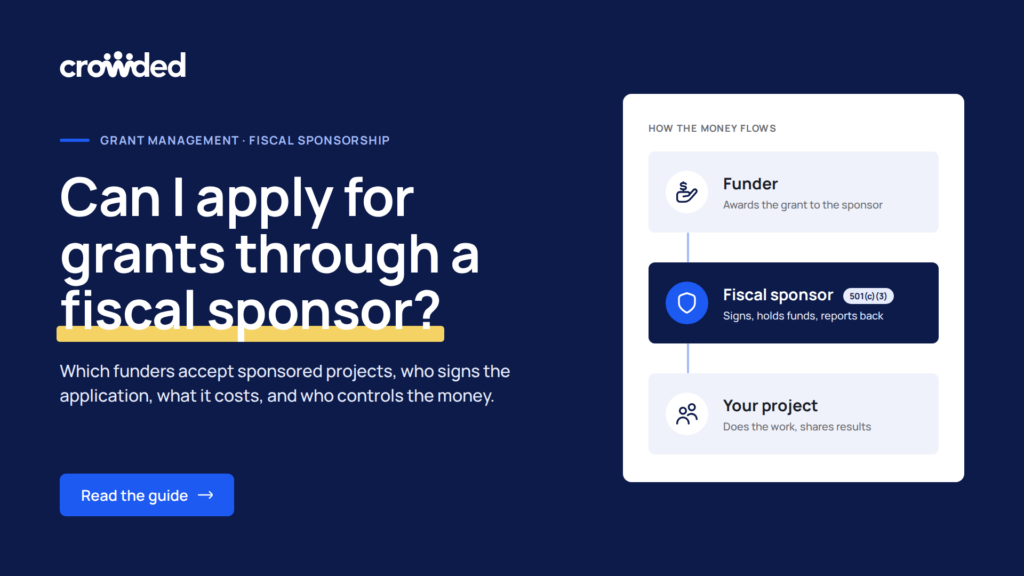
With fiscal sponsor grants, the funder contracts with the sponsor, and the sponsor works with your project. The sponsor’s legal name and EIN go on the application and on the grant agreement.
The money follows a clear path. The funder pays the sponsor, the sponsor holds the funds in a restricted fund for your project, and the sponsor releases them under your fiscal sponsorship agreement, minus its fee. Reports travel back up the same path, from your project to the sponsor to the funder.
Model A and Model C
|
Model |
How It Works |
|
Model A |
The project becomes a program of the sponsor. The sponsor employs staff and signs contracts. |
|
Model C |
The project stays a separate group, and the sponsor regrants funds to it as a preapproved grant. |
In the 2023 Field Scan, 72% of sponsors offered Model A and 68% offered Model C, making them the two leading sponsorship models.
Which Funders Accept A Fiscal Sponsorship Grant Application?
Grant guidelines determine whether a sponsored project can apply, and each funder sets its own rules.
The National Endowment for the Arts (NEA) offers a clear example. Its Grants for Arts Projects program excludes applications submitted by a fiscal sponsor. The NEA treats a sponsor used solely to submit an application as ineligible, and it welcomes groups without their own nonprofit status to participate in an eligible organization’s project.
Many private and community foundations welcome sponsored projects, and some require a fiscal sponsor for groups without 501(c)(3) status. The Chicago Community Trust is one example.
How To Check Before You Apply
Search the funder’s guidelines for these terms:
- “fiscal sponsor”
- “fiscal agent”
- “sponsored project”
- “eligible applicant”
- “determination letter”
If the guidelines stay silent on sponsorship, email the program officer before you start drafting.
The Fiscal Sponsorship Grant Application, Step By Step
These seven steps keep fiscal sponsor grants on track from the first eligibility check to the final report.
- Confirm the funder accepts sponsored applicants. Use the checklist in the section above.
- Sign the fiscal sponsorship agreement before you apply. In the 2023 Field Scan, 92% of sponsors use a standard agreement.
- Get your sponsor’s approval of the proposal and budget. Include the sponsor’s fee line in that budget.
- Agree on who submits. The sponsor usually owns the portal account and signs, and your project writes the narrative.
- Use the sponsor’s legal name, EIN, and registrations. For federal grants, that includes its SAM.gov registration and UEI. Name your project and describe the relationship in one sentence.
- Receive the award through the sponsor. The sponsor signs the grant agreement, and the money lands in its restricted fund for your project.
- Report on time. Your project supplies the program narrative and receipts, and the sponsor signs and submits the financial report.
Who Controls The Grant Money After The Award?
The sponsor controls the money as part of its core compliance responsibilities. A 1968 IRS revenue ruling requires the sponsor to keep discretion and control over the funds so it serves as a true sponsor and avoids acting as a mere conduit.
For fiscal sponsor grants, that control shapes daily operations:
- Disbursements: the sponsor can set a disbursement schedule, require approval for spending, and hold back funds that fall outside the grant’s terms or the sponsor’s mission.
- Restricted funds: grant money goes toward what the grant agreement allows, by the dates it allows.
- Accountability: the sponsor answers to the funder because it signed the agreement. Late reports also affect the sponsor’s record, which is why sponsors set internal report deadlines.
- Changing sponsors: an active grant stays with the sponsor until the funder approves a transfer. In the 2023 Field Scan, 49% of projects that left their sponsor became their own 501(c)(3), and 28% moved to a new sponsor.
- Equipment and intellectual property: the sponsorship agreement sets ownership of anything bought with grant funds, so read that clause before you sign.
How Much is a Fiscal Sponsor Administrative Fee On Grants?
Sponsor fees range from 1% to 15%, and most fixed rates fall between 5% and 12% of revenue, according to the 2023 Fiscal Sponsor Field Scan.
|
Sponsor Type |
Fee Range |
|
Sponsors offering Model C only |
6% to 8% |
|
Sponsors offering Model A only |
8% to 12% |
For example, a $50,000.00 grant at an 8% fee leaves $46,000.00 for the project.
A budget tip for fiscal sponsor grants: ask the funder whether the fee can sit in your budget as an administrative or indirect cost.
Does A Fiscal Sponsor Affect Your Chances?
On its own, a sponsor keeps your application on a level playing field. Funders that accept sponsored projects judge the project itself, and an established sponsor adds financial oversight they can see.
Two risks deserve attention. The first is a sponsor whose mission sits far from your project’s work. The second comes from funders that cap applications per organization, since your sponsor’s other projects may compete for the same slot. Ask your sponsor about both before you start writing.
How To Find A Fiscal Sponsor That Funders Will Accept
Start with mission fit, then check the sponsor’s grant record with your type of funder. A well-matched sponsor makes fiscal sponsor grants easier to manage from start to finish.
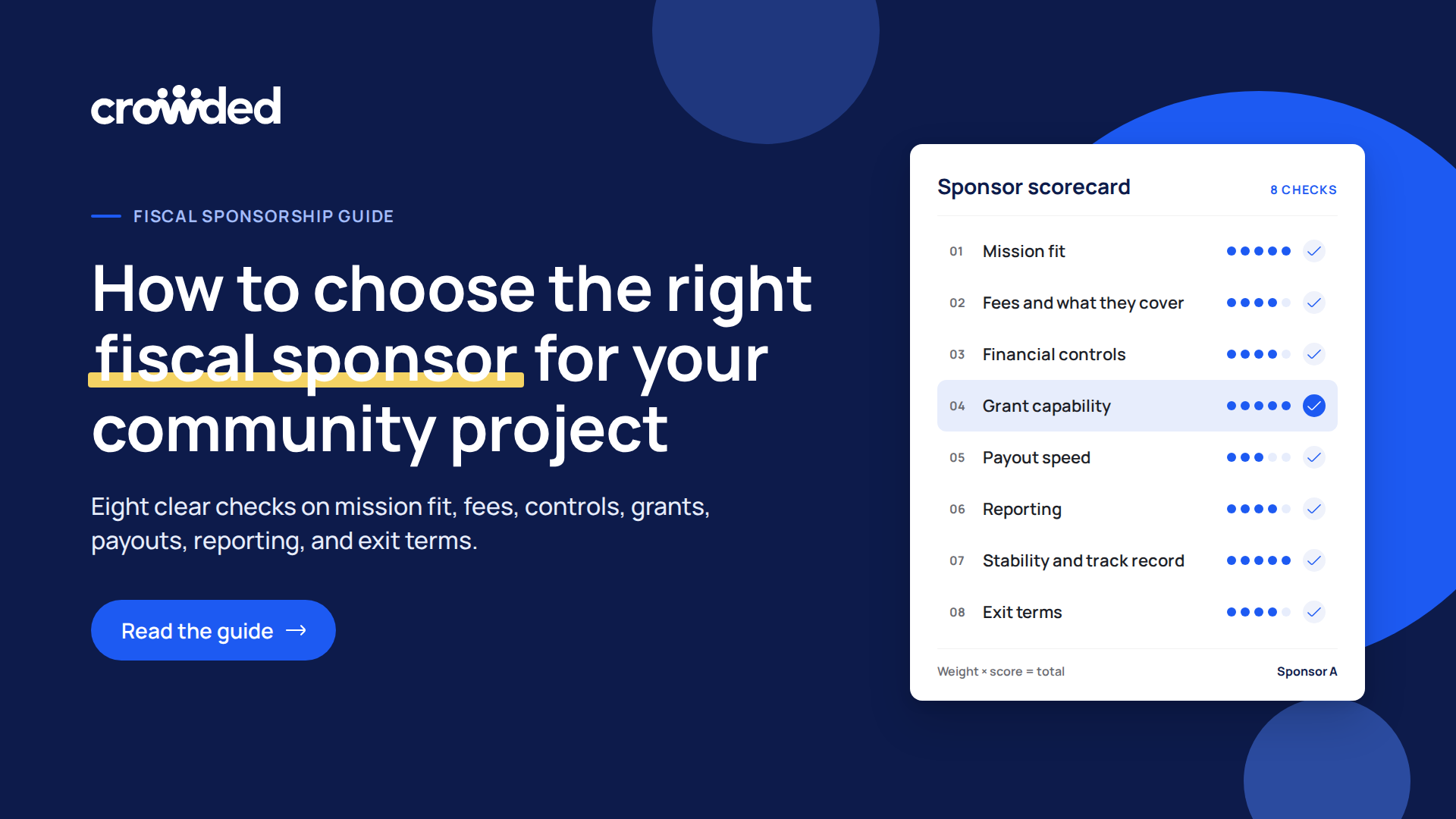
Use this checklist when you compare sponsors:
- Mission match with your project and community
- Model offered: Model A or Model C
- Fee and what it covers
- Grant record with funders like yours
- Balance visibility, since 30% to 35% of sponsors offer projects online access to their financials
Start early. Sponsors in the 2023 Field Scan turned away one project for every two they took on, mostly due to limited capacity. Good places to look include the Fiscal Sponsor Directory and the National Network of Fiscal Sponsors member list.
Applying For Grants With The Crowded Foundation
The Crowded Foundation offers fiscal sponsorship for community organizers, artists, filmmakers, collectives, and new nonprofits awaiting IRS recognition. Projects that join gain a 501(c)(3) home for their fiscal sponsor grants and a partner that shares their commitment to community impact.
Crowded is a financial platform for nonprofits and community organizations, and our values of transparency and accountability guide how the Foundation works with each project. If you lead a fiscal sponsor, Crowded for fiscal sponsors helps you keep funds for each sponsored project organized and easy to report on.
Ready to start? Submit your Foundation application.
What May Change For Fiscal Sponsors In 2026
The Fiscal Sponsorship Transparency Act of 2026 (H.R. 9721) was introduced on July 16, 2026, and the House Ways and Means Committee ordered it reported on July 22. The bill would require sponsors to report each sponsorship arrangement on their returns. It remains a proposal at this stage, so check its current status on Congress.gov.
Your Next Step
Pick the grant you want, check its eligibility language, then line up a sponsor before you write a word. When you are ready, see how it works and apply for Crowded Foundation fiscal sponsorship.
Required Disclosures
Crowded Technologies Inc. is a financial technology company and is not a bank. Banking services provided by i3 Bank; Member FDIC.
Crowded is an IRS-certified E-Filer that makes it easy for nonprofits to prepare and electronically file their federal tax returns with the IRS. Crowded is not a law firm, accounting firm, or financial advisory service, and does not provide legal, tax, or accounting advice.
Frequently Asked Questions
Can an individual artist or filmmaker apply for grants through a fiscal sponsor?
Often, yes. Many arts and media sponsors take individual projects, and many funders accept them. The NEA’s Grants for Arts Projects excludes applications submitted by a fiscal sponsor, so check each funder’s eligibility section.
How long does it take to get a fiscal sponsor before a grant deadline?
It ranges from days to weeks. In the 2023 Field Scan, 72% of sponsors had their board involved in approving new projects, and board review takes time. Start the sponsor search before you start the proposal.
Can a sponsored project apply for its own 501(c)(3) status?
Yes. Becoming an independent nonprofit was the most common reason projects left their sponsor in the 2023 Field Scan (49%). Plan for active grants first, since the funder usually needs to approve moving them to your new organization.
Who is responsible if a sponsored project misses a grant report?
In the funder’s eyes, the sponsor is responsible because it signed the grant agreement. Most sponsorship agreements pass the reporting duty to the project internally with set deadlines, and a missed report can delay your next disbursement.
Is a fiscal sponsor the same as a fiscal agent?
Funders often use the terms interchangeably, and the NEA writes “fiscal sponsor/agent.” Legally, a sponsor must control the funds, while “agent” can imply a party that simply acts on your behalf. Ask your sponsor which arrangement your agreement creates.
How does the Crowded Foundation support sponsored projects?
The Crowded Foundation gives qualifying projects a 501(c)(3) home so they can pursue fiscal sponsor grants with funders that accept sponsored applicants. Transparency and accountability guide how we work with each project, from the sponsorship agreement to the final report.
What does Crowded offer organizations that act as fiscal sponsors?
Crowded is a financial platform built for nonprofits and community organizations. Fiscal sponsors use Crowded’s platform to keep funds for each sponsored project organized in subaccounts, supporting clear reporting to funders and the projects they serve.