Yes, a fiscal sponsor can carry most of a sponsored project’s compliance and reporting work, including the IRS Form 990, donor receipts, the official books, and many grant reports. Good fiscal sponsor compliance is a shared job: your written agreement and sponsorship model decide which duties stay with your team, and your team provides accurate, timely records.
Many project teams sign a sponsorship agreement in the rush of a launch and learn the details later. Knowing the split from day one keeps grants on schedule and donors confident.
TL;DR
- Your fiscal sponsor files its own Form 990, and the money it holds for your project appears inside that return as part of the sponsor’s totals.
- Donations to your project are legally gifts to the sponsor. IRS Revenue Ruling 68-489 lets a sponsor fund your work when it keeps control and discretion over the money and keeps records showing a charitable use.
- In Model A, the sponsor runs payroll, signs contracts, carries insurance, and owns project assets. In Model C, your own entity keeps its EIN, bank account, payroll, and tax filings.
- A donor needs a written acknowledgment to deduct any single gift of $250 or more, and the sponsor issues it.
- On April 23, 2026, Treasury announced plans to revise Form 990 reporting on fiscal sponsorship. As of October 2026, the new rules remain in development.
How Fiscal Sponsor Compliance Splits Task By Task
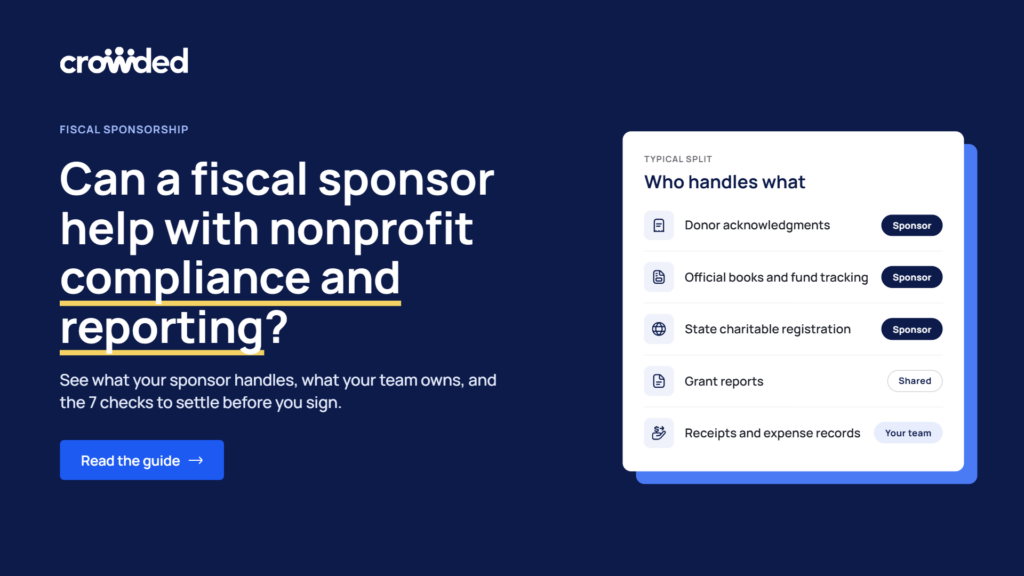
A fiscal sponsor handles the compliance that belongs to the charity holding the money: its Form 990, donor acknowledgments, the official ledger for project funds, and its state charitable registrations. Your project team provides evidence that each dollar went where promised. This split sits at the heart of fiscal sponsor compliance.
A fiscal sponsor is an established 501(c)(3) organization that accepts tax-deductible donations and grants for a charitable project and oversees how that money is used. The sponsored project is usually a group operating under the sponsor’s tax-exempt status.
The sponsor’s annual audit reaches your project too. Money held for a sponsored project sits on the sponsor’s books, so the sponsor’s auditors can ask your team for the receipts, contracts, and approvals behind any project expense.
Compliance Task | Usually the Sponsor | Usually Your Project Team |
IRS Form 990 | Files it, with project income and expenses included | Supplies year-end figures and program descriptions |
Donor acknowledgments | Issues them in the sponsor’s name | Passes along donor details for gifts made through project channels |
Official books and restricted fund tracking | Keeps the ledger and separates each project’s money | Sends receipts, invoices and coding notes on schedule |
Grant agreements and grant reports | Signs as the legal grantee and submits reports | Writes the narrative, outcomes and budget variance explanations |
State charitable registration | Registers where it and its projects ask for donations | Tells the sponsor before fundraising in a new state |
Payroll, employment taxes and insurance | Sponsor, under Model A | Your entity, under Model C |
Annual audit | Its audit covers the money held for your project | Produces documentation when auditors ask |
The sponsor owns the filings because the money legally belongs to the sponsor, and your team owns the paper trail behind every expense. State registration follows the same logic: Perlman & Perlman notes that a sponsor stays registered with charity regulators based on where it and all of its projects operate and solicit donations.
Sponsors that hold each project’s money in its own fund account, for example on Crowded, a compliant money movement and banking platform for mission-driven organizations, can show that separation straight from account statements at audit time.
Your Fiscal Sponsor Holds Final Say Over Project Money
A fiscal sponsor holds the authority to approve, redirect, or hold project funds within the terms of your agreement. That authority makes donations to your project deductible, and it anchors fiscal sponsor compliance under federal tax law.
The rule dates to 1968. IRS Revenue Ruling 68-489 says a 501(c)(3) keeps its exemption when it distributes funds to nonexempt groups, provided it retains control and discretion over how the funds are used and keeps records proving a charitable use. Lawyers call this “variance power.”
A sponsor that forwards every donation automatically acts as a conduit. The DC Bar Pro Bono Center explains that gifts to a sponsored project are deductible when the sponsor exercises discretion and control, and it advises sponsors to tell donors that project gifts stay subject to that discretion.
Expect your sponsor to approve your budget, review larger contracts, read fundraising copy before launch and ask for regular financial reports. Daily program choices, such as which workshop runs on Tuesday, usually stay with your team when they fit the approved budget and the sponsor’s mission.
Our recommendation: if your team wants full control of every spending decision, your own 501(c)(3) is the right structure.
Model A Vs Model C Fiscal Sponsorship Sets Who Files What
Model A makes your project a program of the sponsor, so the sponsor carries nearly every filing and legal duty. Model C keeps your project as a separate legal entity that receives grants from the sponsor, so your entity keeps its own tax, payroll, and liability obligations.
The Model A vs. Model C fiscal sponsorship choice decides whether payroll, contracts, and filings sit with the sponsor or with your entity, which makes it the biggest single factor in your share of fiscal sponsor compliance. Model A and Model C are the two models most sponsors offer. Attorney Gregory Colvin’s reference book on fiscal sponsorship describes six models in total, and a few sponsors use the others.
Question | Model A (Direct Project) | Model C (Preapproved Grant) | Your Own 501(c)(3) |
What is the project legally? | A program inside the sponsor | A separate entity or group | An independent charity |
Whose Form 990 shows the money? | The sponsor’s | The sponsor’s shows its grants to you; your entity files what its legal form requires | Yours |
EIN and bank account | Uses the sponsor’s | Your own | Your own |
Who runs payroll? | The sponsor; staff are its employees | Your entity | You |
Who signs contracts and carries liability? | The sponsor | Your entity | You |
Who owns assets and intellectual property? | The sponsor by default, and the agreement can assign them | Your entity | You |
Who governs? | The sponsor’s board, with an optional advisory committee | Your own board or managers | Your own board |
Each step from Model A to Model C to your own 501(c)(3) gives a project team added control and added filings.
Payroll and governance show the difference clearly. Under Model A, project staff are the sponsor’s employees on the sponsor’s payroll, and the sponsor’s board holds legal authority over the project; your team can form an advisory committee. Under Model C, your entity runs its own payroll and has its own board or managers, so it files its own employment tax returns.
Choose Model A if your project operates under the sponsor’s legal identity, plans to pay staff, and wants the sponsor to handle payroll and insurance. Model A also suits small volunteer-led projects with limited bookkeeping help, since the sponsor handles the paperwork. Choose Model C if you already have an entity with its own bank account and someone qualified to handle its tax filings. Projects planning to spin out fit Model C well too.
What Your Project Team Owes In Fiscal Sponsorship Reporting
Your team gives the sponsor the raw material for every report: receipts, invoices, program data, and explanations when spending drifts from the budget. The sponsor turns that material into official grant reports and its own financial statements, so strong fiscal sponsor compliance starts with complete, on-time project records.
Here is how one interim grant report might come together for a youth coding project run under a Model A sponsor, funded by a foundation grant restricted to after-school classes:
- The project lead sends attendance counts, two participant stories, and a note on curriculum changes made this term.
- The project team matches each class expense to the grant’s budget lines and explains why instructor pay ran over while supply costs came in under.
- The sponsor’s finance staff check the ledger, confirm the restricted balance, and prepare the financial section.
- The sponsor signs and submits the report because the sponsor is the legal grantee.
If the project team’s expense matching arrives late, the whole grant report arrives late, and the funder sees the sponsor’s name on the delay. Ask your sponsor for its internal deadline, which usually falls ahead of the funder’s date.
Donor receipts follow the same split. IRS Publication 1771 says a donor needs a contemporaneous written acknowledgment from the charity to deduct any single contribution of $250 or more. The sponsor issues that acknowledgment. Publication 1771 includes a sample receipt for a gift made in the name of one of the charity’s programs, the format many sponsors use to name your project.
Ticketed events add one more rule. When a payment above $75 is partly a gift and partly buys something, such as a gala dinner, the charity gives the donor a written disclosure statement. Publication 1771 sets the penalty for a missed disclosure at $10 per contribution, up to $5,000 per event or mailing. Tell your sponsor about any ticketed event before tickets go on sale.
How The Fiscal Sponsor Form 990 Covers Your Project Today and What May Change
Your sponsor’s Form 990 already includes the money it holds and spends for your project. For a project operating under the sponsor’s legal identity, the fiscal sponsor’s Form 990 is the one federal return that shows the project’s activity. According to Carr, Riggs & Ingram, today’s Form 990 leaves fiscal sponsorship arrangements out of its required disclosures, and sponsored projects rely on the sponsor’s return. The firm also notes that the last significant changes to Form 990 came in 2008.
Regulators and Congress are now looking closely at that missing project-level detail:
- April 23, 2026: Treasury announced that the IRS plans to revise Form 990 for clearer reporting on government grants, government contracts and fiscal sponsorship arrangements. The release cites congressional concern that some arrangements may obscure who operates a project, who controls its funds and how they are used. Treasury and the IRS plan to publish proposed regulations and take public comments before any change becomes final.
- July 16, 2026: Representative Lloyd Smucker introduced HR 9721, the Fiscal Sponsorship Transparency Act of 2026. As introduced, it would require sponsors to report, for each arrangement, the amounts involved, a description of the funded activities, the name of the officer managing the arrangement, and its start and end dates.
- July 22, 2026: The House Ways and Means Committee ordered HR 9721 reported to the full House by a 23-to-15 vote. As of October 2026, HR 9721 awaits a vote in the full House, with the Senate to follow if it passes.
Both the Treasury rules and HR 9721 point toward project-by-project detail on the sponsor’s return. Keep books that tie each dollar to your project and its funding source now, so fiscal sponsor compliance stays easy to prove as the new rules arrive. For more on what finance teams are preparing for, see our guide to Form 990 changes in 2026.
7 Checks Before You Sign A Fiscal Sponsorship Agreement
Before signing, get written answers on who files, who reports, who pays, and what happens when you leave. These seven questions cover the fiscal sponsor compliance details that most often surprise sponsored projects later.
- Whose Form 990 shows our activity, and in whose name are donor receipts issued?
- Who signs grant agreements, tracks restrictions, and submits grant reports, and how many days before each funder deadline does the sponsor need our material?
- In which states is the sponsor registered to solicit donations, and what happens if we fundraise elsewhere?
- Who approves spending, how quickly are vendors paid or expenses reimbursed, and what monthly statement do we receive?
- Are payroll, insurance, contracts, and intellectual property covered by the fee or billed separately?
- What percentage fee applies, to which kinds of income (grants, donations, earned revenue), and what does it pay for?
- If we leave or form our own 501(c)(3), what happens to restricted balances, assets, contracts, and donor records, and how much notice is required?
Get every answer written into the agreement itself, and use a sample agreement template to spot any missing terms. A signed agreement holds both sides to their promises.
Signs A Fiscal Sponsor Can Carry Your Compliance Load
A sponsor is ready to carry your compliance work when it can show its own records are in order. Ask to see its most recent independent audit or reviewed financial statements, its latest Form 990, proof of current state charitable registrations and its written policies for spending approvals and conflicts of interest. Then ask how many projects it sponsors today and how many finance staff keep their books.
Two warning signs deserve a pause before signing: slow answers about where your project’s money sits, and an agreement that skips the terms for ending the relationship. The money legally belongs to the sponsor, so a sponsor with loose controls puts your restricted grants at risk and leaves your project with limited options if payments freeze.
What Moves With Your Project When You Leave A Fiscal Sponsor
When a project becomes its own 501(c)(3), its compliance history stays with the sponsor, because the sponsor filed every return. Your new organization starts its own filing record in its first year.
What moves with a sponsored project depends on the sponsorship model. Under Model A, the sponsor holds legal title to project assets, so a written transfer agreement moves assets and liabilities to your new corporation, as attorney Gregory Colvin explains on fiscalsponsorship.com. Under Model C, the exit is often simpler: the sponsor can end the agreement, close your project fund, and grant the remaining net assets to your new charity as a final exercise of its discretion.
Before you set a spin-out date, read each open grant agreement to see whether unspent funds can move with your project. Ask your sponsor for a full project-level ledger export along with copies of every grant report and budget. Your new board and your first auditor will ask for all of it.
Where Crowded Fits For Sponsors and Sponsored Projects
Crowded provides compliant money movement and banking for mission-driven organizations, giving a fiscal sponsor a dedicated fund account for each sponsored project, so fiscal sponsor compliance starts with separate project money in the account structure. The sponsorship itself comes from your fiscal sponsor, and Crowded works alongside the sponsor’s accounting system, legal counsel, and sponsorship agreement.
For a sponsor managing dozens of sponsored projects, a fund account per project changes the monthly routine:
- Spending rules and approvals apply before money moves, so over-budget purchases get caught before the money leaves.
- Statements for each fund give each project lead, the sponsor’s finance staff and the auditor the same numbers.
- Disbursements for program spend, such as volunteer stipends and scholarships, run from the right project’s fund account.
- Ask Crowded to answer plain-language questions such as “How much is left in the youth coding fund?” from live account data.
Projects looking for a sponsor can also review Crowded Foundation, a 501(c)(3) that is a separate entity from Crowded Technologies Inc. It currently offers Model C fiscal sponsorship to qualifying projects, so your own entity keeps the Model C filing duties described above.
Crowded Technologies Inc. is a financial technology company and is not a bank. Banking services provided by i3 Bank, Member FDIC.
Frequently Asked Questions
Who files the Form 990 for a sponsored project?
Your fiscal sponsor files it. The money the sponsor holds and spends for your project appears inside the sponsor’s own return, including its expense reporting, and your team supplies year-end figures and program descriptions when asked. Under Model C, your separate entity also files whatever return its legal form requires.
Can a fiscal sponsor hold or redirect project funds?
Yes, within the terms of your agreement. IRS Revenue Ruling 68-489 asks the sponsor to keep control and discretion over donated funds, and that control is what makes gifts to your project tax-deductible. Your team usually keeps control of daily program choices, as long as they fit the approved budget.
How does a donor get a tax receipt for a gift to a sponsored project?
The donor gives to the sponsor and names your project, and the sponsor issues the receipt. Under IRS Publication 1771, any single gift of $250 or more needs a written acknowledgment from the charity. Gifts paid straight to an unincorporated project or a nonexempt entity lose the charitable deduction, so route every gift through the sponsor.
Who is liable when a sponsored project signs a contract?
Under Model A, the sponsor signs and carries the liability, and attorneys at Nonprofit Law Blog note that a Model A sponsor may be liable for all of the project’s debts and obligations. Under Model C, your own entity signs and carries the liability, which is one reason Model C projects buy their own insurance.
Does a fiscal sponsor handle sales tax permits and local business licenses?
The answer follows your model. Under Model A, the sponsor handles permits and licenses for merchandise sales or events because project activities are the sponsor’s activities. Under Model C, your entity holds them. Check with your sponsor before you sell anything, since sales tax rules vary by state and city.
Can we switch to a different fiscal sponsor?
Yes. Moving between sponsors usually takes a written agreement between the old and new sponsor that transfers your project’s assets and liabilities, plus a new sponsorship agreement. Give both sponsors time to update open grant agreements, since funders may need to approve the change before restricted money moves.
How does Crowded support fiscal sponsor compliance?
Crowded, compliant money movement and banking for mission-driven organizations, gives each sponsored project its own fund account, with spending rules that apply before money moves and statements every project lead and auditor can share. Our Trust value guides that work: we steward the funds in every account, with every dollar accounted for.
What does Crowded Foundation offer sponsored projects?
Crowded Foundation, a 501(c)(3) that is a separate entity from Crowded Technologies Inc., currently offers Model C fiscal sponsorship to qualifying projects. It reflects our Nonprofit Native value: we build for nonprofits from day one, with volunteers, lean finance teams, and busy boards in mind.