If you’re considering launching a mission-driven organization, you might wonder: can an LLC be a nonprofit? While Limited Liability Companies (LLCs) are typically designed for for-profit businesses, under certain conditions an LLC can operate as a nonprofit. However, the rules are strict, and many organizations find that forming a nonprofit corporation is the more practical choice.
This guide breaks down the difference between LLC and nonprofit, explores how to start a nonprofit LLC, and looks at the pros and cons of each structure.
TL;DR
- Yes, but it’s rare. An LLC can operate as a nonprofit, but only if it meets strict IRS requirements and is structured so that no profits benefit members and it serves a charitable mission.
- Most nonprofits are corporations, not LLCs, because nonprofit corporations have a clearer and easier path to 501( c )(3) tax-exempt status and donor credibility.
- Nonprofit LLCs are usually used for things like joint ventures between existing nonprofits or specific projects, not typical standalone charities.
- Starting one requires special IRS-compliant articles and ownership rules, and many founders instead opt to form a nonprofit corporation.
What Is an LLC?
A Limited Liability Company (LLC) is a flexible business structure that combines features of a corporation and a partnership. LLCs are known for:
- Pass-through taxation (profits flow to members’ personal returns)
- Personal liability protection for members
- Simple setup compared to corporations
Most LLCs are formed to generate profit for their owners, but the question remains: can a nonprofit be an LLC? Under certain circumstances, yes—but it comes with additional requirements.
What Is a Nonprofit?
A nonprofit organization is created to serve the public good, not to distribute profits to individuals. Most nonprofits choose to form as nonprofit corporations, which makes them eligible to apply for 501(c)(3) tax-exempt status.
Nonprofits are typically:
- Governed by a board of directors
- Eligible to receive tax-deductible donations (if granted 501(c)(3) status)
- Required to follow strict compliance and reporting rules
So, is a nonprofit a corporation or an LLC? The vast majority are corporations, but in limited cases, an LLC can qualify as a nonprofit if it meets IRS standards.
Can an LLC Be a Nonprofit?
Yes—but it’s rare. A nonprofit LLC must be structured and operated exclusively for charitable purposes. The IRS has set strict rules, which include:
- The LLC must have a recognized charitable mission
- No profits can benefit members or individuals
- The articles of organization must include nonprofit-specific language
- The LLC is often wholly owned by one or more 501(c)(3) organizations
Because of these requirements, nonprofit LLCs are most commonly used for joint ventures between existing nonprofits or specific projects rather than standalone organizations.
LLC vs Nonprofit: Key Differences
Here’s a side-by-side comparison of LLC or nonprofit structures:
Feature | Nonprofit LLC | Nonprofit Corporation |
Ownership | Members (often other nonprofits) | No owners; governed by a board |
IRS Tax-Exempt Status | Rare and difficult to obtain | Common and widely recognized |
Governance | Flexible, member-managed | Formal governance structure |
Donations | Often limited unless 501(c)(3) | Eligible for tax-deductible gifts |
Use Cases | Joint ventures, special projects | Full-scale nonprofit operations |
Understanding the difference between LLC and nonprofit helps clarify why corporations remain the default for most organizations seeking tax-exempt status.
How to Start a Nonprofit LLC
If you’re still interested in creating a nonprofit LLC, here are the steps:
- Draft Articles of Organization that include charitable purpose language required by the IRS.
- Ensure ownership is restricted to qualifying 501(c)(3) organizations (if applicable).
- Apply for an EIN (Employer Identification Number).
- Submit IRS Form 1023 (or 1023-EZ if eligible) to apply for 501(c)(3) status.
- Comply with state-specific nonprofit LLC laws, which vary across jurisdictions.
Because this process is complex, many founders instead choose to start with a nonprofit corporation.
How to Convert an LLC to a Nonprofit
If you already have an LLC but want to operate as a nonprofit, you may be wondering how to turn an LLC into a nonprofit. The process typically involves:
- Dissolving the for-profit LLC and forming a new nonprofit corporation, or
- Restructuring the LLC to meet IRS requirements for charitable entities, which is often more complicated and less effective.
In practice, how to convert LLC to nonprofit often means starting fresh with a nonprofit corporation to avoid compliance issues.
Pros and Cons of LLC vs Nonprofit
Pros of a Nonprofit LLC:
- Flexible governance structure
- Can be useful for collaborations between nonprofits
- Limited liability protection
Cons of a Nonprofit LLC:
- Harder to obtain IRS recognition and 501(c)(3) status
- Less credibility with donors and funders
- Not widely understood by regulators or partners
Pros of a Nonprofit Corporation:
- Easier path to 501(c)(3) tax-exemption
- Eligible for grants and tax-deductible donations
- Recognized by funders, government agencies, and the IRS
Cons of a Nonprofit Corporation:
- More formal governance required
- Ongoing reporting obligations
How Crowded Supports Both Structures
Whether you operate as a nonprofit corporation or a nonprofit LLC, Crowded offers modern financial tools to help you stay compliant and manage operations effectively.
Crowded helps with:
- Banking and financial management customized for nonprofits
- Compliance tracking to maintain 501(c)(3) status
- Automated donation tracking for easier fundraising and reporting
- Segregated accounts for managing programs or chapters
- Streamlined onboarding for volunteer treasurers and board members
Because Crowded was built specifically for mission-driven organizations, it understands the unique financial and administrative needs of both nonprofit corporations and LLCs.
Which Structure Is Right for You?
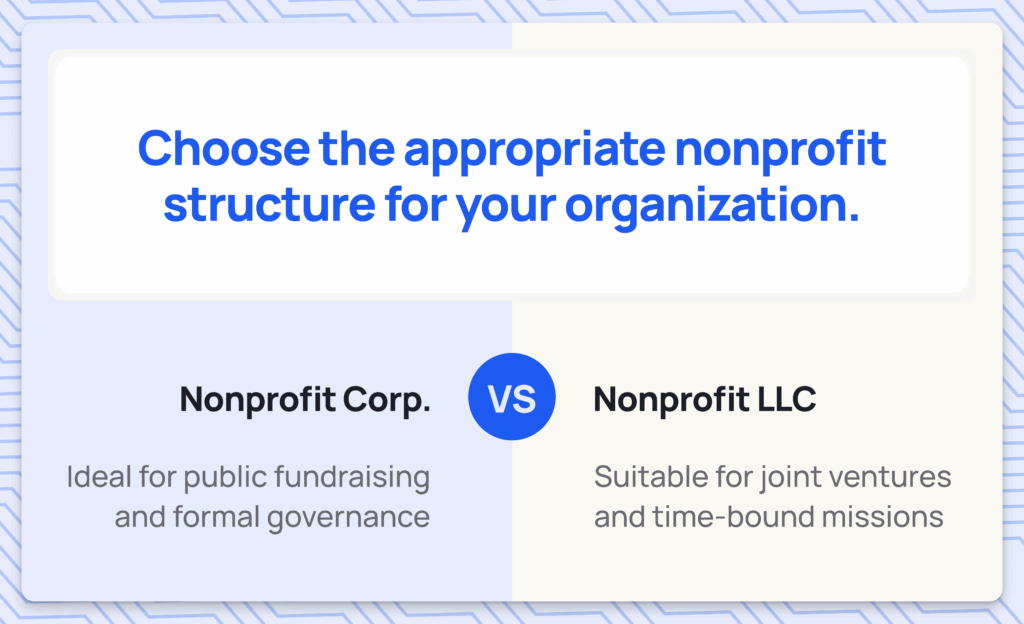
Choose a nonprofit corporation if:
- You want to apply for 501(c)(3) tax-exempt status
- You plan to fundraise publicly or apply for grants
- You need formal governance and credibility with donors
Consider a nonprofit LLC if:
- Your organization is a joint venture between existing nonprofits
- You have a narrow, time-bound mission
- You understand and can meet the IRS requirements
Final Thoughts: LLC or Nonprofit?
So, can an LLC be a nonprofit? Technically yes—but only under very limited conditions, and often with more complexity than most founders want to navigate. For most mission-driven leaders, forming a nonprofit corporation is the clearer path to tax exemption, funding, and long-term success.
Still, in certain cases—such as joint ventures or specialized projects—a nonprofit LLC may be the right fit.
Whichever path you take, platforms like Crowded can simplify financial management, keep your organization compliant, and free up your time to focus on impact.
Your questions, answered.
Is it easier to start a nonprofit corporation or a nonprofit LLC?
Generally, it’s easier and more straightforward to start a nonprofit corporation. The process for forming a nonprofit LLC is more complex due to additional IRS rules, especially if you’re seeking tax-exempt status.
Why would someone choose a nonprofit LLC over a corporation?
A nonprofit LLC might be chosen for joint ventures between nonprofits, limited-purpose projects, or when more operational flexibility is needed. However, this structure is best suited for organizations that understand the complexities of nonprofit compliance.
Can a nonprofit LLC receive tax-deductible donations?
Only if the nonprofit LLC has been granted 501(c)(3) status by the IRS. Otherwise, donations are not tax-deductible. Most donors and grantmakers prefer donating to nonprofit corporations because of their recognized tax-exempt status.
How does Crowded support nonprofit LLCs and corporations?
Crowded provides financial tools tailored to mission-driven organizations, including donation tracking, compliance monitoring, nonprofit banking, and board-friendly reporting. Whether you’re structured as a nonprofit corporation or LLC, Crowded simplifies your financial operations.