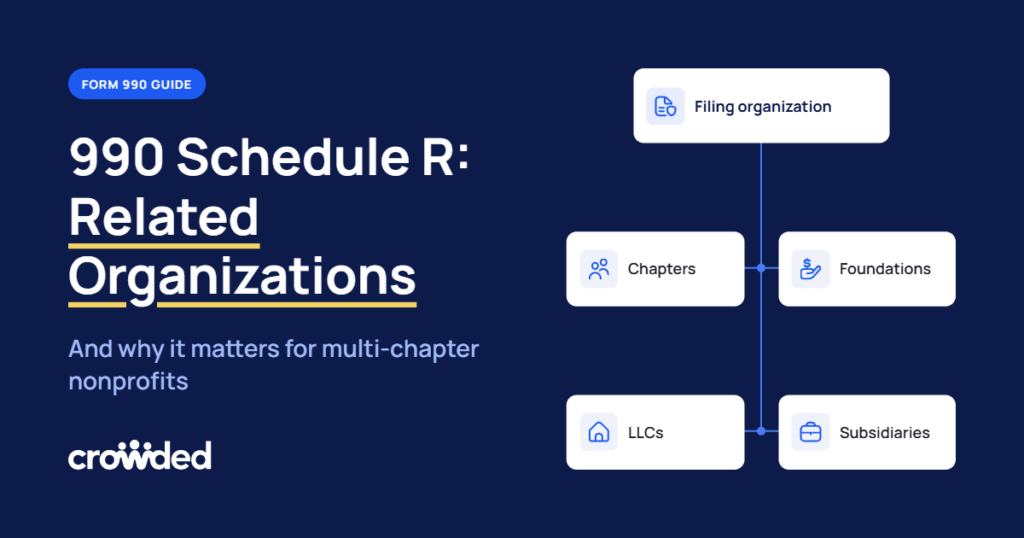
A nonprofit rarely operates as one legal entity, which is why the 990 Schedule R matters for associations and multi-chapter organizations. Chapters, foundations, LLCs, and taxable subsidiaries can create reporting relationships that must be understood before preparing Form 990.
Schedule R helps the IRS see how related organizations are controlled, connected, and financially linked. This guide explains what Form 990 Schedule R covers, why multi-chapter nonprofits face added complexity, and what finance teams should track throughout the year.
TL;DR
- 990 Schedule R reveals the full structure behind a nonprofit, including related organizations, subsidiaries, LLCs, partnerships, and inter-entity transactions.
- Separate EINs do not always mean separate reporting, making control, governance, and ownership critical for finance leaders to understand.
- Multi-chapter nonprofits face higher reporting risk when entity records, bank accounts, and financial activity are spread across departments and local leaders.
- Year-round entity tracking reduces filing pressure, improves internal controls, and helps teams identify reporting gaps before Form 990 deadlines.
- Crowded gives associations clearer entity-level visibility, helping finance teams maintain organized records, preserve separation, and spend less time chasing data at year-end.
What Is Form 990 Schedule R?
Form 990 Schedule R is an attachment to Form 990 used to disclose certain related organizations, transactions between related organizations, and specific partnership interests.
Rather than evaluating a nonprofit in isolation, the IRS uses Schedule R to understand the broader organizational network surrounding the filing organization. Depending on the organization’s structure, this may include:
- Parent organizations
- Subsidiaries
- Related tax-exempt organizations
- Taxable corporations
- Disregarded entities
- Certain partnerships
- Transactions between related entities
The purpose is transparency. Organizations that share governance, ownership, or financial relationships may influence one another in ways that aren’t visible from the primary Form 990 alone.
Why the IRS Requires Schedule R
Many nonprofit organizations operate through multiple legal entities for legitimate operational, legal, or tax reasons. A national association may establish a charitable foundation, own an LLC that manages property, or oversee affiliated organizations serving different missions.
Without Schedule R, regulators would only see each organization individually. Schedule R connects those entities, helping the IRS understand ownership, control, governance, and significant financial relationships across the entire network.
For organizations with relatively simple structures, completing Schedule R may be straightforward. For larger associations and multi-entity nonprofits, identifying what belongs on the schedule is often the more difficult challenge.
Which Organizations Count as Related Organizations?
One of the biggest misconceptions about 990 Schedule R is that it only applies to organizations that share a name or operate under the same brand. In reality, the IRS looks beyond branding to the legal and governance relationships between organizations.
Whether an organization is considered “related” depends on factors such as control, ownership, governance, and organizational structure. Understanding these relationships is essential because different types of related organizations are reported in different parts of Schedule R.
Parent Organizations
A parent organization generally has the authority to control another organization through governance, voting rights, or other legal mechanisms.
For example, a national association may have the power to appoint the majority of a regional organization’s board or approve significant organizational decisions. Although the regional organization has its own EIN and files its own returns, the governance relationship may make it a related organization for Schedule R purposes.
The key point is that separate legal incorporation does not automatically mean separate reporting responsibilities.
Subsidiaries
A subsidiary is an organization that another organization controls.
While subsidiaries are often associated with for-profit businesses, nonprofits may also create subsidiaries for operational reasons. An association, for example, may establish a separate corporation to manage conferences, publications, or other revenue-generating activities while keeping those operations legally distinct.
Because the parent organization maintains control, the relationship may need to be disclosed on Schedule R.
Brother/Sister Organizations
Some organizations are considered related because the same individuals or the same governing body control them. A common example is a nonprofit network that includes:
- A national membership association
- A charitable education foundation
- An affiliated advocacy organization
Each entity serves a different purpose and may file separate tax returns, but if the same governing body controls them, they may be considered related organizations under the IRS rules.
Supporting and Supported Organizations
Many nonprofit networks establish supporting organizations to raise funds or provide operational assistance to other tax-exempt organizations.
For example, a foundation may exist primarily to raise and distribute funds for a related association’s educational programs. Even though the organizations have different missions and separate finances, their legal relationship may create Schedule R reporting obligations.
Understanding these connections helps ensure the IRS has a complete picture of how resources move across the organization.
Disregarded Entities
Disregarded entities are among the most misunderstood parts of Schedule R. A common example is a single-member LLC wholly owned by a nonprofit. Although the LLC exists as a separate legal entity under state law, it is generally treated as part of its owner for federal tax purposes.
These entities are still reported on Schedule R because they represent an important part of the organization’s legal structure. For associations, disregarded entities are frequently used to hold real estate, manage facilities, or isolate operational risk while remaining under the nonprofit’s control.
Taxable Subsidiaries
Tax-exempt organizations sometimes own taxable corporations. These subsidiaries may operate bookstores, parking facilities, conference services, retail businesses, or other commercial activities that support the nonprofit’s mission while remaining subject to corporate taxation.
Although they are taxable entities, their relationship with the nonprofit is still relevant to the IRS. It may require disclosure on Schedule R. Being tax-exempt does not determine whether an organization is “related.” Governance, ownership, and control are what matter.
Multi-Chapter Nonprofits Face Unique Schedule R Challenges
Most guidance on Form 990 Schedule R focuses on definitions. What it rarely explains is why associations and federated nonprofits often have a much harder time determining what belongs on the form.
A typical nonprofit network can include far more than a national office and local chapters. It may also include:
- Regional chapters
- State associations
- Scholarship foundations
- Supporting organizations
- Political action committees (where applicable)
- Property-holding LLCs
- Taxable subsidiaries
- Investment partnerships
Each entity may have separate leadership, finances, and tax filings while remaining connected to the larger organization.
This creates two common risks: assuming every chapter belongs on Schedule R and overlooking reportable entities managed by different departments. Group-exempt chapters may follow different reporting rules, while foundations, LLCs, and affiliates can be missed without a complete entity inventory.
Schedule R is therefore more than a year-end filing task. It requires year-round visibility into the organization’s legal structure, control relationships, and related entities.
Understanding the Six Parts of Schedule R
Although 990 Schedule R may seem intimidating at first, it follows a logical structure. Each section focuses on a different type of organizational relationship or reportable transaction, allowing the IRS to understand how the filing organization fits within a broader network.
|
Part |
What It Covers |
Why It Matters |
|
Part I |
Disregarded entities |
Identifies single-member LLCs and similar entities treated as part of the nonprofit for federal tax purposes. |
|
Part II |
Related tax-exempt organizations |
Reports affiliated nonprofits, foundations, and other tax-exempt entities connected through control or governance. |
|
Part III |
Related organizations taxed as partnerships |
Discloses partnerships in which related organizations have an interest. |
|
Part IV |
Related organizations taxed as corporations or trusts |
Covers taxable subsidiaries, corporations, and trusts related to the filing organization. |
|
Part V |
Transactions with related organizations |
Reports significant financial relationships such as grants, loans, shared services, and transfers. |
|
Part VI |
Certain unrelated organizations are taxed as partnerships |
Provides information about substantial partnership interests that may affect the organization’s operations or reporting. |
The applicable parts depend on the nonprofit’s legal structure and its relationships with other entities. However, understanding how the schedule is organized makes it much easier to identify which information should be gathered before filing season.
Common Reporting Mistakes
Most Schedule R issues don’t arise from misunderstandings of IRS terminology. They happen because information is fragmented across departments, chapters, or legal entities.
Here are some of the most common mistakes.
Assuming Separate EINs Mean Organizations Are Unrelated
Separate incorporation does not automatically eliminate reporting obligations. An affiliated foundation, subsidiary, or chapter may have its own EIN and independent tax filings, yet still qualify as a related organization because of shared governance, ownership, or control. Always evaluate the relationship.
Forgetting Controlled Entities
Organizations often remember obvious affiliates but overlook entities established years ago for a specific purpose, such as a property-holding LLC or a taxable subsidiary created to manage commercial activities. These entities may remain reportable even if they have limited day-to-day activity.
Missing Transactions Between Related Organizations
Schedule R requires disclosure of certain financial relationships between them.
Examples may include:
- Grants between affiliated organizations
- Shared service agreements
- Management or administrative fees
- Rent or facility usage
- Intercompany loans
- Shared employees or payroll allocations
- Asset transfers
When these transactions are tracked consistently throughout the year, year-end reporting becomes significantly easier.
Waiting Until Form 990 Preparation
One of the biggest reporting challenges begins long before Form 990 is drafted.
Organizations often wait until filing season to determine which entities exist, who controls them, and what transactions occurred between them. By then, finance teams are reconstructing months of organizational activity from emails, spreadsheets, bank statements, and chapter records.
Maintaining this information throughout the year is considerably more efficient than recreating it under filing deadlines.
What Information Should You Track Throughout the Year?
Organizations with multiple entities benefit from maintaining a centralized record of their organizational structure rather than treating Schedule R as an annual compliance project.
A practical checklist includes:
- A current list of every legal entity in the nonprofit network
- EINs for each organization
- Ownership and control relationships
- Board member overlap across organizations
- Parent, subsidiary, and affiliate relationships
- Intercompany grants and funding transfers
- Loans between related organizations
- Shared service or management agreements
- Shared employees or payroll allocations
- Bank accounts maintained by each entity
- Financial statements for each organization
- Significant transactions between related organizations
This information supports more than Schedule R. It also strengthens governance, improves financial oversight, and reduces the time spent preparing Form 990 each year.
Build Cleaner Records Before Form 990 Filing Season
Schedule R becomes harder when financial information is spread across chapter treasurers, separate bank accounts, spreadsheets, and multiple legal entities. Crowded helps associations and multi-chapter nonprofits bring that activity into a clearer financial structure while preserving separation between entities.
With dedicated accounts, permission-based access, centralized oversight, and organized entity-level records, finance teams gain better visibility across the network and spend less time chasing information at year-end.
Crowded provides the financial infrastructure that supports stronger internal controls, cleaner records, and more efficient collaboration across related organizations.
Bottomline
990 Schedule R is about far more than completing another attachment to Form 990. It provides the IRS with a clearer view of how a nonprofit relates to other organizations, including affiliated nonprofits, subsidiaries, supporting organizations, disregarded entities, and certain partnerships.
For associations and multi-chapter nonprofits, understanding those relationships is often more challenging than completing the form itself. Maintaining an accurate inventory of legal entities, documenting governance and control, and tracking transactions throughout the year can significantly reduce reporting complexity during filing season.
The stronger your organization’s financial visibility across every entity, the easier it becomes to support compliance, strengthen governance, and prepare accurate filings year after year.
Frequently Asked Questions
What is Form 990 Schedule R?
Form 990 Schedule R reports related organizations, certain inter-entity transactions, and specific partnership interests.
Who needs to complete Schedule R?
A nonprofit may need to file it if it has related organizations, disregarded entities, taxable subsidiaries, or reportable partnership interests.
What counts as a related organization?
Related organizations may include parent entities, subsidiaries, brother/sister organizations, supporting organizations, LLCs, and taxable corporations connected through control, ownership, or governance.
Are all nonprofit chapters reported on Schedule R?
No. Reporting depends on the chapter’s legal relationship, level of control, and applicable IRS rules.
Does a separate EIN mean an organization is unrelated?
No. Separate EINs do not remove reporting obligations when organizations share control, ownership, or governance.
What transactions may need to be reported?
Examples include grants, loans, rent, management fees, shared services, payroll allocations, and asset transfers.
What should nonprofits track during the year?
Maintain entity lists, EINs, board overlap, control relationships, intercompany transfers, shared services, bank accounts, and financial statements.
How does Crowded help?
Crowded supports cleaner entity separation, centralized visibility, permission-based access, and organized financial records. It does not prepare Form 990 or provide tax or legal advice.