Choosing the right tax-exempt structure is one of the most critical decisions an organization can make. Whether you’re forming a new association or reassessing your current classification, understanding the difference between a 501c3 and a 501c6 is essential for legal compliance, financial management, and long-term sustainability.
This guide breaks down the 501c6 vs 501c3 distinctions—tax rules, revenue restrictions, lobbying limits, and operational differences—so your leadership team can make informed, confident decisions.
TL;DR
- 501(c)(3) nonprofits serve the public good and can receive tax-deductible donations.
- 501(c)(6) organizations serve member or industry interests (trade and professional associations); dues are generally not charitable deductions.
- Lobbying is limited for 501(c)(3) but allowed and expected for 501(c)(6).
The right structure depends on whether your mission prioritizes public benefit or member advocacy and business interests.
What Is a 501(c) Organization?
A 501(c) organization is any nonprofit recognized by the IRS as tax-exempt. There are more than 25 types under the 501(c) umbrella, but two categories account for most nonprofit activity:
- 501(c)(3): Charitable, educational, or religious organizations
- 501(c)(6): Professional associations, trade groups, chambers of commerce, and business leagues
Both are tax-exempt, but the way they earn revenue—and what they’re allowed to do—differs significantly.
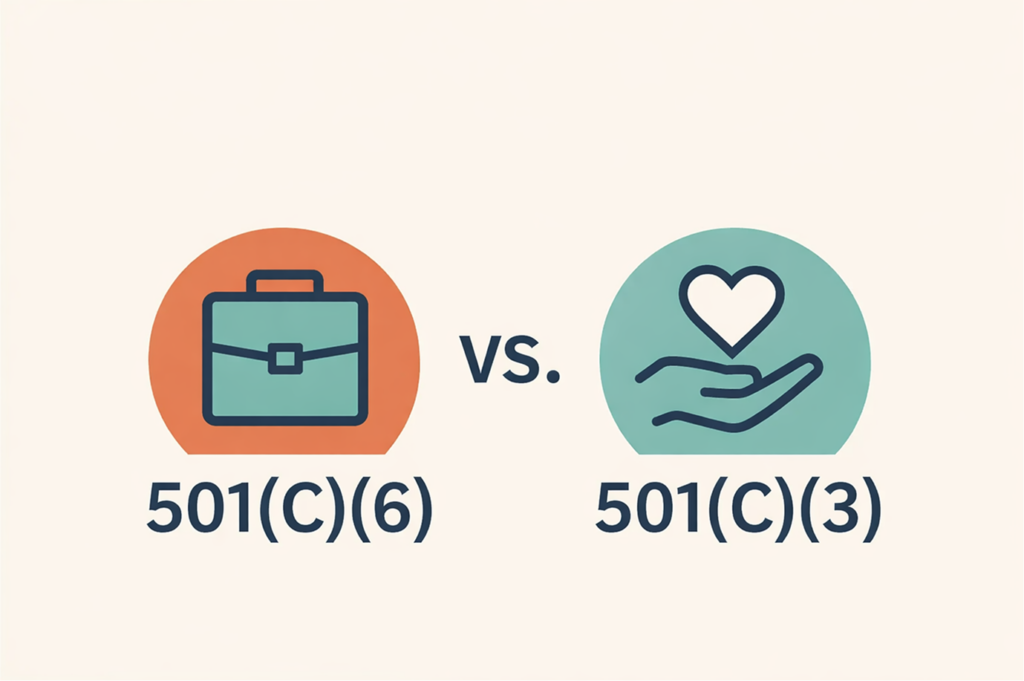
501c6 vs 501c3: The Core Difference
The main difference between a 501c3 and 501c6 is their purpose:
- 501(c)(3): Exists to benefit the general public.
- 501(c)(6): Exists to benefit an industry, profession, or collective business interest.
This difference drives everything else—tax treatment, fundraising rules, lobbying limits, and eligible programs.
501(c)(3) Overview: Public Benefit Nonprofits
What Is a 501c3?
A 501c3 nonprofit is organized for charitable, educational, scientific, or religious purposes. Most public charities, community organizations, and foundations fall into this category.
Key Characteristics of a 501c3
- Donations are tax-deductible for donors
- Strict limits on lobbying
- Absolutely no political campaign activity
- Must demonstrate public benefit
- Revenue must directly support charitable programs
Common Examples
- Charities
- Foundations
- Schools
- Animal welfare groups
- Religious organizations
501(c)(6) Overview: Business & Professional Associations
What Is a 501c6?
A 501c6 organization—also referred to as a 501c6 nonprofit or 501c 6 non profit organization—exists to support the shared business interests of a profession, trade, or industry.
It does not need to serve the general public. Instead, it advances the collective goals of its members.
Key Characteristics of a 501c6
- Donations are not tax-deductible as charitable gifts
- Membership dues are typically tax-deductible as business expenses
- Can engage in unlimited lobbying related to its mission
- Can participate in limited political activity
- Programs may focus on advocacy, professional development, or industry advancement
Common Examples
- Chambers of commerce
- Trade associations
- Real estate associations
- Professional societies
- Business leagues
501c6 vs 501c3: Side-by-Side Comparison
Below is a simple, board-friendly comparison of the difference between a 501c3 and 501c6:
Purpose
- 501c3: Public benefit
- 501c6: Member or industry benefit
Tax-Deductibility for Donors
- 501c3: Yes, donations are tax-deductible
- 501c6: No, donations generally are not deductible as charitable gifts
Lobbying
- 501c3: Very limited
- 501c6: Allowed and often central to mission
Political Activity
- 501c3: Prohibited
- 501c6: Permitted in limited, issue-focused contexts
Revenue Restrictions
- 501c3: Must avoid private benefit or industry-focused programs
- 501c6: Can deliver direct member benefits, advocacy, and industry training
Examples
- 501c3: Food banks, schools, charities
- 501c6: Trade associations, chambers, professional associations
When Should an Organization Choose a 501c6?
A 501c6 is the better option if your mission is to:
- Advance an industry or profession
- Provide advocacy or lobbying
- Offer member benefits
- Serve businesses rather than the general public
- Host conferences, certifications, or professional development for members
Most professional associations and trade groups fall under this category for a reason—their work directly supports their members, not the broader public.
When Should an Organization Choose a 501c3?
A 501c3 is ideal if your mission focuses on:
- Charitable work
- Education
- Religious services
- Community-based programs
- Scientific or cultural initiatives
If the goal is broad public benefit—with minimal lobbying—501c3 is the right fit.
Can an Organization Have Both a 501c6 and a 501c3?
Yes—and many associations do.
A 501c6 may create a related 501c3 foundation to:
- Accept tax-deductible donations
- Offer scholarships
- Fund public education programs
- Support research initiatives
This dual-entity structure expands fundraising opportunities and creates clear boundaries between member-serving work (501c6) and public-serving work (501c3).
Compliance Considerations for 501c6 Organizations
Association leaders often underestimate the regulatory requirements of a 501c6 organization. Key areas include:
- Lobbying reporting and IRS communication
- Proper allocation of dues for lobbying (per IRS rules)
- Avoiding private inurement
- Maintaining transparent financial oversight for chapters (in multi-chapter orgs)
- Keeping member benefits aligned with exempt purpose
This is where many associations rely on modern financial platforms—like Crowded—to maintain chapter transparency, reserve standards, and compliant financial workflows.
Which Status Is Right for Your Organization?
If you primarily:
- Represent businesses
- Advocate for an industry
- Provide certifications, networking, or member benefits
- Operate through chapters
- Host conferences or trade shows
…a 501c6 is almost always the best fit.
If you:
- Provide charitable services to the public
- Rely heavily on grants or philanthropy
- Need tax-deductible donations
- Avoid lobbying
…a 501c3 is the proper structure.
How Crowded Supports 501(c)(3) and 501(c)(6) Organizations
Crowded makes it easier for both 501(c)(3) and 501(c)(6) organizations to manage finances, spending, and compliance across chapters and programs. With FDIC-insured digital banking, sub-accounts, spending controls, receipt uploads, and built-in tax documentation, every transaction stays tied to the right fund, event, or mission.
Leaders get real-time visibility into cash, approvals, and filings, while local volunteers maintain autonomy for day-to-day expenses. Whether your nonprofit exists to serve the public or your members, Crowded reduces manual work, strengthens oversight, and keeps financial operations running smoothly.
Final Thoughts: Choose the Structure That Matches Your Mission
The 501c6 vs 501c3 distinction comes down to one simple question:
Who does your organization exist to serve, the public or your members?
Once you clarify that, the right structure becomes clear.
For associations, chambers, trade groups, and professional societies, the 501(c)(6) is the IRS category designed specifically for your work.
A clear understanding of your tax status strengthens governance, eliminates compliance risk, and empowers your organization to focus on what matters most: advancing your mission and serving your members.
Your questions, answered.
What is the main difference between a 501c3 and 501c6?
The core difference between a 501c3 and 501c6 is their purpose.
A 501c3 serves the general public through charitable or educational programs, while a 501c6 serves an industry or professional membership group. This distinction drives differences in tax-deductibility, lobbying rules, and allowable activities.
Is a 501c6 a nonprofit?
Yes. A 501c6 organization is a type of nonprofit recognized by the IRS, but it is not considered a charitable organization. Instead, it supports the shared business or professional interests of its members.
Are donations to a 501c6 tax-deductible?
No. Donations to a 501c6 are generally not tax-deductible as charitable contributions.
However, membership dues to a 501c6 may be deductible as ordinary business expenses if they relate to the member’s trade or profession.
Can a 501c6 engage in lobbying?
Yes. One of the biggest advantages of a 501c6 is the ability to engage in unlimited lobbying related to its mission. This makes the classification ideal for associations, chambers of commerce, trade groups, and professional societies.
What is a 501c6 used for?
A 501c6 nonprofit supports the collective interests of a profession or industry. Common activities include:
- Advocacy and lobbying
- Professional development
- Certifications
- Conferences
- Networking programs
- Industry standards or research