Many nonprofit local chapters assume that once they become part of an IRS group exemption, their tax-exempt status continues automatically. However, Rev. Proc. 2026-8 introduces updated requirements that affect how central organizations maintain their group exemption and how subordinate organizations remain eligible to remain under it. While the new revenue procedure primarily places responsibilities on the national organization, local chapters, affiliates, branches, and councils also have an important role in maintaining compliance.
For chapter leaders, treasurers, and volunteer officers, this doesn’t mean your chapter suddenly needs to file its own exemption application. It means your organization’s governance, financial records, and ongoing relationship with headquarters matter more than ever.
This guide explains what subordinate organizations should know about Rev. Proc. 2026-8, what situations could place a chapter at risk, and the practical steps nonprofit local chapters can take to remain compliant while supporting their central organization.
TL;DR
- Rev. Proc. 2026-8 raises the stakes for subordinate organizations by putting greater focus on eligibility, affiliation, oversight, and documentation.
- Local chapters can face risk even when HQ owns the formal compliance process, especially when records are outdated or reporting is inconsistent.
- Chapter treasurers should verify their status, governing documents, EIN details, bank access, and financial records now.
- Removal from a group exemption can create new filing, governance, and operational burdens, making prevention far easier than recovery.
- Crowded helps chapters and headquarters stay audit-ready with dedicated accounts, centralized visibility, permission-based access, and more consistent financial workflows.
What Is a Subordinate Organization?
A subordinate organization is a nonprofit organization that receives federal tax-exempt recognition through a central organization’s IRS group exemption rather than applying for its own IRS determination letter.
Subordinate organizations commonly include:
- Local nonprofit chapters
- State affiliates
- Regional branches
- Local associations
- Councils
- Membership-based local organizations
Instead of each chapter applying for recognition under Section 501(c) independently, the central organization obtains a group exemption, allowing eligible subordinate organizations to operate under that umbrella.
This model reduces administrative work, creates organizational consistency, and allows national nonprofits to oversee numerous affiliated organizations while maintaining a unified tax-exempt structure.
Why Rev. Proc. 2026-8 Matters to Local Chapters
Although Rev. Proc. 2026-8 is primarily directed at central organizations, it changes expectations for subordinate organizations by establishing a more structured framework for eligibility, oversight, and ongoing compliance.
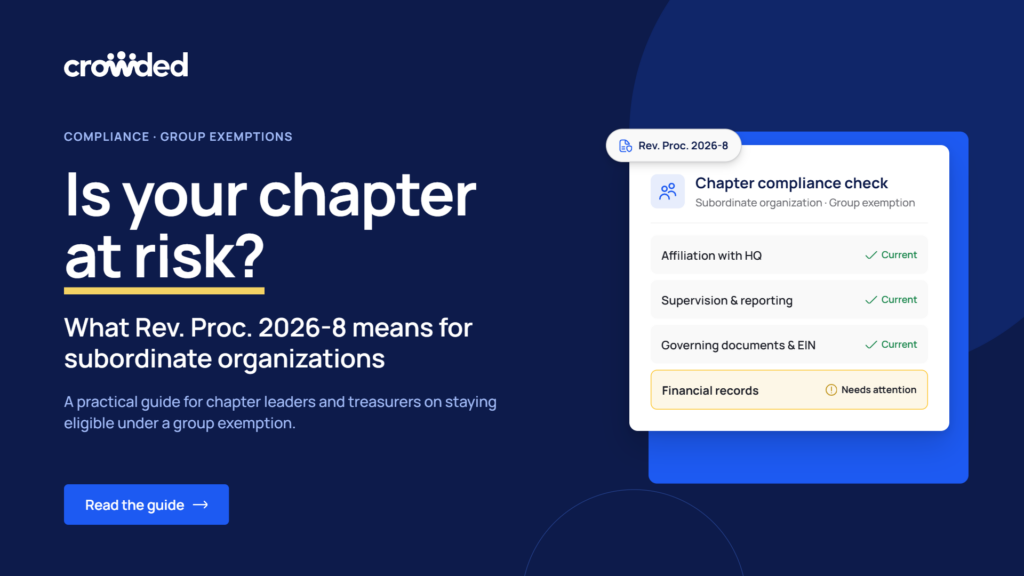
In practical terms, headquarters must now be better prepared to demonstrate that every subordinate organization included in its group exemption:
- Continues to qualify for inclusion
- Maintains the required affiliation with the central organization
- Operates under appropriate supervision
- Has current organizational documentation
- Remains eligible under IRS requirements
For nonprofit local chapters, maintaining organized records and staying engaged with headquarters is no longer merely good governance; it also supports the organization’s overall compliance responsibilities.
The new guidance doesn’t fundamentally change how chapters operate day to day, but it raises the importance of documentation, communication, and consistent financial management across the entire organization.
Could Your Chapter Be Removed From the Group Exemption?
The possibility of removal is one of the most significant questions surrounding Rev. Proc. 2026-8 subordinate organizations. The good news is that removal generally results from identifiable compliance issues. Understanding these situations can help chapters reduce unnecessary risk.
Your Chapter No Longer Meets Affiliation Requirements
A subordinate organization must maintain a meaningful relationship with its central organization.
Potential concerns may arise if a chapter:
- Operates independently of headquarters
- Stops following governing documents or bylaws
- Adopts policies inconsistent with the national organization
- Functions as though it were a completely separate entity
If the required affiliation no longer exists, the central organization may determine that the chapter no longer qualifies under the group exemption.
The National Organization Cannot Demonstrate Supervision
One of the defining characteristics of a valid IRS group exemption is ongoing supervision by the central organization. That doesn’t mean headquarters manages every local decision.
It does mean there should be evidence of an active relationship through activities such as:
- Regular reporting
- Governance oversight
- Policy compliance
- Officer updates
- Organizational communication
If headquarters cannot demonstrate appropriate supervision across its subordinate organizations, maintaining the group exemption becomes more difficult. For chapters, responding to requests from headquarters and participating in required reporting helps support this oversight.
Required Documentation Is Missing
Another important feature of Rev. Proc. 2026-8 is the increased emphasis on maintaining accurate documentation for subordinate organizations.
Depending on the organization, headquarters may need current records such as:
- Governing documents
- Authorization to be included under the group exemption
- Employer Identification Number (EIN)
- Organizational contact information
- Officer and leadership records
Missing or outdated documentation doesn’t automatically remove a chapter from the group exemption. Still, it can make it more difficult for the central organization to demonstrate ongoing eligibility during compliance reviews.
Financial Reporting Becomes Inconsistent
The IRS does not state that poor bookkeeping alone causes a subordinate organization to lose its place under a group exemption. However, inconsistent financial records often create a different problem.
If headquarters cannot obtain reliable financial information from local chapters, it becomes harder to demonstrate oversight, monitor organizational activity, and maintain accurate compliance records.
In other words, weak financial management can contribute to larger compliance challenges across the organization.
What Local Chapters Should Do Right Now
Most nonprofit chapters don’t need to overhaul their operations overnight.
Instead, focus on strengthening the practices that already support good governance.
A practical compliance checklist includes:
✓ Keep governing documents current
✓ Respond promptly to requests from headquarters
✓ Maintain accurate financial records throughout the year
✓ Use only approved organizational bank accounts
✓ Follow national financial and governance policies
✓ Document officer and leadership changes promptly
✓ Verify that your chapter’s EIN and organizational information remain accurate
✓ Retain important financial and governance records in an organized location
These habits make future compliance significantly easier for both the chapter and the central organization.
Questions Every Chapter Treasurer Should Ask
Chapter treasurers are often the first line of defense in maintaining nonprofit compliance.
Consider asking these questions regularly:
- Is our chapter currently included under the organization’s active group exemption?
- Does the headquarters have our latest governing documents?
- Are our financial records complete and easy to access?
- Who currently has authority over our bank accounts?
- Are our authorized signers still current?
- Can we quickly provide financial reports if the headquarters requests them?
- Have we documented recent leadership changes?
- Are we following the financial policies established by the national organization?
If several of these questions are difficult to answer, it may be worth reviewing your chapter’s administrative processes before the reporting season.
What Happens If a Chapter Is Removed?
Being removed from a group exemption doesn’t automatically mean an organization loses its federal tax-exempt status forever. However, it can create additional administrative responsibilities.
Depending on the circumstances, a removed chapter may need to:
- Seek its own IRS tax-exempt recognition
- Complete additional IRS filings
- Establish independent compliance processes
- Build separate governance procedures
- Reassure donors and stakeholders regarding its organizational status
Rev. Proc. 2026-8 also clarifies the procedures central organizations follow when removing subordinate organizations and explains how organizations may later regain recognition if they once again satisfy the applicable requirements.
For most chapters, the objective is to maintain the organizational practices that help prevent those situations from arising.
How Crowded Helps Chapters Stay Ready for Compliance
Preparing for nonprofit compliance is much easier when financial operations are already organized.
Instead of scrambling to locate reports or reconcile transactions whenever headquarters requests information, chapters using Crowded can maintain structured financial operations year-round.
Crowded helps nonprofit chapters support stronger operational readiness through capabilities such as:
- Dedicated chapter bank accounts
- Centralized financial visibility
- Permission-based access for officers and volunteers
- Standardized transaction tracking
- Built-in financial controls
- Simplified reporting to headquarters
- Reduced dependence on spreadsheets
- Clear financial records across multiple chapter leaders
For organizations managing multiple subordinate organizations, standardized financial workflows make collaboration between headquarters and local chapters more efficient while supporting stronger governance practices.
Compliance becomes easier when financial information is already organized before the reporting season begins.
Conclusion
Rev. Proc. 2026-8 subordinate organizations doesn’t mean every nonprofit chapter is suddenly at risk of losing its place under an IRS group exemption. What it does signal is a growing emphasis on documentation, oversight, organizational relationships, and consistent compliance across the entire nonprofit network.
For local chapters, the best response is preparation.
Maintaining current governance records, accurate financial information, and regular communication with headquarters supports both your chapter’s and the central organization’s compliance responsibilities.
Strong operational habits throughout the year are far more effective than trying to prepare after a compliance request arrives. As nonprofit compliance expectations continue to evolve, chapters that prioritize organization, transparency, and financial accountability will be in the strongest position to remain part of a healthy and well-managed group exemption structure.
Frequently Asked Questions
Can a new chapter join an existing group exemption?
Yes, if it meets the central organization’s eligibility requirements and follows the proper IRS procedures.
Do subordinate organizations need separate bank accounts?
Often, yes. Dedicated accounts can improve accountability, especially when the headquarters needs visibility across chapters. Crowded supports chapter-level accounts with centralized oversight.
How often should chapters review compliance records?
At least annually, especially before Form 990 preparation, leadership changes, or year-end reporting.
Can volunteer-led chapters stay compliant?
Yes. Clear processes, organized records, and tools like Crowded can simplify banking, approvals, and reporting for volunteer teams.
What records should chapters keep?
Governing documents, meeting minutes, financial reports, bank records, EIN details, officer information, and affiliation records.
How can Crowded support chapter compliance?
Crowded helps centralize financial visibility, standardize workflows, strengthen controls, and reduce spreadsheet dependence across nonprofit chapters.