

To set up a fiscal sponsorship agreement, choose a sponsorship model, confirm the sponsor’s mission matches your project, and sign a written contract that gives the sponsor legal control over donations before your first fundraising appeal goes out.
The contract covers 11 areas, from variance power and fees to who keeps the donor list at exit. Clear control language protects your sponsor’s tax-exempt status and your donors’ deductions.
TL;DR
- Under Rev. Rul. 68-489, a 501(c)(3) can fund a project that has yet to earn its own tax-exempt status when the charity keeps control and discretion over the money and records showing charitable use.
- Model C, the preapproved grant relationship, is offered by 63% of the 376 sponsors in the Fiscal Sponsor Directory, and Model A by 46%.
- Of the sponsors in the directory, 96% charge a percentage of project revenue. The most common range is 5% to 10%, and fees of 15% or more usually apply to projects funded by government grants.
- A fiscal sponsorship agreement protects donor deductions when the sponsor exercises discretion over every payment. The IRS can treat gifts forwarded on autopilot as made to the project itself.
- H.R. 9721, the Fiscal Sponsorship Transparency Act of 2026, cleared the House Ways and Means Committee by a 23-to-15 vote on July 22, 2026, and awaits a full House vote and Senate action. Its rules would start with tax years beginning after December 31, 2027.
What A Fiscal Sponsorship Agreement Decides
A fiscal sponsorship agreement is a written contract in which an established 501(c)(3) public charity receives tax-deductible donations for a charitable project and keeps legal control over how that money is used. Your project gains the sponsor’s tax-exempt status for fundraising, and the sponsor takes legal responsibility for the charitable use of every dollar.
Fiscal sponsorship rests on IRS rulings and practice, and the Internal Revenue Code and Treasury regulations leave the term undefined, according to the Joint Committee on Taxation. Your contract defines the rules of your arrangement.
Older contracts call the sponsor a “fiscal agent.” The field moved to “fiscal sponsor” after attorney Gregory Colvin’s 1993 book, Fiscal Sponsorship: 6 Ways To Do It Right, because a sponsor carries legal responsibility and keeps discretion and control over the funds.
Model A suits projects that have not yet formed a legal entity, because the project becomes a program of the sponsor. Model C usually works with a separate organization, such as a nonprofit corporation waiting on its IRS determination letter.
Step 1: Choose Between Model A and Model C
Choose Model A when you want the sponsor to run your back office, and Model C when you already have an organization and want to run your own operations. Colvin’s book describes six models, and these two cover most arrangements.
|
Model A (direct project) |
Model C (preapproved grant) |
|
|
Who legally owns donations |
The sponsor; the project is one of its programs |
The sponsor, until it grants the funds to the project |
|
Who employs project staff |
The sponsor |
The project’s own organization |
|
Separate legal entity |
Optional; the project runs inside the sponsor |
Usually required |
|
Who signs operating contracts |
The sponsor |
The project’s organization |
|
How lobbying limits apply |
Counted at the sponsor level, across all its projects |
Grant funds spent on lobbying can count as the sponsor’s lobbying |
|
Best fit |
Early, unincorporated projects |
Projects with their own entity, insurance and payroll |
|
Share of directory sponsors offering it |
46% |
63% |
Name your chosen model in your fiscal sponsorship agreement, since the model sets who owns funds, who employs staff, and who signs contracts. Model A gives your project full back office support from the sponsor. Model C gives your project operating independence, and 16% of sponsors in the Fiscal Sponsor Directory offer both.
We recommend Model C for projects that already have a legal entity, insurance, and someone to run payroll. Projects still building those pieces do well with Model A in their first year. Model C also suits projects planning their own 501(c)(3) soon, because closing a grant relationship makes a clean exit. Under Model A, staff, contracts, and assets all move out of the sponsor at exit.
Step 2: Vet The Fiscal Sponsor Before You Sign
Mission fit decides most applications to a fiscal sponsor. In the Fiscal Sponsor Directory, 87% of sponsors name-aligned mission and values as their main criterion for accepting a project, and 43% require projects to operate in their area.
Work through these steps before you negotiate terms:
- Confirm the sponsor’s 501(c)(3) public charity status in the IRS Tax Exempt Organization Search.
- Ask for its written sponsorship policies and a sample fiscal sponsorship agreement.
- Get the fee schedule in writing, along with the list of services the fee covers.
- Ask how long a disbursement request takes and who approves it.
- Prepare your side: a project description, a first-year budget, leadership bios, and your expected funding sources.
Individuals and for-profit companies can sometimes be sponsors when the activity is charitable and furthers the sponsor’s exempt purpose. Sponsor policies vary, so ask early and bring in a nonprofit attorney for any arrangement where funds reach a for-profit company.
The Fiscal Sponsor Directory lists 376 sponsors hosting 20,566 projects as of its May 2024 update, with filters for state and service category.
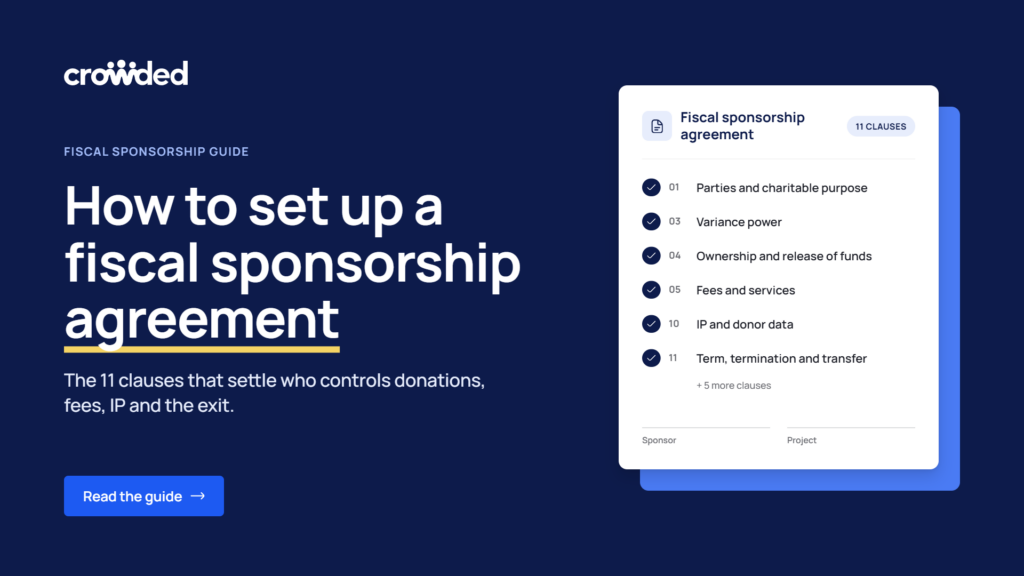
Step 3: Draft The 11 Clauses Every Fiscal Sponsorship Contract Needs
Ask the sponsor for its standard agreement and check it against these 11 clauses with your attorney before you sign. A strong fiscal sponsorship agreement settles each question below.
|
Clause |
Question It Settles |
|
1. Parties and charitable purpose |
Does our project fit the sponsor’s mission? |
|
2. Model and scope of activities |
What can we run without asking for new approval? |
|
3. Variance power |
When can the sponsor redirect our funds? |
|
4. Ownership and release of funds |
Who legally controls donations, and how fast do we get paid? |
|
5. Fees and services |
What fee is reasonable, and what does it cover? |
|
6. Fundraising and grant applications |
Whose name goes on appeals and grant applications? |
|
7. Reporting and recordkeeping |
What do we report, and how often? |
|
8. Taxes and compliance |
Who handles filings, registrations and lobbying limits? |
|
9. Staff, liability and insurance |
Who carries the risk if something goes wrong? |
|
10. Intellectual property and donor data |
Who keeps the name, website and donor list? |
|
11. Term, termination and transfer |
How do we leave or move to a new sponsor? |
1. Parties and Charitable Purpose
List both organizations’ full legal names, the sponsor’s 501(c)(3) status, and one sentence on how the project furthers the sponsor’s exempt purpose.
2. Model and Scope Of Activities
Name the model in the fiscal sponsorship contract. Attach the approved activities as an exhibit, and require written approval before the project adds new ones.
3. Variance Power
Variance power is the sponsor’s right to redirect donated funds to another charitable purpose if your project’s original purpose ends or becomes unlawful. This clause shows the sponsor holds genuine discretion. Example wording for your attorney to adapt: “All contributions received for the Project are assets of Sponsor. Sponsor retains discretion and control over their use and may redirect them to another charitable purpose if the Project’s purpose becomes impossible or unlawful to carry out.”
4. Ownership and Release Of Funds
State that the sponsor legally owns all donations. Then set the request process: who submits, what receipts or invoices are required, and how many business days a payment takes.
5. Fees and The Services They Buy
Most sponsors charge 5% to 10% of project revenue. Some 55 directory sponsors charge 15% or more, usually for projects funded by government grants that must meet federal audit standards. Government grants usually list the sponsor as the applicant or legal recipient, so build that rate into the grant budget. Write down whether the fee applies to all revenue or to donations only, and when it is deducted. Compare what each fee buys: nearly 3 in 4 sponsors include bookkeeping and bill paying, and over a third run payroll.
6. Fundraising and Grant Applications
Solicitations go out in the sponsor’s name. Name who approves appeals and who signs grant applications.
7. Reporting and Recordkeeping
Set how often the project sends financial and narrative reports, in what format, and confirm the sponsor’s right to inspect project records.
8. Taxes and Compliance
The sponsor reports sponsored funds on its own Form 990. The contract assigns charitable solicitation registrations, lobbying limits, and the rules on political campaign activity.
9. Staff, Liability and Insurance
Say who employs whom, which insurance each party carries, who indemnifies whom, and whether the project can sign contracts that bind the sponsor.
10. Intellectual Property and Donor Data
Decide who owns the project name, website domain, content, and donor list, both during the sponsorship and after it ends.
11. Term, Termination and Transfer
Set the notice period, the grounds for early termination, and where unspent restricted funds go. A clean exit clause lets the sponsor transfer remaining funds, assets, and grant agreements to the project’s new 501(c)(3) or to a successor sponsor, with the sponsor’s approval. Under Model C, the sponsor can grant remaining funds to the new 501(c)(3). Tell donors and funders your new legal name and EIN before your next appeal.
Step 4: Prove The Sponsor Exercises Discretion and Control
A fiscal sponsorship agreement holds up when the sponsor exercises discretion over the money in daily practice. Rev. Rul. 68-489 allows a 501(c)(3) to distribute funds to organizations outside section 501(c)(3) when it limits distributions to projects that further its own exempt purposes, keeps control and discretion over their use, and keeps records proving charitable use. When a sponsor acts as a mere conduit, the IRS can treat each gift as made straight to the project, and the deduction then depends on the project’s own status.
Picture a neighborhood food project that raises $60,000 through a sponsor. In version one, the sponsor wires each gift onward the week it arrives, and the file holds only bank transfers. In version two, the sponsor approves a budget first, releases money against invoices, and declines a $4,000 request outside the budget. Version two leaves a clear paper trail of control.
Congress wants that paper trail on record. H.R. 9721, the Fiscal Sponsorship Transparency Act of 2026, would require 501(c)(3) sponsors to report each arrangement’s parties, amounts, activities, managing officer and start and end dates. The version the House Ways and Means Committee approved by a 23-to-15 vote on July 22, 2026 sets a 20% excise tax on amounts knowingly transferred under an “improper conduit arrangement,” a 100% tax on transfers left uncorrected, and a 5% tax, capped at $10,000, on managers who knowingly approve one. As of October 2026, the bill awaits a full House vote and Senate action.
Treasury announced in April 2026 that it plans revised Form 990 reporting for fiscal sponsorship. Nonprofit law firm Perlman & Perlman advises sponsors to review their agreements now and confirm they document the sponsor’s discretion and control over sponsored funds.
Step 5: Set Up Controls Before The First Donation
Have authorized signers from both organizations sign the fiscal sponsorship agreement before public fundraising starts. For Model C, both organizations’ authorized leadership approves the arrangement.
Then put the controls in place: a separate ledger or bank account for each sponsored project, a written approval workflow for spending, a calendar of report due dates, and donor acknowledgments issued by the sponsor. Donors make gifts payable to the sponsor, which keeps donations tax-deductible for eligible donors. A “retains discretion” clause protects everyone once every payment runs through approval.
How Crowded Supports Fiscal Sponsors and Sponsored Projects
Crowded, a compliant money movement and banking platform for mission-driven organizations, gives fiscal sponsors a dedicated fund account for each sponsored project, so each project’s donations and spending sit in its own account.
Sponsor staff get a combined view across every sponsored project, and each project lead gets a personal login with role permissions. Policy controls stop spending outside your policy before money moves, and statements for each fund give your auditor a record that backs up the control terms in your fiscal sponsorship agreement.
Projects looking for a sponsor can apply to Crowded Foundation, a separate 501(c)(3) public charity that currently offers Model C sponsorship. Its team reviews applications within 5 business days.
Your attorney drafts and reviews the agreement, and Crowded works alongside your attorney, accounting software, and donor CRM. Before you sign, map where each sponsored project’s money will sit and who approves its spending.
This article shares general information for educational purposes. Please have a nonprofit attorney review your agreement before you sign it.
Crowded Technologies Inc. is a financial technology company and is not a bank. Banking services provided by i3 Bank, Member FDIC.
Frequently Asked Questions
What should a sponsorship contract cover?
A fiscal sponsorship agreement covers 11 areas: parties and purpose, model and scope, variance power, ownership and release of funds, fees, fundraising, reporting, taxes and compliance, staff and liability, intellectual property and donor data, and the terms for ending the relationship. Ask the sponsor for its standard agreement and review it against that list with your attorney.
Which model fits a new project, Model A or Model C?
Model A fits early projects that have not yet formed a legal entity, because the sponsor runs the back office. Model C fits projects with their own entity, insurance, and payroll. We recommend Model C for projects planning to become their own 501(c)(3) soon, since a grant relationship makes a clean exit.
How much do fiscal sponsors charge?
Most charge 5% to 10% of project revenue, according to the Fiscal Sponsor Directory, where 96% of sponsors charge a percentage. Projects funded by government grants often carry fees of 15% or more because of federal audit standards. Compare the services each fee covers, such as bookkeeping, bill paying, and payroll.
How do donors keep their tax deduction?
Donors give to the sponsor, and the sponsor keeps discretion and control over the funds, as Rev. Rul. 68-489 requires. Gifts are made payable to the sponsor, and the sponsor sends each donor an acknowledgment. Donors can confirm their own deduction with a tax adviser.
What would H.R. 9721 change for fiscal sponsors?
H.R. 9721 would require 501(c)(3) sponsors to report each arrangement’s parties, amounts, activities, managing officer, and dates. It also sets excise taxes on improper conduit arrangements, starting at 20% of amounts knowingly transferred. The House Ways and Means Committee approved it on July 22, 2026, and the bill awaits a full House vote and Senate action.
How does Crowded support fiscal sponsors?
Crowded gives each sponsored project its own fund account, a combined view for sponsor staff, personal logins for project leads, and policy controls that stop spending outside policy before money moves. This reflects Crowded’s Trust value: “We are stewards of our clients’ funds.” It also serves the Crowded vision: “Crowded envisions a world where every dollar reaches its given purpose.”
Is Crowded Foundation part of Crowded?
Crowded Foundation is a separate 501(c)(3) public charity, distinct from Crowded Technologies Inc. It sponsors projects through Model C, and its team reviews applications within 5 business days. Its work reflects Crowded’s Nonprofit Native value: built for nonprofits from day one.