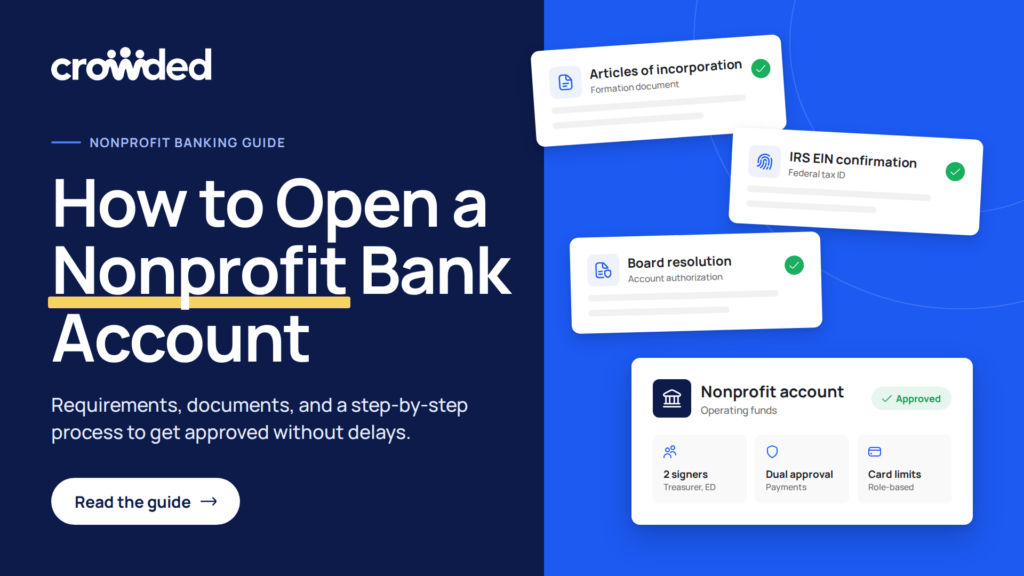
Learning how to open a nonprofit bank account starts with understanding the basic requirements. Most nonprofits need a legal structure, an EIN, formation documents, board authorization, and verified representatives before the account can be approved.
Because the account belongs to the organization, not an individual, authorized users must have documented authority, and all legal information should match across IRS, state, and banking records.
This guide covers the documents, signers, verification steps, and nonprofit banking options that can help organizations avoid delays and strengthen financial controls.
TL;DR
- Learning how to open a nonprofit bank account starts with the right legal structure, EIN, board approval, authorized signers, and consistent organizational documents.
- Preparing these requirements before applying can reduce verification delays and prevent account-access problems later.
- Nonprofits should separate personal and organizational funds, assign role-based permissions, and plan for leadership transitions from day one.
- Chapters, foundations, and multi-program organizations may need more flexible account structures to maintain both fund separation and centralized oversight.
- Crowded helps nonprofits move beyond basic banking with purpose-built accounts, permissions, expense management, and financial controls designed for nonprofit operations.
What Does It Mean to Open a Nonprofit Bank Account?
Opening a nonprofit bank account means creating an account in the organization’s legal name rather than an individual’s name. Most nonprofits need an EIN, formation documents, governing-body approval, and identity verification for authorized representatives.
Because nonprofits handle donations, grants, dues, and restricted funds, providers may require additional documentation to confirm who can access and manage the account.
What Do You Need to Open a Nonprofit Bank Account?
If you’re researching how to open a nonprofit bank account, most financial institutions will ask for the following:
- The nonprofit’s legal organizational name
- An Employer Identification Number (EIN)
- Articles of incorporation or another formation document
- Bylaws or a constitution, when requested
- A board resolution authorizing the account
- Government-issued identification for authorized signers
- The nonprofit’s physical business address
- Information about the organization’s mission and funding
- An IRS determination letter, if available or required
- An opening deposit, when required by the provider
The exact requirements for nonprofit bank accounts vary by financial institution, legal structure, and state. Some providers may request additional information during the verification process.
Here’s how to open a nonprofit bank account in seven steps:
Step 1: Form Your Organization Before You Open a Nonprofit Bank Account
Before opening a nonprofit bank account, confirm that the organization is legally formed and apply using its exact legal name. Depending on its structure, this may require articles of incorporation, a certificate of formation, a charter, a constitution, or another organizing document.
Legal formation is separate from federal tax-exempt recognition. Some nonprofits may open an account before receiving 501(c)(3) status, but they must be able to document their legal existence. Requirements may also differ for associations, chapters, foundations, and trusts.
Step 2: Get an EIN to Open a Nonprofit Bank Account
An Employer Identification Number (EIN) is the federal tax ID assigned to an organization by the IRS. Most nonprofits need one to open an account, even without employees, because it identifies the organization for tax and financial purposes.
An EIN is commonly required to:
- Open a nonprofit bank account
- Apply for federal tax-exempt status
- File IRS Form 990-series returns
- Hire employees
- Process payroll
- Apply for grants
- Establish merchant or payment accounts
Use the nonprofit’s exact legal name so its application matches the EIN and formation records. Chapters, affiliates, and subordinate organizations should also confirm whether they use a parent organization’s EIN or need their own, since an incorrect EIN can delay verification.
Step 3: Obtain Board Approval Before Opening a Nonprofit Bank Account
Financial institutions generally expect the nonprofit’s governing body to authorize the opening of the account before an officer begins the application. A board resolution or approved meeting minutes demonstrates that the organization, not an individual, is authorizing the account.
A banking resolution commonly identifies:
- The financial institution or account provider
- The type of account being opened
- The officers authorized to submit the application
- The people permitted to sign or transact
- Whether one or multiple approvals are required
- Who may issue cards or approve payments
- Who may add or remove account users
A simple resolution may authorize the organization to open the account and name the Treasurer and Executive Director as representatives. The final wording should align with the nonprofit’s bylaws and governance policies to confirm authority and prevent delays.
Step 4: Gather the Documents Required to Open a Nonprofit Bank Account
Preparing every required document before beginning the application is one of the easiest ways to speed up the process of opening a nonprofit bank account. While requirements differ among providers, most organizations should expect to provide documents in three categories.
Organizational Documents
These documents establish the nonprofit’s legal identity.
Typical requirements include:
- Articles of incorporation
- Certificate of formation or equivalent document
- Bylaws or constitution
- Certificate of good standing, when requested
- IRS EIN confirmation
- IRS determination letter, if available
- Recent Form 990, when applicable
- Board resolution authorizing the account
It’s important to distinguish between an EIN confirmation and an IRS determination letter. An EIN identifies the organization for federal tax purposes, while a determination letter confirms that the IRS recognizes the organization as tax-exempt.
Representative and Signer Information
Every authorized representative may be asked to provide:
- Government-issued photo identification
- Full legal name
- Residential address
- Date of birth
- Tax identification information
- Organizational title
- Phone number and email address
Financial institutions use this information to verify the identities of the individuals responsible for managing the organization’s funds.
Organizational Activity Information
Many providers will also ask questions about the nonprofit itself, including:
- Physical business address
- Website or public profile
- Mission and organizational activities
- Expected monthly transaction volume
- Primary funding sources
- Expected deposits and payments
- Countries where funds may be sent, if applicable
If information cannot be verified electronically, the provider may request additional supporting documentation. Preparing these materials before you open a nonprofit bank account can significantly reduce verification delays and create a smoother application experience.
Step 5: Choose the Right People as Authorized Signers
One of the most important decisions in opening a nonprofit bank account is determining who should have access to the account. While many people assume a board member, treasurer, or executive director automatically manages the organization’s finances, each role carries distinct responsibilities.
For example:
- Board members provide governance but may not need direct access to accounts.
- Officers are typically authorized to act on behalf of the organization.
- Account administrators manage users, permissions, and settings.
- Authorized signers can approve transactions and legally act on behalf of the organization.
- Cardholders may only be allowed to make purchases within assigned spending limits.
Choosing the right people is about more than convenience—it’s an important financial control. Account access should always follow documented organizational roles rather than personal relationships.
Before you open a nonprofit bank account, consider establishing:
- At least two qualified account administrators
- Separate permissions for viewing, spending, and approving payments
- Spending limits for debit cards
- A documented process for removing former officers
- Leadership transition procedures
- Dual approvals for larger or higher-risk transactions
Many nonprofits experience account access problems when a founder, volunteer treasurer, or former officer leaves the organization. Establishing multiple administrators and documented permissions from the beginning reduces operational risk and helps ensure continuity.
Step 6: Complete Identity and Organization Verification
After submitting your application, the financial institution will begin verifying both the nonprofit and the individuals authorized to manage the account.
During this stage, the provider may verify:
- The organization’s legal existence
- Its EIN and legal name
- State registration details
- Organizational address
- The identity of authorized representatives
- Individuals with significant responsibility or control
- The nonprofit’s mission and expected financial activity
- Sources of funding
- Expected transaction volume
Verification is a standard part of opening a financial account. Additional questions usually mean the provider needs more information, not that there is a problem. To reduce delays, make sure the nonprofit’s legal name, EIN, address, officer details, and formation documents are consistent before applying.
Step 7: Fund Your Nonprofit Bank Account and Establish Financial Controls
Successfully opening the account is only the beginning. After you open a nonprofit bank account, it’s important to configure it to support transparency, accountability, and long-term financial management.
Once the account is active, your nonprofit should:
- Deposit initial operating funds
- Confirm who can initiate ACH transfers and payments
- Set debit card spending limits
- Establish payment approval workflows
- Connect accounting software and payment platforms
- Schedule regular account reconciliations
- Determine how restricted funds will be tracked
- Store account statements centrally
- Create a documented leadership transition process
Keep personal and nonprofit funds separate to improve bookkeeping, strengthen oversight, and support compliance. Clear financial controls also make reporting, growth, and leadership transitions easier to manage.
Can You Open a Nonprofit Bank Account Before Receiving 501(c)(3) Status?
Yes, in many cases, you can open a nonprofit bank account before receiving IRS recognition as a 501(c)(3), provided your organization has been legally formed and has obtained an Employer Identification Number (EIN).
However, it’s important to understand that these are separate milestones:
- Incorporation creates the organization under state law.
- An EIN identifies the organization for federal tax purposes.
- An EIN does not automatically grant tax-exempt status.
- An IRS determination letter confirms federal recognition as a tax-exempt organization.
Some financial institutions will allow legally formed nonprofits with an EIN to open an account while their tax-exemption application is pending, while others may require additional documentation. Always review the provider’s requirements before applying.
How Long Does It Take to Open a Nonprofit Bank Account?
A nonprofit bank account may be approved within a few business days once the documents are complete and the organization is verified electronically. Missing paperwork, inconsistent records, or additional identity checks can extend the timeline, so preparing everything in advance helps prevent delays.
Can You Open a Nonprofit Bank Account Online?
Yes. Many financial institutions now allow organizations to open a nonprofit bank account online, eliminating the need to visit a physical branch.
Digital account opening typically includes:
- Online application submission
- Identity verification
- Organizational verification
- Electronic document upload
- Digital signatures
- Online account administration
For nonprofits with remote teams, volunteer leaders, or distributed chapters, online banking can simplify both account setup and ongoing financial management.
Common Reasons Nonprofit Bank Account Applications Are Delayed
Even organizations with the correct documents can experience delays if information is inconsistent.
Some of the most common reasons include:
- The nonprofit’s legal name does not match IRS or state records.
- The EIN belongs to another organization or parent entity.
- The applicant lacks documented board authorization.
- Required formation documents are incomplete.
- Government-issued identification has expired.
- Former officers are still listed as authorized representatives.
- The nonprofit cannot clearly explain its funding sources or expected banking activity.
- The organization’s website or public information conflicts with the application.
Before submitting your application, review every document carefully. Consistency across organizational records is one of the most important factors in successfully opening a nonprofit bank account.
Open a Nonprofit Bank Account Designed for Nonprofit Operations
Opening the account is only the first step. Crowded helps nonprofits, associations, foundations, and chapters manage banking, spending, permissions, and daily financial operations in one nonprofit-focused platform.
With Crowded, organizations can access:
- Fully digital nonprofit account setup
- No minimum balance requirements
- Online signatory changes
- Physical and virtual debit cards
- Permission-based access controls
- Read-only access for accountants and advisors
- Sub-accounts for chapters, committees, programs, or restricted funds
- Built-in expense management
- Receipt collection
- Centralized transaction visibility across the organization
These capabilities help nonprofits strengthen financial controls while reducing administrative work. Crowded also allows organizations with chapters, affiliates, or multiple programs to separate funds, manage permissions, monitor spending, and update account access from one platform.
Instead of adopting a generic business account, nonprofits can use a solution tailored to their financial management.
Crowded is a financial technology company, not a bank. Banking services are provided through Crowded’s partner financial institutions.
Conclusion
Knowing how to open a nonprofit bank account comes down to preparation: the proper legal structure, an EIN, board authorization, the required documents, and verified signers. Preparing these requirements in advance reduces delays and strengthens financial oversight.
Crowded helps nonprofits go beyond basic banking with purpose-built accounts, permission controls, expense management, and financial tools designed for nonprofit operations.
Frequently Asked Questions
Can a nonprofit have multiple bank accounts?
Yes. Nonprofits may use separate accounts for operating funds, reserves, grants, chapters, or restricted funds.
Can an accountant access a nonprofit bank account?
Yes. Accountants can receive read-only or limited access for reconciliation and reporting. Crowded allows nonprofits to assign permissions based on each user’s role.
Do nonprofit chapters need separate accounts?
It depends on the organization’s structure. Crowded can help chapters separate funds while giving administrators centralized visibility.
What happens when an authorized signer leaves?
The nonprofit should remove the signer immediately and update account permissions. Multiple administrators and documented transition procedures help prevent access issues.
What should nonprofits look for in a banking platform?
Look for permission controls, approval workflows, expense management, online signer changes, and support for multiple programs or chapters. Crowded combines these capabilities in one nonprofit-focused platform.
How do you open a nonprofit bank account?
To open a nonprofit bank account, form your organization, get an EIN, obtain board approval, gather your documents, choose authorized signers, complete verification, and fund the account.