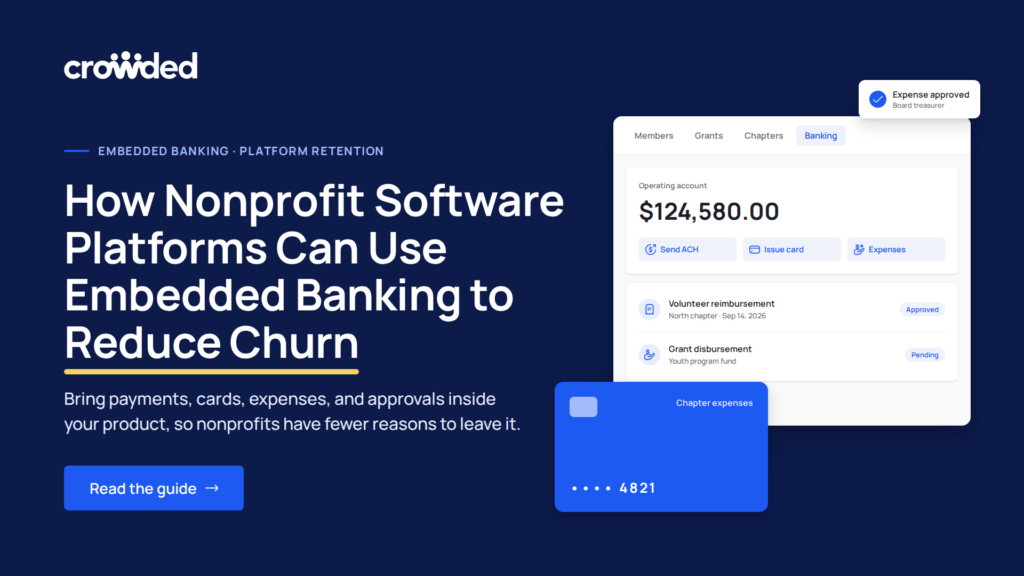
Embedded banking nonprofit platform churn often begins when critical financial work happens outside the software. Nonprofit platforms may manage donors, grants, members, or chapters, but users still leave to handle payments, expenses, cards, balances, and reconciliation elsewhere.
That fragmentation weakens engagement and makes the platform easier to replace. By bringing daily financial workflows into the product, embedded banking helps software providers increase stickiness and become the place nonprofits actually run their organizations.
TL;DR
- Embedded banking nonprofit platform churn is often driven by disconnected financial workflows rather than missing product features.
- Every time nonprofit users leave a platform to manage banking, payments, cards, or expenses, the platform loses engagement and operational value.
- Embedding nonprofit-specific financial tools inside the product can increase daily usage, improve product stickiness, and strengthen customer retention.
- Generic embedded finance solutions rarely address nonprofit operational needs like restricted funds, chapter banking, board oversight, and grant management.
- Crowded helps nonprofit software platforms embed banking, payments, expense management, and financial workflows without building complex banking infrastructure themselves.
Why Nonprofit Platform Churn Often Starts Outside Your Product
Most SaaS companies link churn to pricing, onboarding, support, or feature adoption. But nonprofit customers often disengage because critical financial workflows happen outside the product.
A typical organization may use one platform for fundraising, another for accounting, a separate bank portal for payments, an expense tool for reimbursements, spreadsheets for grants, and another system for chapter finances.
Your software may manage the data, but the work customers perform every day happens elsewhere.

Those workflows often include:
- Checking account balances
- Sending ACH payments
- Issuing virtual or physical cards
- Reviewing expenses
- Approving purchases
- Managing reimbursements
- Paying vendors
- Monitoring grant spending
- Tracking chapter transactions
- Reviewing financial reports
These recurring financial tasks often determine whether a platform stores information or helps users complete real work.
When banking, payments, and expenses happen elsewhere, other tools gain value while platform engagement declines. By renewal, the product may no longer feel essential.
That is why embedded banking nonprofit platform churn often begins long before cancellation, when customers develop habits that require them to leave the platform for critical financial workflows.
How Embedded Banking Nonprofit Platform Churn Increases Through Disconnected Financial Workflows
Nonprofit software companies often add dashboards, integrations, reporting tools, and AI features to improve engagement. But retention may depend more on reducing how often users leave the platform.
Disconnected financial workflows force users to switch systems, re-enter data, reconcile transactions, and manage separate permissions. A finance manager may review spending in one platform, approve ACH payments in another, check receipts elsewhere, and then return to update records manually.
Each step may seem manageable, but together they create a fragmented experience. Instead of becoming the organization’s operational hub, the platform becomes just one stop in a longer workflow.
Connected vs. Fragmented Financial Workflows
Connected Platform Experience | Fragmented Platform Experience |
Banking happens inside the platform | Users leave for a separate banking portal |
Cards are managed within existing permissions | Cards are managed through another provider |
ACH payments happen within existing workflows | Payments are initiated outside the platform |
Expenses, receipts, and approvals stay together | Teams move between multiple applications |
Financial activity updates automatically | Staff manually reconcile transactions |
One source of operational truth | Data is scattered across systems |
Higher daily engagement | Lower product usage over time |
Stronger product stickiness | Greater risk of customer churn |
These differences directly shape the customer experience. Disconnected workflows create more logins, manual reconciliation, and opportunities for other products to become more valuable.
As key financial tasks move outside the platform, engagement declines, adoption weakens, expansion slows, and churn risk grows. That is why embedded banking nonprofit platform churn is a product engagement, retention, and platform economics issue.
By bringing banking, payments, approvals, and financial controls into the product, platforms can reduce friction, strengthen customer dependence, and become harder to replace.
Why Embedded Banking Changes Platform Economics
Embedded banking is more than a technical integration. It changes how often customers use the platform and how much they depend on it.
Financial tasks happen continuously. Nonprofits check balances, approve expenses, issue cards, reimburse volunteers, pay vendors, and monitor transactions throughout the week. When those workflows happen inside the product, they can improve:
- DAU and MAU through more frequent usage
- Product stickiness by connecting operations with financial execution
- Expansion revenue through cards, payments, accounts, and premium services
- Customer lifetime value through stronger adoption and retention

The goal is simple: keep more essential workflows inside the platform. That strengthens the customer relationship and helps reduce embedded banking nonprofit platform churn over time.
Why Nonprofits Need Embedded Banking Differently Than Other Industries
Generic embedded banking solutions are often built for commercial businesses with simple ownership structures, centralized finance teams, and straightforward approvals.
Nonprofits operate differently. They may need to manage:
- Restricted and unrestricted funds
- Multiple chapters or affiliated entities
- Volunteer treasurers and distributed users
- Grant-specific spending
- Board and finance committee approvals
- Clear audit trails for compliance and donor accountability

National organizations may need local chapters to manage spending while headquarters maintains oversight. Fiscal sponsors may need separate controls for multiple projects without creating disconnected banking relationships.
These are operational workflow challenges, not just banking needs. Nonprofit-specific infrastructure helps platforms support permissions, fund separation, reporting, and stronger adoption while reducing embedded banking nonprofit platform churn.
What Nonprofit Platforms Should Look for in an Embedded Banking Partner
Choosing an embedded banking partner is a long-term product decision. Nonprofit software platforms should look beyond basic APIs and assess whether the infrastructure supports the financial workflows their customers manage every day.
A strong partner should offer:
- Flexible APIs and developer tools that integrate into existing workflows without forcing a full product redesign.
- Nonprofit-specific infrastructure for chapters, grants, restricted funds, sponsored projects, volunteers, and multiple entities.
- Role-based permissions for staff, board members, chapter leaders, and other financial users.
- Flexible account structures that support programs, funds, committees, regions, and affiliated organizations.
- Integrated cards and expense management with spending controls, receipts, approvals, and reporting.
- Native payment capabilities for vendors, reimbursements, collections, and grant disbursements.
- Real-time reporting and financial data that reduce reconciliation and improve visibility.
- Security, compliance, and onboarding support that reduce the operational burden on the platform.
The right partner should simplify development and improve the customer experience. The goal is not only to launch embedded finance, but to reduce workflow fragmentation, increase adoption, and address embedded banking nonprofit platform churn.
Turn Embedded Banking Into a Retention Advantage
For nonprofit software platforms, embedded banking should strengthen retention.
Crowded provides nonprofit-specific infrastructure for organizations, associations, chapters, and fiscal sponsors. Instead of combining multiple banking, payment, and expense providers, platforms can deliver one connected financial experience within their own product.
Depending on the platform’s needs, Crowded Embedded Banking can support capabilities such as:
- Digital nonprofit bank accounts
- Embedded ACH payments and transfers
- Physical and virtual cards
- Built-in expense management
- Approval workflows
- Permission-based financial access
- Financial controls for distributed organizations
- Chapter and multi-entity account structures
- Transaction reporting
- Developer-friendly APIs and embedded components
Embedded banking creates more than a broader product roadmap. It gives nonprofit users one place to manage banking, payments, expenses, approvals, and reporting.
That increases engagement, reduces workflow fragmentation, and makes the platform harder to replace. In this way, embedded banking nonprofit platform churn becomes a growth opportunity.
The goal is to become the software nonprofits rely on every day.
Build the Platform Nonprofits Depend On
Reducing churn is not always about adding more features. Sometimes, it means removing the reasons customers leave your platform.
When nonprofit users rely on separate tools for banking, payments, cards, approvals, and expenses, your product loses engagement and becomes easier to replace. That is why embedded banking nonprofit platform churn is ultimately a platform economics challenge.
By bringing essential financial workflows into one connected experience, software providers can reduce friction, improve product stickiness, strengthen retention, and become the platform nonprofits rely on every day.