A chapter financial policy nonprofit volunteers can easily understand gives local leaders clear guidance on budget management, expense approval, event revenue collection, and reimbursement submissions. Without consistent financial rules, chapters often rely on assumptions or verbal instructions, which can lead to uneven practices, avoidable risk, and added work for headquarters.
The policy should establish a practical framework for how local chapters spend money, request reimbursements, handle cash, access bank accounts, and document financial activity. More importantly, a strong chapter financial policy nonprofit volunteers can follow should help them make confident financial decisions without interpreting complex governance documents.
Whether your organization oversees five chapters or hundreds, a well-written policy strengthens accountability while making financial management easier for the people doing the work.
TL;DR
- A strong chapter financial policy nonprofit volunteers gives local leaders clear rules for spending, reimbursements, cash handling, documentation, and bank access.
- The most effective policies use plain language, defined approval limits, and practical examples volunteers can apply in day-to-day chapter operations.
- Consistent policies help finance teams, association leaders, and headquarters reduce risk, simplify oversight, and avoid financial confusion across chapters.
- Written rules alone are not enough; compliance improves when approvals, permissions, and financial visibility are built into daily workflows.
- Crowded helps organizations turn policy into practice through role-based controls, approval workflows, and centralized visibility across every chapter.
What Is a Chapter Financial Policy Nonprofit Volunteers?
A chapter’s financial policy for nonprofit volunteers is a governance document that explains how local chapters manage organizational finances. It outlines financial responsibilities, approval authority, documentation requirements, reimbursement policies, and internal controls so every volunteer follows the same standards.
Rather than functioning as an accounting manual, the policy should answer the practical questions volunteers encounter every day, such as:
- Can I purchase event supplies without approval?
- What expenses qualify for reimbursement?
- How long do I have to submit receipts?
- Who can approve larger purchases?
- Who has access to the chapter bank account?
When organizations document these expectations clearly, they reduce confusion and create greater financial consistency across every chapter.
Chapter Financial Policy vs. Financial Procedures
These terms are often used interchangeably, but they serve different purposes.
|
Chapter Financial Policy |
Financial Procedures |
|
Defines financial rules and governance |
Explains how volunteers carry out those rules |
|
Establishes expectations |
Documents operational steps |
|
Approved by leadership or the board |
Updated as workflows evolve |
|
Answers what and why |
Answers how |
For example, your policy may require receipts for all reimbursable expenses. Your procedures explain where volunteers upload receipts, who reviews them, and how you process reimbursements.
Together, policies and procedures create a consistent financial management system.
Why Many Chapter Financial Policies Fail
Many nonprofit financial policies are written to meet governance requirements rather than help volunteers do their jobs. Policies often become long documents filled with accounting terminology, legal language, and exceptions, making them difficult to use in everyday decision-making.
As a result, volunteers begin creating their own interpretations of the rules. One chapter requires approval for every purchase, while another reimburses expenses months after the event. Different leaders manage cash differently. New volunteers rely on verbal instructions instead of written guidance.
Over time, inconsistent financial practices create unnecessary compliance risks for the organization. An effective chapter financial policy should reduce uncertainty.
What Every Chapter Financial Policy Nonprofit Volunteers Should Include
Every nonprofit has different governance needs, but the most effective chapter financial policies consistently address the same core areas.
1. Spending Authority
Volunteers should immediately understand who has the authority to approve expenses.
Rather than relying on informal expectations, define approval responsibilities by role, such as:
- Committee Chair
- Chapter Treasurer
- Chapter President
- Regional Director
- Headquarters Finance Team
Clear spending authority prevents duplicate approvals, unauthorized purchases, and confusion over financial responsibility.
2. Spending Limits
One of the most common volunteer questions is: “What is the maximum amount I can spend without pre-approval?”
Your policy should establish approval thresholds appropriate for your organization.
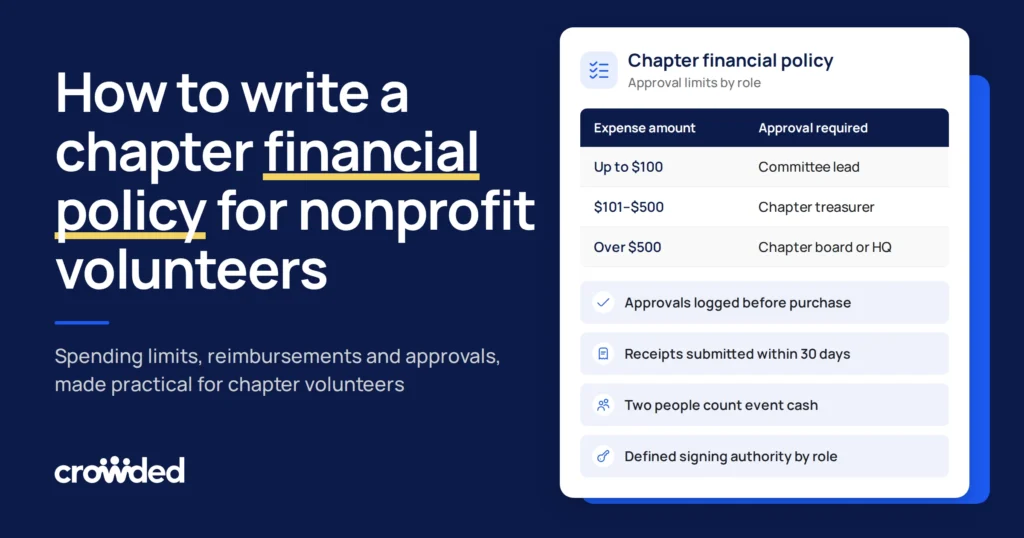
For example:
|
Expense Amount |
Approval Required |
|
Up to $100 |
Committee Lead |
|
$101–$500 |
Chapter Treasurer |
|
Over $500 |
Chapter Board or Headquarters |
The exact amounts are less important than applying them consistently across every chapter.
3. Reimbursement Policy
A chapter’s financial policy should clearly define which expenses are reimbursable.
Typical examples include:
- Event supplies
- Venue rentals
- Printing
- Postage
- Approved travel
- Mileage
- Program materials
The policy should also identify expenses that require advance approval and purchases that are not eligible for reimbursement. Examples help volunteers make better decisions before expenses occur.
4. Documentation Requirements
Every financial transaction should leave a clear paper trail.
Your policy should specify:
- Required receipts
- Acceptable documentation
- Reimbursement forms
- Submission deadlines
- Missing receipt procedures
Many organizations require reimbursement requests within 30 days to simplify month-end reporting and budget reconciliation. Good documentation protects both volunteers and the organization.
5. Personal Credit Card Use
Many volunteers use personal credit cards to purchase chapter supplies, often to earn rewards points.
If your organization permits this practice, the policy should explain:
- When personal payment methods are allowed
- Required pre-approvals
- Documentation expectations
- Reimbursement timelines
Using a personal credit card should never bypass approval requirements or financial controls.
6. Cash Handling
Many nonprofit chapters still collect cash during fundraising events, conferences, membership drives, and community programs. While cash can be unavoidable, it also presents greater financial risk than electronic payments.
Your chapter’s financial policy for nonprofit volunteers should clearly explain:
- Who is responsible for collecting cash during events?
- Where cash should be stored before deposit.
- How deposits should be documented.
- How quickly must funds be deposited into the chapter account?
- Who verifies the amount collected?
Organizations should encourage digital payment methods to reduce manual handling and improve transaction records. For events where cash is accepted, documenting responsibilities beforehand helps reduce errors and improve accountability across every chapter.
7. Segregation of Duties
One of the most effective nonprofit financial controls is segregation of duties: dividing financial responsibilities so that no single individual controls an entire transaction.
For example:
- One volunteer approves an expense.
- Another volunteer makes the payment.
- A different person reconciles the bank account.
- The finance committee or headquarters reviews financial reports periodically.
This separation reduces the risk of mistakes, unauthorized spending, and fraud while protecting volunteers from unnecessary scrutiny.
Why do two people count event money?
Requiring two people to count cash is a simple but effective internal control. Both individuals independently verify the amount collected before documenting and depositing the funds. This practice improves accuracy and provides transparency if questions arise later. Many chapters also reduce cash handling by collecting event payments online, which creates a digital record of each payment automatically.
Even smaller chapters with limited volunteers can apply segregation of duties by involving regional leaders or headquarters in review and reconciliation processes where appropriate.
8. Bank Account Access and Financial Records
Every chapter’s financial policy for nonprofit volunteers should clearly define who can access organizational funds.
The policy should answer questions such as:
- Who can access online banking?
- Who can sign checks?
- Who can authorize ACH or electronic payments?
- Who manages debit cards?
- How is access removed when volunteers leave their roles?
Volunteer turnover is inevitable. Without a defined process for updating banking permissions, former leaders may retain unnecessary access to organizational accounts.
The policy should also establish minimum recordkeeping requirements. Chapters should retain:
- Receipts and invoices
- Expense approvals
- Reimbursement requests
- Deposit records
- Bank statements
- Budget reports
- Event financial summaries
Consistent documentation supports board oversight, annual reporting, audits, and smooth leadership transitions.
Should Volunteers Sign a Financial Conflict of Interest Form?
In many organizations, yes. A conflict-of-interest policy helps volunteers disclose situations where personal relationships or financial interests could influence organizational decisions.
Examples include:
- Purchasing supplies from a business owned by a volunteer.
- Hiring a family member as a vendor.
- Approving payments to a company where a chapter leader has a financial interest.
Annual disclosure forms encourage transparency and help organizations identify potential conflicts before making financial decisions. For chapter leaders who regularly approve expenses or oversee budgets, conflict-of-interest disclosures are considered a governance best practice.
How to Ensure Volunteers Actually Follow the Financial Policy
Writing a policy is only the first step. Volunteers are far more likely to follow financial guidelines when they are practical, accessible, and easy to reference during everyday activities.
Consider these best practices:
- Write in plain language instead of accounting terminology.
- Keep the policy concise and organized by topic.
- Include approval matrices and spending tables.
- Use real-world examples for reimbursements and event expenses.
- Provide a one-page quick reference guide for volunteers.
- Review financial policies during onboarding.
- Update the policy annually as organizational needs evolve.
The easier a policy is to understand, the more consistently it will be applied across every chapter. Tools like Crowded’s expense management can help reinforce your guidelines by building spending limits, budgets, and receipt tracking directly into how volunteers spend chapter funds.
Writing a Financial Policy Doesn’t Guarantee Compliance
A common misconception is that publishing a policy automatically creates compliance. In reality, financial policies only establish expectations. Organizations still need operational processes that reinforce those expectations throughout daily chapter activities.
For example, leadership should be able to answer questions such as:
- Who approved this expense?
- Was the purchase within the authorized spending limit?
- Has the reimbursement been reviewed?
- Are receipts attached?
- Who currently has access to chapter bank accounts?
- Which chapters are following organizational policies consistently?
Without visibility into day-to-day financial activity, even well-written policies can be applied inconsistently as volunteers and chapter leaders change over time. Strong governance combines clear policies with financial controls that embed compliance into everyday operations rather than treating it as an annual review exercise.
How Crowded Helps Organizations Put Chapter Financial Policies Into Practice
A chapter’s financial policy for nonprofit volunteers establishes the rules. Crowded helps organizations apply those rules consistently across every chapter.
Rather than relying on spreadsheets, shared bank accounts, or manual oversight, organizations can operationalize their financial policies through built-in controls that support volunteer leaders while giving headquarters greater visibility.
For organizations managing multiple chapters, Crowded helps reinforce governance by enabling:
- Role-based permissions that align financial responsibilities with volunteer roles.
- Approval workflows that support organizational spending policies.
- Centralized visibility into financial activity across every chapter.
- Standardized expense management that promotes consistent documentation and reimbursement practices.
- Transparent transaction histories that simplify reporting and strengthen accountability.
Instead of expecting volunteers to remember every financial rule, organizations can support compliance through systems that reflect their governance policies in day-to-day financial management.
A financial policy defines expectations. Crowded helps organizations turn those expectations into consistent financial practices.
Conclusion
A chapter’s financial policy for nonprofit volunteers should simplify financial governance.
When volunteers understand spending limits, reimbursement requirements, documentation standards, cash-handling procedures, and approval responsibilities, they can confidently manage chapter finances while reducing risk to the organization.
Just as importantly, consistency shouldn’t depend on who’s serving as chapter treasurer this year. Clear governance, practical guidance, and operational controls help every chapter follow the same financial standards regardless of leadership changes.
By combining a well-written chapter financial policy with tools that reinforce approvals, permissions, and financial oversight, nonprofit organizations can strengthen governance while empowering volunteers to focus on advancing their mission.
Frequently Asked Questions
How often should a chapter's financial policy be reviewed?
Review it annually and whenever financial processes, leadership roles, or banking arrangements change.
Should every chapter follow the same financial policy?
Yes. A shared policy creates consistent expectations, while limited local flexibility can address chapter-specific needs.
How can nonprofits improve compliance across chapters?
Use clear policies, volunteer training, approval workflows, role-based permissions, and centralized oversight. Crowded helps organizations apply these controls consistently across every chapter.
What should happen when chapter leaders change?
Remove outdated account access, transfer records, assign new permissions, and train incoming volunteers on the financial policy.
Can a chapter's financial policy help prevent fraud?
Yes. Spending limits, documentation requirements, limited account access, and segregation of duties reduce financial risk.
Is a written policy enough to ensure compliance?
No. Organizations also need systems that reinforce the policy through approvals, permissions, transaction records, and financial visibility. Crowded helps turn written rules into everyday financial controls.