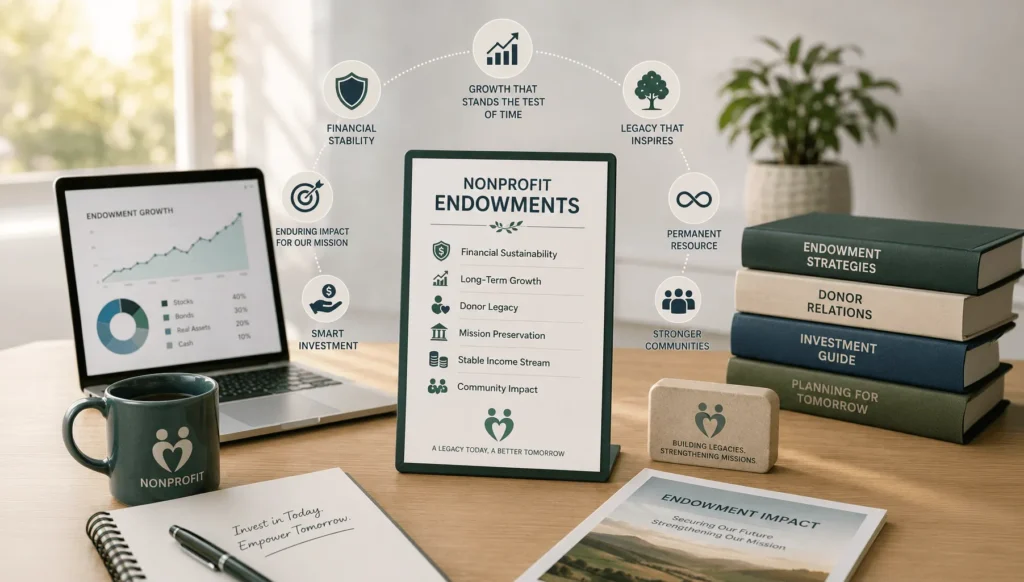
As your organization successfully scales its impact and secures major gifts, you may have the flexibility to devote resources toward long-term financial stability. For many nonprofits, this takes the form of an endowment.
An endowment can provide your nonprofit with consistent revenue in perpetuity. However, these permanent financial structures come with a host of financial complexities your team may not be familiar with. To ensure your team maintains legal compliance, continues to pass audits, and builds strong major donor relationships, this guide will explore:
- Nonprofit Endowment FAQ
- 4 Essential Nonprofit Endowment Financial Concepts
TL;DR
- Most nonprofit endowments are donor-restricted, permanent funds that provide revenue from investment dividends.
- Nonprofits should develop investment strategies and spending policies that preserve the principal funds.
- Nonprofits should familiarize themselves with legal and accounting regulations, such as UPMIFA and GAAP.
- Nonprofits should take care to maintain accurate financial records to ensure funds are properly allocated and to provide transparency with donors.
Nonprofit Endowment FAQ
What are nonprofit endowments?
A nonprofit endowment is a pool of funds intended to generate revenue through investments. There are several types of endowments, and the most common ones are:
- True endowments. True endowments are donor-restricted endowments created with the intention of never spending the initial principal. As these endowments are donor-restricted, revenue generated through dividends must be spent according to the donors’ wishes.
- Term endowments. Term endowments are similar to true endowments with one exception. After a given date or event, term endowments can be dissolved, and the principal can be spent according to the donors’ specifications.
- Quasi-endowments. Unlike true and term endowments, quasi-endowments are not donor restricted. These endowments are created by nonprofit boards and consist of funding the nonprofit already has on hand. As such, these endowments can also be dissolved at the board’s discretion.
How do endowments differ from operating funds?
Endowment funds cannot be spent as freely as operating funds. General operating funds provide liquidity and can be used for day-to-day expenses. In contrast, endowment funds are legally restricted, must be spent according to donor restrictions, and the invested principal cannot be spent.
Is my nonprofit ready to start an endowment?
Starting an endowment is not the right choice for every nonprofit. A few key factors for checking your endowment readiness include:
- Consistent operating surpluses over several fiscal years
- A highly engaged major donor pipeline
- A formal, board-approved strategic plan
If your board, donors, and financial priorities are aligned, your nonprofit is well-positioned to start an endowment.
4 Essential Nonprofit Endowment Financial Concepts
1. Principal preservation and investment income
The goal of an endowment is for the principal to stay intact and continue generating revenue. As such, preserving the principal is essential for earning dividends and showing donors you are investing their gifts well.
A few terms related to protecting the core endowment principal include:
- Spending policy: Your endowment spending policy dictates what percentage of the investment dividends you will spend, how much will be reinvested back into the endowment, and what projects the dividends will be spent on. Maintain proper documentation for every gift to ensure it is spent in accordance with donor restrictions.
- Investment policy: Your investment policy specifies how the endowment will be invested. Ensure your investments align with your organization’s values while still generating revenue. For example, an environmentally conscientious nonprofit would not invest in the oil and gas industry.
- Underwater spending: Underwater spending occurs when the endowment’s current amount is lower than the initial principal. This can happen due to poor investments or economic downturns. While underwater spending is legally allowed, it is inadvisable outside of emergency situations.
Essentially, endowment preservation requires separating the core principal from the income and being diligent about how that income yield is spent. If your nonprofit uses endowment management tools, you can leverage spending formulas, AI-assistants, and other features to keep your account organized.
2. Donor-restricted funds
Donor-restricted funds are gifts that must be used for a purpose designated by the donor. For each gift your nonprofit receives, in your records, you should specify if it is:
- Permanently restricted and must only be spent on the projects or initiatives specified by the donor.
- Temporarily restricted and will become unrestricted after a specified date or event occurs. For example, you might receive restricted funds for a given project, but if there is funding left over at the project’s completion, they become unrestricted.
- Unrestricted and can be spent however your nonprofit desires.
Outside of quasi-endowments, most endowments require donor-restricted fund management. Always honor donor intent, maintain proper records, and avoid commingling funds to prevent any mis-spending.
3. UPMIFA
Before starting an endowment, familiarize yourself with relevant legislation. In the U.S., most states have adopted the Uniform Prudent Management of Institutional Funds Act (UPMIFA), which governs nonprofit endowment management.
EverTrue’s guide to UPMIFA lists out this policy’s key guidelines:
- General fund management: Nonprofits are required to manage their endowment funds to the best of their abilities. This means following donor restrictions and doing their best to make sound investment decisions.
- Spending: Nonprofits must create a spending policy that adheres to donor restrictions while still considering the organization’s priorities.
- Investing: Nonprofits must develop a written investment policy that includes: a risk management strategy, an investment monitoring process, and guidelines for changing investments.
- Reporting: Nonprofits must create annual financial reports for their endowments and share them with the appropriate state regulatory bodies upon request.
- Delegation: Nonprofits can either oversee their endowments themselves or delegate management to a third-party agent.
- Changing donor restrictions: Nonprofits can change the terms of donor restrictions if they receive the donor’s written permission. In the event that a donor restriction becomes unfeasible, nonprofits are advised to work with the donor to rework the restrictions. In rare cases where a donor refuses to cooperate, the nonprofit can seek to modify the agreement through the court system.
4. GAAP
GAAP stands for Generally Accepted Accounting Principles, and nonprofits should follow these guidelines for all of their finances, including their endowment. Jitasa’s guide to GAAP for nonprofits outlines a few key components of these regulations:
- Principle of Regularity: Nonprofits follow established accounting rules and regulations.
- Principle of Consistency: The nonprofit uses consistent standards for creating financial reports.
- Principle of Sincerity: Accounting practices are accurate and impartial.
- Principle of Permanence of Methods: Nonprofits used standardized methods to create financial reports.
- Principle of Non-Compensation: All aspects of a nonprofit’s financial status are reported without the prospect of debt compensation.
- Principle of Prudence: Reports should not be influenced by speculation.
- Principle of Continuity: Reports of assets should act on the assumption that your nonprofit will continue operations.
- Principle of Periodicity: Financial reports should be created on a routine schedule, such as quarterly or annually.
- Principle of Materiality: Your nonprofit’s financial reports must fully disclose your financial situation.
- Principle of Utmost Good Faith: Everyone involved in your financial processes should act with integrity.
To ensure your nonprofit adheres to the GAAP, particularly standards related to creating reports, consider investing in a financial management solution.
Securing your organization’s financial future
An endowment is an investment in your organization’s financial future. However, to manage a successful endowment, you’ll need a strong base of financial knowledge and the right tools supporting your efforts.
Assess your nonprofit’s endowment readiness, connect with donors about potential gifts, and start researching endowment management tools.