

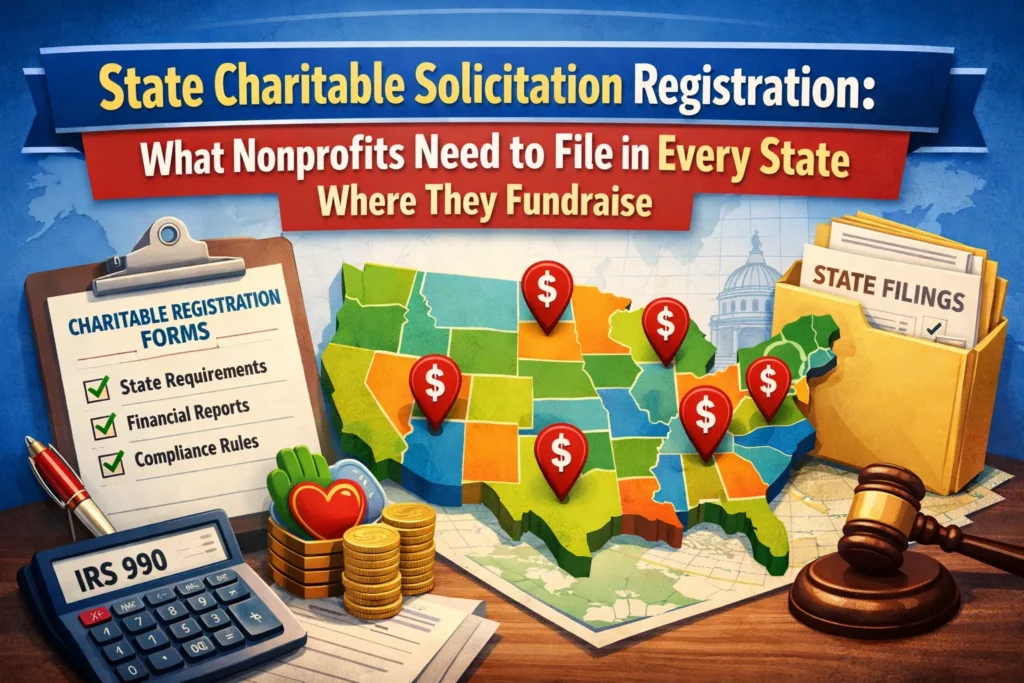
State charitable solicitation registration is the state-level filing that nonprofits complete before fundraising in certain states. For national fundraisers, it is an ongoing compliance process covering campaigns, online donations, events, chapter fundraising, renewals, and disclosures.
This article is for education only and is not legal advice.
What Is State Charitable Solicitation Registration?
State charitable solicitation registration is a compliance requirement created by charitable solicitation laws. These laws are designed to protect donors, promote transparency, and help states monitor organizations that solicit contributions from their residents.
In practice, registration may require a nonprofit to submit:
- Organizational information
- IRS determination letter
- Form 990 or financial statements
- Officer and director details
- Fundraising methods
- Professional fundraiser information, if applicable
- Registration fees
- Annual renewal filings
The challenge is that charitable solicitation registration requirements are not uniform. Each state can define solicitation, exemptions, deadlines, forms, fees, and renewal rules differently.
Which States Require Charitable Solicitation Registration?
Most states require nonprofits to register before soliciting donations from residents. That makes nonprofit fundraising registration by state essential before launching campaigns, opening chapters, hosting events, or accepting donations in new jurisdictions.
Home-state registration is not enough for multi-state fundraising.
What Activities Trigger Registration?
State fundraising registration requirements are usually triggered by solicitation activity. Common triggers may include:
- Sending donation appeals by mail
- Emailing residents of a state
- Running digital fundraising campaigns
- Calling prospective donors
- Hosting fundraising events
- Using paid solicitors or fundraising consultants
- Asking for donations through social media
- Soliciting through local chapters or affiliates
- Adding donation forms to a website
In many states, asking for a charitable contribution can create a registration obligation even before funds are received.
Does Online Fundraising Require Registration?
Online fundraising registration depends on how donations are solicited. A passive donation button may be treated differently from targeted emails, paid ads, social media, peer-to-peer campaigns, or state-specific outreach. Active online solicitation can create filing obligations in the states where donors are targeted.
For example, a nonprofit may need to evaluate registration if it:
- Runs paid ads targeting donors in multiple states
- Sends email appeals to a national list
- Hosts crowdfunding campaigns
- Promotes donation links through social media
- Uses online fundraising platforms
- Receives repeated donations from residents of certain states
Because digital fundraising crosses state lines, online fundraising should be included in every nonprofit compliance checklist.
Do Fundraising Events Create State Registration Requirements?
Yes, fundraising events can create registration obligations when they involve soliciting state residents.
This may include:
- Galas
- Auctions
- Giving days
- Ticketed benefit events
- Golf tournaments
- Peer-to-peer campaigns
- Chapter-led fundraisers
- Sponsorship drives
Even if headquarters manages compliance centrally, a local event may still create state-level exposure. The key question is what it does. It is where fundraising activities occur, and donors are solicited.
How Does Local Chapter Activity Affect Registration?
Local chapters can complicate state charitable solicitation registration because fundraising often happens outside the headquarters’ direct oversight. If chapters collect dues, host events, accept donations, or run fundraising campaigns, those activities may create additional compliance obligations.
Headquarters should understand:
- Which chapters fundraise
- Where those chapters operate
- Whether chapters solicit the public
- Whether funds are held locally or centrally
- Who approves fundraising campaigns
- Whether the chapter activity is covered by parent registration
- Whether separate registrations or exemptions apply
For federated nonprofits, associations, fraternities, sororities, and multi-chapter organizations, registration risk often begins with visibility gaps.
Why Is Multi-State Charitable Registration So Difficult?
Multi-state charitable registration is difficult because each state has its own rules, deadlines, exemptions, forms, and renewal standards.
A nonprofit may need to track:
- Initial registration requirements
- Annual renewal deadlines
- Fiscal year-based due dates
- Extension rules
- Financial statement thresholds
- Audit requirements
- Professional fundraiser disclosures
- State-specific online portals
- Required attachments
- Late fees and penalties
The operational problem is maintaining an accurate system for knowing where the organization fundraises, what has been filed, what needs renewal, and what has changed during the year.
Why Decentralized Chapters Increase Compliance Risk
Decentralized chapters create a specific charitable solicitation compliance challenge: headquarters may be responsible for oversight, but may not have real-time visibility into local activity.
Risk increases when chapters:
- Use separate bank accounts
- Run local fundraisers independently
- Accept donations through personal payment apps
- Maintain separate donor lists
- Change treasurers frequently
- Lack of standardized reporting
- Use inconsistent expense and revenue labels
- Open accounts without central approval
This makes nonprofit fundraising compliance harder to manage because the finance team may not know which activities created state obligations until after campaigns are complete.
What Are Charitable Registration Renewal Requirements?
Charitable registration renewal requirements vary by state, but many states require annual renewal filings.
Renewals may require:
- Updated organizational information
- Most recent Form 990
- Financial statements
- Audit or review, depending on revenue thresholds
- List of officers or directors
- Fundraising disclosures
- Registration fee
- Confirmation of professional fundraiser relationships
Renewal deadlines vary by state and may be based on your fiscal year, registration date, or other state-specific rules. Track deadlines early and begin the renewal process before Form 990 is finalized to avoid penalties.
What Happens If a Nonprofit Fails to Register?
Failing to register can create financial, operational, and reputational consequences.
Possible consequences may include:
- Late fees
- Penalties
- Loss of good standing
- State enforcement inquiries
- Required corrective filings
- Restrictions on fundraising
- Donor trust issues
- Public compliance records
- Delays in campaigns or grants
For nonprofit leaders, the goal is the process. Most registration problems are easier to manage when the organization has accurate records, clear ownership, and a proactive renewal calendar.
What Compliance Process Should Nonprofits Use?
A practical nonprofit compliance checklist for state charitable solicitation registration should include five steps.
1. Map Where You Fundraise
List every state where the organization solicits donations, hosts fundraising events, sends appeals, targets ads, or has local chapters.
2. Identify Registration Requirements
Review charitable solicitation registration requirements in each state. Confirm whether the organization must register, qualifies for an exemption, or needs additional filings.
3. Centralize Fundraising Records
Track donation channels, campaign activity, chapter fundraising, event revenue, and professional fundraiser relationships in one place.
4. Build a Renewal Calendar
Create a calendar for charitable registration renewal requirements by state. Include due dates, extension dates, required attachments, fees, and responsible owners.
5. Review Changes Before Filing
Before submitting renewals, review changes in officers, addresses, fundraising methods, financial results, chapters, and professional fundraiser relationships.
Turn Chapter Fundraising Activity Into Compliance-Ready Financial Visibility
State charitable solicitation compliance is easier when headquarters can see fundraising activity before it creates filing risk. For multi-chapter nonprofits, the challenge is visibility: which chapters are collecting funds, where funds are held, who has access, and whether local activities need compliance review.
Crowded helps centralize oversight across chapters, programs, and funds, giving teams clearer visibility into accounts, balances, transactions, permissions, and treasurer access.
Crowded helps organizations:
- See chapter-level balances and transactions in one place
- Standardize account structures across distributed teams
- Track where funds are collected and held
- Manage treasurer access and permission changes
- Reduce reliance on scattered spreadsheets
- Strengthen financial records for compliance review
- Support better oversight across local fundraising activity
Crowded gives nonprofit teams the financial infrastructure to identify activities that may need compliance review and to manage distributed fundraising with greater control.
Frequently Asked Questions
What is state charitable solicitation registration?
State charitable solicitation registration is the process of registering with a state before soliciting donations from that state’s residents. Requirements vary by state and may include forms, fees, financial disclosures, and annual renewals.
Do nonprofits need to register in every state?
Not always. Nonprofits generally need to evaluate the states where they solicit donations. Some states require registration, some offer exemptions, and some have limited or no general registration requirement.
Does online fundraising trigger registration?
It can. Online fundraising registration may be required when a nonprofit actively solicits residents of a state through email, ads, social media, crowdfunding, or other digital campaigns.
Do local chapter fundraisers count?
They may. Chapter fundraising can create state registration issues, especially when chapters solicit the public, host events, collect donations, or manage local fundraising accounts.
How often do charitable registrations need to be renewed?
Many states require annual renewals, but deadlines and documentation vary. Nonprofits should maintain a state-by-state renewal calendar tied to their fiscal year and filing obligations.
What should be included in a nonprofit compliance checklist?
A nonprofit compliance checklist should include states where the organization fundraises, registration status, exemptions, renewal deadlines, required attachments, Form 990 availability, chapter fundraising activity, and responsible owners.