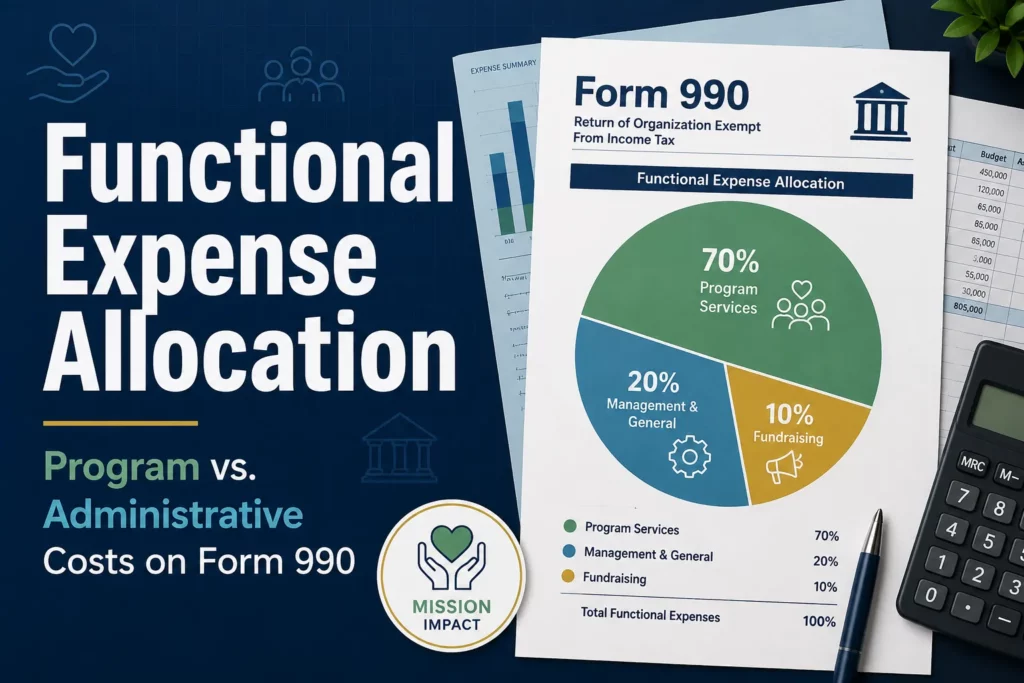
Functional Expense Allocation is where nonprofit expense reporting becomes a judgment call. Every dollar on Form 990 must be classified as Program Services, Management & General, or Fundraising.
For nonprofits with chapters, affiliates, shared staff, restricted funds, or centralized finance teams, the goal is to create a consistent, documented, and defensible allocation process.
TL;DR: Functional Expense Allocation
- Functional Expense Allocation is the process nonprofits use to classify expenses by purpose: Program Services, Management & General, and Fundraising.
- Form 990 Part IX requires nonprofits to report expenses across these functional categories.
- Shared expenses should be allocated using reasonable, consistent, and documented methods.
- Common nonprofit expense allocation methods include time tracking, square footage, headcount, transaction volume, and direct cost assignment.
- Multi-chapter nonprofits need standardized rules to ensure chapters classify similar expenses consistently.
What Is Functional Expense Allocation?
Functional Expense Allocation is the process of assigning nonprofit expenses to the activities they support. Instead of reporting expenses only by natural category (such as salaries, rent, or software), nonprofits must also classify them by function: Program Services, Management & General, or Fundraising.
Some expenses fit a single category, while shared costs must be allocated across multiple functions using a consistent, documented methodology. The goal of functional expense allocation is to show how each expense supports the organization’s mission, operations, or fundraising activities.
The Three Functional Categories Used on Form 990
Form 990 expense allocation is reported in Form 990 Part IX, Statement of Functional Expenses. The three primary functional categories are Program Services, Management & General, and Fundraising.
Program Services
Program Services are the activities that directly carry out the nonprofit’s exempt purpose. On Form 990, program service expenses may include costs for education, member services, grants, scholarships, community outreach, advocacy, chapter programming, or direct service delivery.
Examples include:
- Program staff salaries
- Direct service supplies
- Program travel
- Grant disbursements
- Chapter event costs tied to mission delivery
- Software used for program administration
- Facility costs for program space
Program Services usually represent the largest functional category for mission-driven organizations.
Management & General
Management & General expenses cover the costs of running the organization. On Form 990, these expenses include governance, finance, legal, compliance, executive oversight, insurance, audits, administrative operations, and other organizational infrastructure that support the nonprofit as a whole.
Examples include:
- Accounting and finance staff
- Board meeting expenses
- Audit and tax preparation
- Legal fees
- General liability insurance
- Executive administration
- Bank fees for central operations
- Compliance and registration costs
Management & General expenses are necessary for operating responsibly, maintaining controls, and meeting legal obligations.
Fundraising
Fundraising expenses in nonprofit reporting include the costs of soliciting contributions, sponsorships, grants, donations, and other forms of support.
Examples include:
- Development staff salaries
- Donor events
- Fundraising campaigns
- Grant writing is tied to contributed revenue
- Sponsorship solicitation
- Donation platform fees
- Fundraising travel
- Direct mail or digital fundraising costs
Fundraising expenses should be separated from Program Services, even when a campaign includes mission messaging.
How Shared Expenses Are Allocated Across Functions
Many nonprofit expenses support more than one function and must be allocated. Shared costs like rent, CRM software, or executive time should be divided based on actual use across programs, management, and fundraising. A defensible nonprofit overhead allocation process connects each shared expense to a clear, documented rationale.
Example:
A nonprofit pays $10,000 per month in rent. The office space is used as follows:
- 60% by program staff
- 25% by finance and administration
- 15% by development staff
The rent allocation would be:
- $6,000 to Program Services
- $2,500 to Management & General
- $1,500 to Fundraising
The same concept applies to salaries, software, insurance, utilities, shared travel, and other costs that benefit multiple functions.
Common Functional Expense Allocation Methods
The best nonprofit expense allocation methods are reasonable, consistent, and supported by documentation. Here are five common approaches:
1. Direct Assignment
Use when an expense clearly supports a single function.
Examples:
- Scholarship software → 100% Program Services
- Audit fees → 100% Management & General
- Donor acquisition campaign → 100% Fundraising
2. Time and Effort Allocation
Allocate salaries based on how employees spend their time.
Example: A COO earning $12,000 per month spends:
- 40% Program Services → $4,800
- 45% Management & General → $5,400
- 15% Fundraising → $1,800
3. Square Footage Allocation
Allocate facility costs based on the space each function occupies.
Example: A 10,000 sq. ft. office:
- 70% Program Services
- 20% Management & General
- 10% Fundraising
Ideal for rent, utilities, and maintenance.
4. Headcount Allocation
Allocate shared employee-related costs based on staff distribution.
Example: A $5,000 HR software subscription for 50 employees:
- 35 program staff → $3,500 (70%)
- 10 administrative staff → $1,000 (20%)
- 5 fundraising staff → $500 (10%)
Best for HR systems and organization-wide employee tools.
5. Activity-Based Allocation
Allocate costs based on measurable usage or transaction volume.
Example: A payment platform processes 10,000 transactions:
- 6,000 program → 60%
- 2,500 fundraising → 25%
- 1,500 administrative → 15%
Commonly used for payment processing, banking fees, disbursement costs, and chapter financial activity.
Where Nonprofits Commonly Get Functional Allocation Wrong
Functional expense reporting becomes risky when allocation is inconsistent, undocumented, or overly aggressive.
Common mistakes include:
- Classifying most shared costs as Program Services without support
- Treating all executive time as Management & General
- Treating all communications as Fundraising
- Failing to separate donor solicitation from program education
- Using different methods across departments or chapters
- Updating allocations only at year-end
- Forgetting to document assumptions
- Using budgeted percentages that no longer reflect reality
A common risk is functional creep, where expenses gradually shift toward Program Services to improve overhead ratios. A clear rationale should support every allocation, applied consistently, and backed by documentation that explains why the expense belongs in that functional category.
Functional Expense Allocation Challenges in Multi-Chapter Organizations
Functional Expense Allocation is more difficult for multi-chapter organizations because expenses often occur outside the central finance team. Chapters may collect dues, host events, reimburse volunteers, pay vendors, run programs, and use separate bank accounts.
The challenge is consistency. One chapter may classify a conference as Program Services, another as Fundraising, and another as a general event expense. For consolidated reporting, multi-chapter organizations need shared nonprofit accounting allocation methods so that similar activities are classified consistently across the network.
A strong chapter allocation framework should define:
- Which expenses are always Program Services
- Which expenses are always Management & General
- Which expenses are always Fundraising
- Which expenses require allocation
- Which allocation method should chapters use
- What documentation chapters must be retained
- Who reviews classifications before Form 990 preparation
Without this structure, Form 990 Part IX becomes a year-end reconstruction project.
What the IRS Expects to See
The IRS expects Form 990 Part IX to reflect a reasonable and consistent classification of expenses by function. Allocations should be based on a reasonable methodology, applied consistently, and supported by documentation.
The IRS and reviewers may look closely at:
- Large shifts between Program Services, Management & General, and Fundraising
- Low reported fundraising costs despite active fundraising campaigns
- High program expense ratios that seem unsupported
- Shared salaries allocated without time records
- Chapter expenses with inconsistent treatment
- Costs classified as Program Services when they appear administrative
- Joint activities that combine education and solicitation
Functional expense allocation should be built during the year.
Best Practices for a Defensible Functional Expense Allocation Process
A defensible Functional Expense Allocation process helps finance teams classify costs before reporting deadlines.
- Create a written allocation policy. Define functional categories, allocation methods, documentation rules, review steps, and how often percentages are updated.
- Map natural expenses to functional categories. Build a simple matrix of common costs, including audit fees, donor software, program supplies, rent, shared salaries, and payment processing fees.
- Use consistent allocation drivers. Match each shared cost to a logical driver: time and effort for salaries, square footage for rent, user count for software, transaction volume for fees, and agenda purpose for events.
- Review allocations during the year. Monthly or quarterly reviews help catch misclassified expenses before they affect Form 990 expense allocation.
- Keep documentation with each transaction. Store invoices, approval notes, event agendas, staff time records, grant budgets, transaction reports, and chapter submissions where finance can retrieve them.
- Train chapter treasurers and department leads. Simple training improves consistency across chapters, programs, and departments.
- Separate allocation policy from ratio management. Program ratios matter, but they should never drive classification. Functional allocation is about accurate reporting.
How Crowded Helps Multi-Chapter Organizations Maintain Consistent Expense Classification
Crowded helps multi-chapter nonprofits, associations, fraternities, sororities, and federated organizations improve financial visibility across distributed operations.
For Functional Expense Allocation, the challenge often lies in operational recordkeeping. Chapters may use different accounts, labels, approval habits, and documentation processes, making Form 990 Part IX harder to prepare and support.
Crowded gives finance teams a centralized way to manage chapter accounts, permissions, spending activity, balances, and transaction records. It helps nonprofit finance leaders maintain cleaner records, strengthen chapter oversight, and support more consistent expense classification.
Frequently Asked Questions
What is Functional Expense Allocation?
Functional Expense Allocation is the process nonprofits use to classify expenses by purpose. Expenses are assigned to Program Services, Management & General, Fundraising, or allocated across more than one function.
Where is functional expense allocation reported on Form 990?
Functional expense allocation is reported in Form 990 Part IX, Statement of Functional Expenses. This section shows expenses by natural category and functional category.
What are Program Services expenses on Form 990?
Program Services expenses are costs directly tied to carrying out the nonprofit’s exempt purpose. Examples include program staff, direct service costs, grants, scholarships, mission-related events, and program supplies.
What are Management & General expenses for nonprofits?
Management & General expenses are costs related to operating and governing the organization. Examples include finance, legal, audit, board governance, compliance, insurance, and general administration.
What counts as Fundraising expenses for nonprofits?
Fundraising expenses include costs related to soliciting donations, grants, sponsorships, and other contributed support. Examples include development staff, donor campaigns, fundraising events, grant writing, and donation platform fees.
What are common nonprofit expense allocation methods?
Common nonprofit expense allocation methods include direct assignment, time-and-effort, square footage, headcount, user count, transaction volume, and activity-based allocation.
Can executive salaries be allocated to Program Services?
Yes, if the executive performs program-related work and the allocation is supported. For example, a CEO who spends 30% of their time on program strategy may have 30% of their salary allocated to Program Services if documented.
How often should nonprofits review allocation percentages?
Nonprofits should review allocation percentages at least annually. Organizations with complex programs, chapters, or shared staff should review allocations quarterly or when operations change.
Why is functional expense allocation harder for multi-chapter nonprofits?
It is harder because chapters may record similar expenses differently. Without standardized rules, the central finance team may need to reconstruct chapter activity before completing Form 990 Part IX.
How can nonprofits make functional expense allocation more defensible?
Nonprofits can strengthen allocation by creating a written policy, using consistent allocation drivers, documenting assumptions, reviewing classifications during the year, and training staff and chapter treasurers.