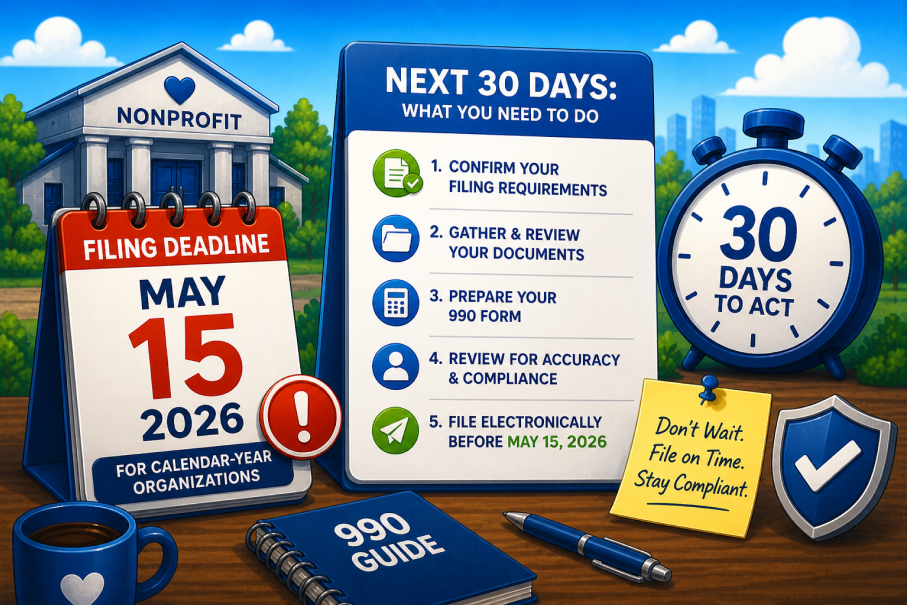
For 501(C)(3) and 501(C)(6) organizations operating on a calendar year (January 1 – December 31), the nonprofit filing deadline of May 15, 2026, is now 30 days away. Missing this date without requesting an extension can expose your organization to daily financial penalties and, after three consecutive years of missed filings, to permanent automatic revocation of its tax-exempt status.
There are exactly two compliant paths forward: file your return by May 15, or file IRS Form 8868 (Application for Automatic Extension of Time to File an Exempt Organization Return) by May 15 to extend your deadline to November 16, 2026. Here is exactly what you need to do in the next 30 days.
TL;DR
- May 15, 2026, is the hard deadline. Calendar-year 501(C)(3) and 501(C)(6) organizations must file by then, or penalties begin the next day.
- Not ready? File Form 8868. It gives you an automatic 6-month extension to November 16, 2026, with no explanation and no filing fee.
- Three missed years can cost you your status. Under IRC §6033(j), the IRS automatically revokes tax-exempt status after three consecutive missed filings.
- Board review matters. Form 990 asks whether the governing body reviewed the return before filing, and that answer is public.
- The issue is readiness. Nonprofits that use tools like Crowded keep books current year-round, making 990 prep far easier when May arrives.
Key Dates at a Glance
Event | Date |
Form 990 series initial deadline (calendar-year orgs) | May 15, 2026 |
Form 8868 extension request due | May 15, 2026 |
Extended filing deadline (if 8868 filed) | November 16, 2026 |
Form 990-N filers | File by May 15 or miss it |
Note: November 15, 2026, falls on a Sunday; the extended deadline shifts to November 16, 2026.
Step 1: Know Which Form Is Due by the Nonprofit Filing Deadline, May 15
The IRS deadline formula is straightforward: returns are due on the 15th day of the 5th month after your fiscal year ends. For calendar-year organizations, that is always May 15 of the following year. What varies is which Form 990 version your organization must file, determined by your gross receipts and total assets.
Form | Who Files | Key Notes |
990-N (e-Postcard) | Gross receipts ≤ $50,000 | No extension available; file by May 15 |
990-EZ | Receipts < $200K AND assets < $500K | Extension available via Form 8868 |
990 (Full) | Receipts ≥ $200K OR assets ≥ $500K | Extension available |
990-PF | All private foundations | Extension available |
990-T | Unrelated Business Taxable Income (UBTI) ≥ $1,000 | Tax payment due May 15, even if extended |
A small nonprofit with gross receipts of $50,000 or less files Form 990-N, the e-Postcard, instead of a full return. For 501(C)(6) organizations, including trade associations and chambers of commerce, the same deadline applies. If your fiscal year ended December 31, 2025, the filing deadline is May 15, 2026.
If your organization has $1,000 or more in unrelated business taxable income, it must also file Form 990-T. Any tax due is still due by May 15, even if you file a Form 990 extension. Before proceeding, verify your active exempt status using the IRS Tax Exempt Organization Search tool at IRS.gov. This takes two minutes and confirms the IRS has your organization on record as current.
Step 2: Your 30-Day Action Checklist
With the May 15 nonprofit filing deadline one month away, focus on these steps now to avoid a last-minute scramble.
Week 1: Close the books
Record and reconcile all 2025 transactions. Gather W-2s, 1099s, bank statements, grant agreements, program expense records, and any new contracts that could trigger extra Form 990 schedules. Verify your exempt status through the IRS Tax Exempt Organization Search. Platforms like Crowded can make this step faster by keeping transaction data organized and audit-ready.
Week 2: Prepare the return
Decide whether to file in-house or through a CPA. Pull last year’s Form 990 for reference. Review any new 2025 activities that may require added schedules, such as lobbying, foreign activity, grants to individuals, or unrelated business income that could trigger Form 990-T.
Week 3: Board review
Form 990 asks whether the full governing body reviewed the return before filing, and that answer is public. Leave 5–7 business days for board review, which means circulating a draft by May 5, 2026. Record the review and approval in meeting minutes.
Week 4: File or extend
Suppose the return is ready for E-file through an IRS-authorized provider. Or file Form 8868 by May 15 to get an automatic six-month extension to November 16, 2026. If you owe UBIT, payment is still due by May 15, even if you extend the due date.
Step 3: How to File a Form 8868 Extension
What is Form 8868? IRS Form 8868 is the Application for Automatic Extension of Time to File an Exempt Organization Return. If your organization cannot complete its return by the nonprofit filing deadline of May 15, filing Form 8868 by that same date grants an automatic 6-month extension with no reason, no explanation, and no IRS approval letter needed.
Here is what you need to know:
- Who can file: Applicable to Form 990, 990-EZ, and 990-PF filers. Form 990-N filers cannot use Form 8868; there is no extension available for the e-Postcard.
- Due date: Must be filed on or before May 15, 2026.
- New deadline upon filing: November 15, 202,6 which shifts to November 16, 20,26 because November 15 falls on a Sunday.
- How to file: File electronically through an IRS-authorized e-file provider (recommended) or by paper. Electronic filing provides instant confirmation.
- What it does not extend: State filing obligations, charitable solicitation renewal deadlines, and UBIT payment deadlines are not affected by Form 8868.
For context: individual taxpayers use Form 4868 for a personal federal extension; C-corporations use Form 7004 for a Form 1120 extension. Nonprofit filers use Form 8868, a distinct, separate form. Submitting the wrong form is a common mistake that results in an invalid extension.
Step 4: Understand the Consequences of Missing the Deadline
Missing the filing deadline can lead to financial penalties, loss of tax-exempt status, and reputational damage.
Late Filing Penalties
The IRS charges daily penalties when an organization misses the deadline without a valid extension. Smaller nonprofits with gross receipts under $1.1 million can face a $ 20-per-day fine, up to $11,000. Larger organizations face $110 per day, with higher caps. Penalties start on the day after the deadline, or on the day after the extended deadline if Form 8868 was filed. Reasonable cause may reduce penalties.
Auto-Revocation
Under IRC Section 6033(j), the IRS automatically revokes tax-exempt status after three straight years of missed filings. Revocation takes effect on the original due date of the third missed return.
Once revoked, the organization appears on the IRS auto-revocation list, may lose eligibility to receive tax-deductible donations, may owe corporate income tax, and must reapply for exemption through Form 1023 or 1024, with a user fee.
Reputation and Funding Impact
Late filings and revocations are public and can appear on platforms like ProPublica Nonprofit Explorer and Candid. That can affect donor trust, grant eligibility, and overall credibility.
Don’t Forget: State Filing Requirements
Federal filing is only part of the picture. Around 40 states, plus DC, require charitable solicitation registration and annual state filings, and those deadlines often do not align with the federal May 15 deadline.
Some states accept a copy of Form 990. Others require separate filings, such as California Form RRF-1 and New York Form CHAR500. For national nonprofits with affiliates or chapters, now is the time to review each entity’s state registration status.
Why Most Nonprofits Miss the Deadline, and How Crowded Fixes the Problem
Most nonprofits miss the May 15 deadline because their financial data is not ready.
Crowded keeps nonprofits deadline-ready by categorizing transactions, supporting reconciliation, mapping records to IRS requirements, and helping prepare Form 990-N, 990-EZ, or full Form 990 based on the organization’s size and receipts.
Instead of rebuilding records at year-end, nonprofits can keep cleaner books throughout the year and file with less stress.
Act Before Compliance Becomes a Crisis
For calendar-year nonprofits, the May 15, 2026, deadline leaves two compliant options: file your Form 990 series return or file Form 8868 for an extension to November 16, 2026. The extension gives more time to file.
Organizations using Crowded keep transaction-level data organized year-round, so Form 990 prep is a review.
Frequently Asked Questions
What happens if my nonprofit files Form 990 one day late?
The IRS penalty starts immediately if no Form 8868 extension was filed. Smaller nonprofits can owe $20 per day, while larger organizations can owe $110 per day. If your return is not ready, file Form 8868 by May 15 to avoid unnecessary penalties.
Can a nonprofit lose its tax-exempt status for missing just one year’s filing?
No. Automatic revocation happens only after three consecutive missed filings under IRC §6033(j). Still, one missed year starts the clock and creates a compliance risk that can grow quickly if ignored.
How do I know if my nonprofit’s financial records are ready for 990 prep?
If your team can quickly pull program expenses, restricted revenue, and officer compensation, your books are likely ready. If it takes spreadsheets, bank statement hunting, and manual cleanup, they are not. Crowded helps keep that data current year-round.
Does filing Form 8868 affect our standing with donors or grantmakers?
No. Filing an extension is a normal compliance step and does not hurt donor or grantmaker trust. What creates concern is a missing or late return with no extension on file.
What separates nonprofits that file on time from those that scramble every year?
Usually, it is infrastructure. Nonprofits that file on time manage transactions, fund tracking, and reporting throughout the year. Crowded supports that model, so Form 990 prep feels like a review.