National offices assume their chapters are filing correctly. Most of the time, that assumption is wrong because they’re operating without visibility. The IRS rules around nonprofit revenue size categories are clear. Revenue shifts at the chapter level constantly, and what was accurate last year can quietly become noncompliant this year.
The result: filings that lag behind reality, exposure to penalties, and, in worst cases, automatic revocation. This piece breaks down the IRS revenue tiers, how gross receipts are calculated, what happens when a chapter outgrows its filing type, and how finance teams can stay ahead of it.
TL;DR
- Nonprofit revenue size categories directly determine which Form 990 your organization must file. The IRS uses gross receipts and asset thresholds, and getting that classification wrong can trigger penalties or worse.
- For chapter-based nonprofits, the real risk is missing the moment a chapter crosses it. A chapter can outgrow 990-N or 990-EZ quietly through one strong fundraising cycle, while the national office stays unaware until filing season.
- Gross receipts are calculated before expenses, which is where many compliance mistakes begin. A chapter that raises $60,000 at an event and spends $55,000 still reports $60,000 in gross receipts, which can quickly change its filing obligation.
- Most federated finance teams are managing multiple IRS filing tiers simultaneously across their networks. One chapter may qualify for 990-N, another for 990-EZ, and another for the full 990, which makes static spreadsheets and self-reported data a weak control system.
- Crowded helps finance leaders stay ahead of threshold changes with real-time chapter visibility and audit-ready records. Instead of discovering a filing problem from an IRS notice, teams can spot approaching risks earlier and manage compliance like an infrastructure issue.
What Are Nonprofit Revenue Size Categories?
Nonprofit revenue size categories are the IRS’s way of determining which version of Form 990 an organization must file. These categories are based primarily on gross receipts and total assets.
This distinction matters. In the sector, terms like “small” or “mid-size” often refer to operating scale or staffing. For the IRS, those labels don’t matter, only whether you cross specific financial thresholds.
The stakes are high. Filing the wrong form affects transparency, triggers penalties, and can ultimately jeopardize tax-exempt status. For standalone nonprofits, this is a periodic check. For federated organizations with dozens or hundreds of chapters, it’s a continuous monitoring problem.
The Three IRS Filing Tiers Explained
Understanding nonprofit revenue size categories starts with the three IRS filing tiers. These tiers define your compliance obligations, and they change the moment your financials cross a threshold.
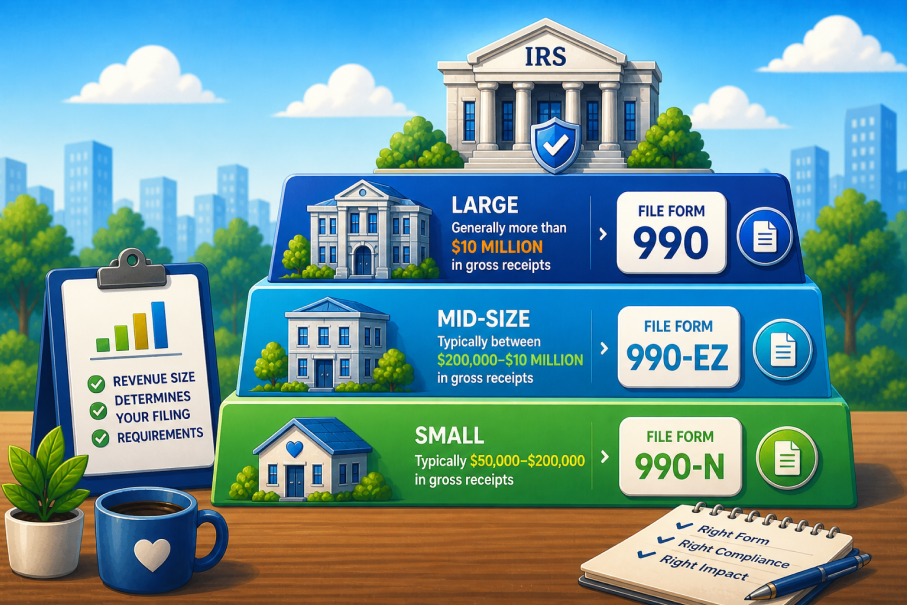
Tier 1: Micro: Gross Receipts ≤ $50,000 → Form 990-N (e-Postcard)
At the lowest tier, nonprofits with gross receipts of $50,000 or less file Form 990-N, commonly known as the e-Postcard. This is the simplest filing. It requires:
- Basic organizational details (name, EIN, address)
- Confirmation of continued operations
- No financial statements or program disclosures
Organizations in this tier are typically:
- All-volunteer groups
- New chapters or early-stage nonprofits
- Grassroots initiatives with minimal funding
The risk here is subtle but common: crossing $50,000 without adjusting your filing type. Because 990-N doesn’t require detailed reporting, many organizations don’t realize they’ve outgrown it until it’s too late.
Tier 2: Small to Mid-Size: Gross Receipts < $200,000 AND Total Assets < $500,000 → Form 990-EZ
The next level introduces a dual threshold. To qualify for Form 990-EZ, a nonprofit must meet both conditions:
- Gross receipts under $200,000
- Total assets under $500,000
Form 990-EZ requires:
- Financial summaries (revenue, expenses, net assets)
- Program service descriptions
- Governance and operational disclosures
This tier captures organizations that are:
- Operationally active
- Running structured programs or recurring events
- Managing modest reserves or endowments
The key complexity here is the AND logic. Many organizations qualify on one dimension but fail on the other, especially chapters that accumulate assets over time.
Tier 3: Standard/Large: Gross Receipts ≥ $200,000 OR Total Assets ≥ $500,000 → Full Form 990
Once an organization crosses either threshold, it must file the full Form 990. This is a comprehensive filing that includes:
- Detailed financial statements
- Executive compensation disclosures
- Governance policies and board structure
- Program outcomes and schedules
This form is public and heavily scrutinized by:
- Donors and grantmakers
- Watchdog organizations
- Regulators and journalists
The defining feature here is the OR logic. You don’t need to exceed both thresholds; just one is enough to trigger full reporting requirements.
Special Category: Private Foundations → Form 990-PF
Private foundations follow a completely separate filing track. Regardless of revenue or asset size, they file Form 990-PF, which includes stricter disclosure and distribution requirements.
How the IRS Actually Calculates Gross Receipts
Gross receipts are often misunderstood, and that misunderstanding drives compliance errors. The IRS defines gross receipts as total income from all sources before any deductions. This includes:
- Donations and grants
- Membership dues
- Event revenue
- Program service fees
- Investment income
Expenses don’t reduce gross receipts. If a chapter raises $60,000 from a fundraising event but spends $55,000 organizing it, its gross receipts are still $60,000. This trips up organizations with:
- High-cost fundraising events
- Program-heavy operations
- Reimbursement-based activities
In chapter networks, this misunderstanding scales. One misclassified event can push a chapter into a higher filing tier without anyone noticing.
How to Determine the Size of a Nonprofit: Two Frameworks Side by Side
To fully understand nonprofit revenue size categories, it helps to compare IRS thresholds with sector conventions:
Size Label | Sector Budget Range | IRS Filing Form |
Micro / Grassroots | Under $50,000 | 990-N |
Small | $50K–$200K | 990-EZ eligible |
Mid-Size | $200K–$1M | Full 990 |
Large | $1M–$10M | Full 990 |
Major | $10M–$50M | Full 990 |
Enterprise / Mega | $50M+ | Full 990 |
By count, roughly 60% of nonprofits have annual revenue below $250,000. But in terms of total dollars, they represent a small share of the sector. This creates a mismatch:
- “Mid-size” in the sector often implies operational maturity
- “Mid-size” in IRS terms simply means you’ve crossed a reporting threshold
For federated organizations, the complexity multiplies. A single national network can have:
- Micro chapters filing 990-N
- Mid-size chapters filing 990-EZ
- Large chapters requiring a full 990
All at the same time.
Why Chapter Networks Face a Compounded Version of This Problem
For multi-chapter organizations, nonprofit revenue size categories aren’t a classification exercise; they’re a coordination challenge. Each chapter operates independently:
- Revenue grows at different rates
- Events and fundraising cycles vary
- Asset accumulation
This creates four common failure modes:
- A chapter crosses $50,000 in revenue but continues filing Form 990-N. The organization is now under-reporting, but no one catches it.
- A chapter exceeds $200,000 or $500,000 but stays on 990-EZ. This is a higher-risk error with more visibility implications.
- The national office relies on self-reported data. By the time discrepancies surface, the filing cycle has already closed.
- Three consecutive incorrect or missed filings trigger automatic revocation. At this point, reinstatement becomes costly and time-consuming.
The IRS thresholds are clear. It’s a visibility problem. Without real-time insight into chapter-level finances, compliance becomes reactive.
How Nonprofits Stay Ahead of IRS Filing Thresholds With Chapter-Level Financial Oversight
This is where infrastructure changes the equation. Crowded is designed as a financial layer for nonprofits built to handle the complexity of multi-entity oversight. Instead of relying on year-end snapshots, it provides:
- Real-time financial visibility across all chapters
- Threshold monitoring that flags when a chapter approaches or crosses $50K or $200K
- Standardized, chapter-level data that feeds accurate 990 preparation
- Audit-ready records that reduce coordination friction at filing time
You don’t discover a compliance issue through an IRS notice; you see it as it happens. The IRS thresholds don’t change. What changes is whether your organization is reacting to them or staying ahead of them.
Closing Thought
Nonprofit revenue size categories are simple on paper and complex in practice, especially in federated structures. For finance teams managing chapter networks, the question is whether your systems are.
If you need real-time visibility into chapter-level financial thresholds and filing obligations, Crowded provides the infrastructure to manage them before they become compliance issues.
Frequently Asked Questions
What happens if a nonprofit files the wrong Form 990?
Filing the wrong form (e.g., 990-N instead of 990-EZ) can lead to penalties and, if repeated, automatic revocation. Crowded helps prevent this by giving real-time visibility into filing thresholds across chapters.
How do you know when a nonprofit crosses IRS thresholds?
You need continuous tracking of gross receipts. Crowded flags when chapters approach or exceed $50K or $200K, so teams can act early.
Can a nonprofit switch filing types mid-year?
The correct form must be filed at year-end based on total activity. Crowded helps teams catch threshold changes early enough to prepare.
What counts as gross receipts?
All income before expenses, donations, dues, grants, events, and fees. Crowded standardizes transaction data, ensuring calculations remain accurate across chapters.
Why is Form 990 more scrutinized?
It’s public and detailed, covering compensation, governance, and programs. Crowded ensures audit-ready records that withstand scrutiny.
Why are multi-chapter nonprofits more at risk?
Each chapter grows independently, making it easy to miss threshold changes. Crowded gives a centralized, real-time view of every chapter’s compliance status.
What’s the biggest compliance risk?
Missing when a chapter crosses a threshold, and continuing to file incorrectly. Crowded turns these thresholds into live signals.