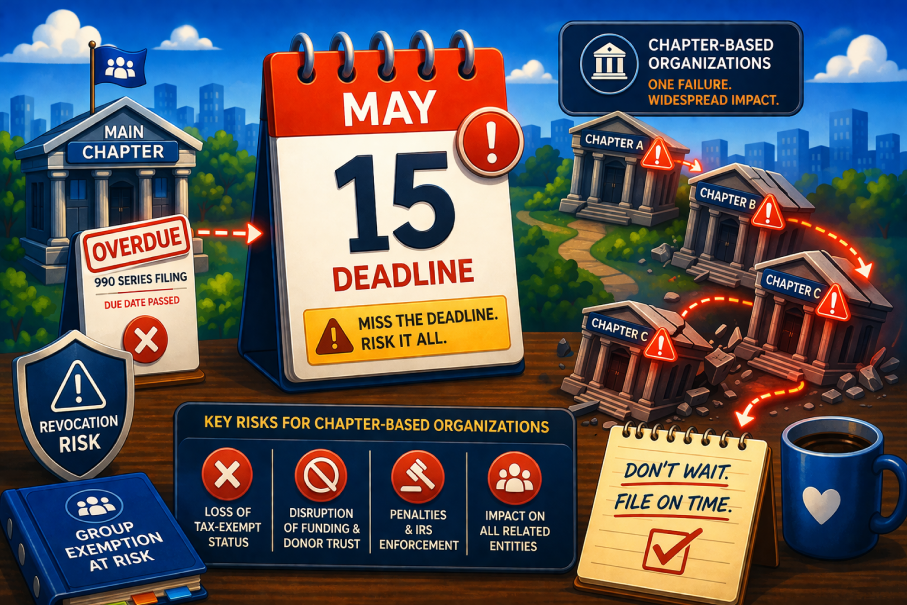
The May 15 nonprofit revocation deadline is the point where missed filings stop being fixable oversights and become permanent consequences. Under IRS rules, nonprofits that fail to file required annual returns for three consecutive years automatically lose their tax-exempt status. For calendar-year organizations, the trigger typically lands on May 15.
For a single-entity nonprofit, that is already a serious risk. In a multi-chapter organization, it becomes something else entirely: a distributed compliance failure that can happen quietly, across multiple entities, without headquarters realizing it.
This is what makes the May 15 deadline uniquely dangerous. It is about whether you can see which parts of your organization are already falling behind.
TL;DR
- May 15 is the nonprofit automatic revocation deadline that can quietly strip tax-exempt status after three consecutive missed filings. For chapter-based organizations, the real danger is not just the deadline itself, but the ease with which risk can build across chapters before headquarters sees it.
- Smaller, volunteer-run chapters are often the most exposed. Entities filing Form 990-N cannot extend beyond May 15, which makes low-visibility chapters the most likely place for a compliance failure to start.
- In multi-chapter nonprofits, one missed filing problem can become a network-level oversight issue. Revocation often happens silently at the chapter level, then surfaces later through donor questions, grant problems, or public IRS records.
- Reinstatement is possible, but it is slow, costly, and disruptive. Once status is revoked, organizations may face months of operational, fundraising, and credibility setbacks while they work through the IRS process.
- The organizations that stay ahead of May 15 are the ones with real-time visibility, not just year-end reminders. This is where Crowded adds value by helping central teams track filing risk across chapter EINs, spot issues earlier, and turn compliance from a reactive scramble into a controlled system.
What Is the May 15 Nonprofit Revocation Deadline?
The May 15 nonprofit revocation deadline refers to the IRS rule under IRC §6033(j), which provides that a nonprofit automatically loses its tax-exempt status after failing to file required annual returns for three consecutive years.
This process is automatic. There is no appeal, no grace period, and no negotiation once the threshold is reached. When revocation is triggered:
- The organization’s tax-exempt status is revoked by operation of law
- The effective date is retroactive to the third missed filing deadline
- Donations are no longer tax-deductible
- The organization must apply for reinstatement to regain status
Churches and certain religious organizations are exempt from filing requirements, but most charitable and educational nonprofits are fully subject to this rule. The key point is that this is a trigger.
Why May 15 Is a High-Risk Deadline for Nonprofits
For most nonprofits, annual filings are due on the 15th day of the fifth month after the fiscal year ends. For calendar-year organizations, that date is May 15. Now combine that with the three-year rule:
- Year 1: Missed filing
- Year 2: Missed filing
- Year 3 (May 15): Automatic revocation
That means May 15 is the moment when accumulated noncompliance becomes permanent. Organizations rarely fail all at once. They fail gradually, through missed reminders, staff turnover, and fragmented systems. By the time May 15 arrives in the third year, the outcome is already determined.
Filing Requirements and Where Risk Concentrates
Not all nonprofits face the same level of risk. Filing requirements vary based on size:
- Form 990-N (e-Postcard): ≤ $50K gross receipts — no extension available
- Form 990-EZ: < $200K receipts / < $500K assets — extension available to November 15
- Form 990: ≥ $200K receipts or ≥ $500K assets — extension available
- Form 990-PF: Private foundations — extension available
The highest-risk group is often the smallest. Chapters filing Form 990-N cannot extend their deadline beyond May 15. These are typically volunteer-run entities with less formal processes, making them more likely to miss filings. In multi-chapter organizations, these smaller units are often the least visible and the most likely to trigger automatic revocation.
Why the Risk Multiplies in Multi-Chapter Organizations
In a chapter-based structure, compliance is decentralized. Each chapter:
- Has its own EIN
- Files independently
- Maintains its own filing timeline
This creates a structural blind spot. A chapter can miss filings for multiple years without the headquarters being aware. The IRS does not notify central organizations when a subordinate entity is revoked. Instead, revocations are published on the IRS Auto-Revocation List, often after the fact.
Most organizations only discover issues when:
- A donor questions the tax-deductibility
- A grant application is denied
- A public listing shows the organization as revoked
By then, the damage is already done.
Compounding Risks in Chapter Networks
Several patterns consistently increase the likelihood of revocation:
- Volunteer turnover: Institutional knowledge disappears, and filing responsibilities are not clearly handed off.
- Dormant chapters: Inactive entities still have filing obligations. Silence does not pause compliance requirements.
- Legacy EIN structures: Older chapters may already be closer to the three-year threshold than expected.
- Fragmented tracking systems: Spreadsheets and manual follow-ups do not scale across dozens or hundreds of chapters.
The result is predictable. A single failure rarely causes revocation. It is the outcome of systems that cannot maintain visibility at scale.
What Happens After Automatic Revocation
Once a nonprofit loses its tax-exempt status, the consequences are immediate and visible:
- Donations are no longer tax-deductible
- The organization is removed from IRS Publication 78
- Grants may be suspended or withdrawn
- The organization becomes subject to federal income tax
- Revocation appears publicly on IRS records
The IRS Auto-Revocation List includes:
- Organization name
- EIN
- Revocation date
- Posting date
These dates are not always the same. The revocation date indicates when the exemption was lost, while the posting date indicates when the status became publicly visible.
How Long Does Reinstatement Take
Reinstating tax-exempt status is possible, but it is not immediate. Under Rev. Proc. 2014-11, organizations may pursue:
- Streamlined retroactive reinstatement (within 15 months)
- Retroactive reinstatement with explanation
- Retroactive reinstatement after 15 months with full justification
- Prospective reinstatement (no retroactive protection)
Each option requires:
- Filing Form 1023 or 1024
- Paying IRS fees
- Waiting for IRS review and approval
Even in the best-case scenario, reinstatement can take months. During that time, the organization operates without tax-exempt status, which affects fundraising, partnerships, and credibility. For chapter-based organizations, this becomes an operational issue at the network level.
How Crowded Helps Prevent Chapter-Level Revocation
The underlying cause of most revocations is a lack of visibility. Organizations fail to comply because they cannot see which chapters are already 1 or 2 years behind. Manual systems break down under scale:
- Spreadsheets become outdated
- Chapters report inconsistently
- Deadlines are tracked reactively
Crowded addresses this by acting as a financial infrastructure layer built for multi-entity nonprofits. With centralized visibility across all chapter EINs, finance teams can:
- Track filing status in real time
- Identify missed filings early (Year 1 instead of Year 3)
- Standardize financial data across chapters
- Support 990 preparation and filing from a single system
This shifts compliance from reactive cleanup to proactive management. Instead of discovering revocation after May 15, organizations can prevent it long before it becomes irreversible.
Why the May 15 Deadline Is Predictable but Preventable
The May 15 nonprofit revocation deadline happens every year. The rules do not change. What changes is whether an organization has the systems in place to stay ahead of it. In a multi-chapter structure:
- One missed filing is a warning
- Two missed filings are a risk
- Three missed filings trigger revocation
And it only takes one chapter to create broader consequences. The difference between control and crisis comes down to visibility. If your organization cannot clearly see compliance status across every chapter, the risk is already building. The deadline is simply when it becomes visible.
Frequently Asked Questions
Can a nonprofit avoid automatic revocation by filing late after May 15?
No. Once the three-year non-filing threshold is reached, revocation happens automatically. Crowded helps teams catch missed filings early so they do not reach that point.
How can headquarters monitor chapter compliance more effectively?
They need centralized visibility into filing status across every EIN. Crowded gives finance teams a clearer, real-time view across chapters.
Can one chapter’s revocation affect the broader organization?
Yes. It can create reputational, fundraising, and oversight risk beyond that single chapter, especially in multi-entity structures.
How often should nonprofits review their filing status?
At least annually, though, multi-chapter organizations benefit from more continuous tracking to catch issues earlier.
How does financial infrastructure affect compliance?
When filings, payments, and records are spread across disconnected systems, risk grows. Crowded helps reduce that fragmentation with centralized financial oversight.
How can nonprofits reduce filing risk during volunteer or leadership turnover?
They need standardized processes and shared visibility. Crowded supports continuity by keeping compliance-related financial data in one place.
Can compliance tracking be automated?
Yes. Automation can reduce missed deadlines and the need for manual follow-up. Crowded supports early detection and more proactive monitoring.
What is the benefit of proactive compliance?
It helps organizations catch issues before they become public or irreversible. Crowded is built to support that earlier visibility.