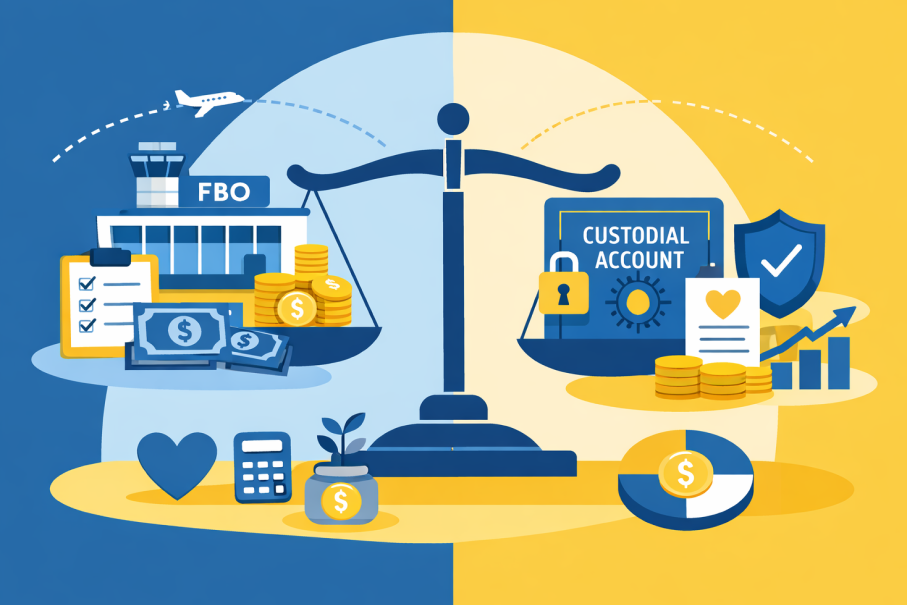
Choosing the wrong account structure for your nonprofit’s funds is a risk-management issue, one that the FBO vs. custodial account question sits squarely at the center of.
In April 2024, Synapse Financial Technologies filed for Chapter 11. The trustee identified a $65–$96 million shortfall between what Synapse’s ledgers showed and what partner banks actually held. Thousands of consumers were locked out of their funds. Some never recovered them.
This guide covers the four structures you’ll encounter most: FBO, custodial, omnibus, and subaccounts/virtual accounts.
TL;DR
- FBO, custodial, omnibus, and subaccount structures are not interchangeable; each carries a different level of legal protection and FDIC insurance eligibility.
- “Your funds are FDIC-insured” is not the same as “your funds are protected if the platform fails.” The Synapse bankruptcy proved it.
- FDIC pass-through insurance only holds up if per-beneficiary records are clean, reconciled daily, and independently validated. Most platforms don’t meet that bar.
- The account agreement is where your actual protection lives or doesn’t.
- Crowded* is built on an FBO structure with bank-level recordkeeping so that nonprofit finance leaders can answer auditors, boards, and regulators with confidence.
What Is an FBO Account?
An FBO (“for benefit of”) account is a bank account held by one legal entity on behalf of specific third parties. In practice, a platform may hold a master account while the actual funds are held by recorded beneficiaries, such as donors, members, or program participants.
How It Works
The bank sees one account holder, but the beneficial ownership belongs to the individuals or entities listed in the platform’s records. That recordkeeping matters because FDIC pass-through insurance only applies when beneficiary balances are clearly documented and regularly reconciled. Without that, coverage may be denied.
Regulatory Context
In 2024, the FDIC proposed Part 375, which would require stronger daily recordkeeping for custodial accounts with transactional features. The rule is not final, but the direction is clear: platforms using FBO accounts need accurate, reconciled per-beneficiary ledgers to support pass-through insurance claims.
FBO accounts are often used for fiscal sponsorships, membership dues, grant disbursements, and giving platforms that temporarily hold pooled funds before distribution. The Synapse bankruptcy showed what can go wrong when records do not match the bank’s actual balances. If an intermediary cannot produce a clean per-beneficiary ledger, pass-through insurance may not hold up when it matters most.
What Is a Custodial Account?
A custodial account is held by a custodian on behalf of specific beneficiaries. The custodian holds legal title to the assets, while the beneficiaries keep the economic interest.
How It Works
This is a formal legal relationship, not just a labeling convention. In fintech and banking, “custodial account” and “FBO account” are often used loosely, but a custodial account usually implies a clearer legal structure and stronger fiduciary obligations.
Why It Matters
The key difference is fiduciary duty. A true custodian must keep assets separate from operating funds, maintain accurate records, and act in the beneficiaries’ interest. An FBO label alone does not always guarantee those obligations. Custodial accounts often appear in endowment management, grant platforms, donor-advised funds, and employee benefit plans.
Problems arise when a custodian relies on sub-custodians or middleware without clearly passing along fiduciary duties. For nonprofits, the key question is simple: Does the agreement create a real custodial obligation, or just a recordkeeping arrangement?
What Is an Omnibus Account?
An omnibus account is a single pooled account that holds funds for multiple parties, but the bank only sees a single account holder. Individual owners are tracked internally, not at the bank level.
How It Works
There’s no FBO designation or per-beneficiary record with the bank. The platform manages allocations internally, which makes it efficient, but also dependent on its own records being accurate and up to date. Pass-through insurance is hardest to prove here. Since the bank has no visibility into individual balances, coverage depends entirely on the platform’s internal ledger being complete and reliable.
Payment processors use omnibus accounts, pooled investment vehicles, and some grant platforms handling commingled funds. If the platform fails and records don’t match actual balances, recovery becomes uncertain. You’re not listed at the bank; you’re just an entry in the platform’s system.
What Are Subaccounts and Virtual Accounts?
Subaccounts (or virtual accounts) are internal ledger entries within a master account. They give each user a separate balance and transaction history without creating separate legal bank accounts.
How They Work
A platform holds one or a few master accounts, while users get their own “virtual” accounts. Everything looks separate on the dashboard, but legally, it may still be one account at the bank. Protection depends on the setup. If the master account has an FBO structure with daily reconciled records, subaccounts can support pass-through insurance. If it’s an omnibus setup, subaccounts are just internal labels.
Subaccounts are used for chapter funds, program tracking, restricted vs. unrestricted funds, and managing multiple projects under one platform. Subaccounts can appear like real accounts but may not offer the same level of legal protection. Without a proper structure at the master account level, separation exists in the interface.
Side-by-Side Comparison: FBO vs Custodial Account vs Omnibus vs Subaccount
Table comparing FBO, custodial, omnibus, and virtual/subaccount structures across six key dimensions relevant to nonprofit finance leaders and platform builders evaluating account structure risk and FDIC insurance eligibility.
Feature | FBO Account | Custodial Account | Omnibus Account | Subaccount / Virtual Account |
Legal title holder | Platform/intermediary | Custodian (fiduciary) | Account holder | Platform/intermediary (master) |
Beneficial owner on record at the bank | Yes, if properly documented | Yes | No | Depends on FBO overlay |
FDIC pass-through insurance is eligible | Yes, with clean per-owner records | Yes, with proper documentation | Difficult; it depends entirely on the internal ledger | Depends on the underlying master account structure |
Fiduciary duty to the end user | Not automatically; it depends on agreement | Yes, by legal definition | No | No |
Reconciliation requirement | Daily, per beneficial owner | Regular; varies by custodian type | Internal only; no bank-level requirement | Depends on the platform |
Operational complexity | Medium | Medium–High | Low | Low–Medium |
Nonprofit risk level if the platform fails | Low–Medium (if records are good) | Low (strongest legal protection) | High | Medium–High (if no FBO overlay) |
Common nonprofit context | Fiscal sponsors, giving platforms, dues pooling | Endowments, DAFs, grant trust accounts | Legacy payment processors, some platforms | Chapter wallets, program fund tracking |
Platform Implications: What You Need to Know
For Nonprofit Finance & Ops Leaders
Your platform’s account structure determines ownership, insurance access, and auditability. Before signing, confirm:
- Account type: FBO, custodial, or omnibus (don’t accept vague “FDIC insured” claims)
- Records: Are beneficiary records maintained at the bank level—not just internally?
- Reconciliation: Is it done daily?
- Validation: Are records independently verified?
- Failure scenario: What happens to your funds if the platform goes under?
For Platform Builders
Standards are tightening. In practice:
- FBO structures with clear per-beneficiary records are becoming the baseline
- Omnibus setups carry growing legal and reputational risk
- Subaccounts must clearly map to a real legal structure, not just UI
- Contracts should define custodial vs. non-custodial responsibility
Build with FBO structures, daily reconciliation, and independent validation from the start. Retrofitting later is harder and riskier.
Closing Thoughts
The account structure you choose determines where risk lands when something breaks. FBO, custodial, omnibus, or subaccount, what matters is whether records are clean, reconciled daily, and independently validated.
Labels won’t protect you from failure. Records will. Review your platform’s agreement. Identify the structure. If it’s unclear, escalate to the bank partner.
Want to see how Crowded handles transparency around nonprofit account structures? Request a Demo →
* Crowded Technologies Inc is a financial technology company and is not a bank. Banking services provided by i3 Bank; Members FDIC. The Crowded Technologies Inc. Visa® Debit Card is issued by i3 Bank pursuant to a license from Visa U.S.A. Inc. and may be used everywhere Visa debit cards are accepted.
Frequently Asked Questions
What’s the difference between FDIC insurance and pass-through insurance?
What should I check in a platform agreement?
Are omnibus accounts ever okay?
Can I track funds without multiple bank accounts?
What questions should I ask my platform?
How does this work for multi-chapter organizations?
Why does this matter more now?
Banking-as-a-service added a middle layer between nonprofits and banks. Failures like Synapse showed that weak records can break protection. Crowded is built with that accountability from the start.