


Finding the best bank for associations sounds straightforward, until you’re three months in and your general ledger can’t separate chapter dues from restricted grant funds, your treasurer is manually reconciling five sub-accounts, and your board approval workflow lives in someone’s email inbox.
The real question is which financial system is built for how associations actually operate: multi-chapter structures, dues cycles, restricted fund separation, and volunteer-led governance. Choosing the best bank for associations in 2026 is less about brand name and more about whether the tools match your organizational complexity. This guide breaks down what to look for, where traditional banks fall short, and which options are worth serious consideration.
TL;DR
- Most banks were built for businesses, not associations, chapter structures, restricted funds, and board approval workflows require a different kind of financial system.
- Traditional banks, credit unions, and online banks all fall short in at least one critical area: governance, fund separation, or multi-entity account structure.
- The best bank for associations prioritizes governance fit first, multi-entity accounts, dues vs. donation separation, and configurable approval workflows, before fees or brand name.
- Purpose-built platforms like Crowded are closing the gap by treating financial governance as a core feature.
- Use the 3-step framework in this guide to map your complexity, test real workflows, and verify compliance posture before committing to any platform.
Why Traditional Banks Fall Short for Associations
Most banks were designed for businesses with a single revenue stream and a single decision-maker. Associations are structurally different, and that gap creates friction fast.
- No Native Chapter or Affiliate Account Structure: Traditional banks offer a flat structure: one account, one set of signatories. Giving chapters financial visibility without exposing the master account typically means opening separate accounts entirely, multiplying reconciliation overhead, and creating reporting blind spots at the national level.
- Dues and Donations Treated the Same: For 501(C)(6) or 501(C)(3) associations, the distinction between membership dues and charitable donations affects deductibility, reporting, and fund usage. Standard bank accounts make no such distinction; every deposit looks the same.
- Restricted Fund Management Is Manual: Banks hold the money; they don’t track the restrictions. Grant-funded programs, memorial funds, and designated reserves all require oversight that falls to your accounting software or your controller’s memory.
- Board Approval Workflows Don’t Exist at the Bank Level: Dual signatures on checks are a workaround. Most banks have no mechanism to enforce policy-level approval before a payment is released.
Traditional banks provide infrastructure. Associations need governance. The gap between them is where financial risk lives.
Core Features the Best Bank for Associations Should Offer
Before comparing specific options, use this checklist to evaluate whether any banking solution fits your operational reality.
- Multi-Entity and Sub-Account Support: Chapters and committees should have their own account views and spending authority without requiring separate bank accounts. Look for tiered access controls and account hierarchies.
- Dues vs. Donation Fund Separation: Income should be tagged or routed by type at the point of entry.
- Restricted and Unrestricted Fund Tracking: You need a clear audit trail confirming restricted funds were spent only on approved purposes, whether that lives in the platform or your accounting software.
- Approval Workflows and Spending Controls: Look for configurable approval chains, for example, disbursements over $2,500 requiring two board officers to authorize before release.
- AMS Integration: Dues payments should post automatically. Your banking system and membership database should communicate without manual intervention.
- Audit-Ready Reporting: Transaction data exportable by fund, program, or chapter makes Form 990 preparation and year-end audits significantly more manageable.
Comparing the Best Banks for Associations (Top Options)
Not every banking option is built with the same association in mind. The right fit depends on your size, chapter structure, and financial complexity. Here’s how the main categories stack up.
National Banks: Chase, Bank of America, Wells Fargo
- Pros: Wide branch access, strong fraud protection, name recognition.
- Cons: Built for commercial accounts. No native association features. Fees of $15–$30+/month without minimum balances. Sub-accounts require workarounds.
- Best for: Large associations with dedicated finance staff needing in-person branch access.
- What to verify: Fee waiver eligibility, how dual-signatory works in practice, and AMS integration availability.
Credit Unions and Community Banks
- Pros: Lower fees, relationship-based service, occasional nonprofit pricing.
- Cons: Limited tech stack. Geographic restrictions can be a problem for multi-chapter organizations.
- Best for: Single-location associations with straightforward financial structures.
- What to verify: Experience with 501(C)(3) or 501(C)(6) accounts, and user/role support in their online platform.
Online Banks (Relay, Mercury, Bluevine)
- Pros: Modern interfaces, sub-accounts, API integrations, low fees, fast setup.
- Cons: Not built for associations. Sub-accounts aren’t mapped to chapters or restricted funds. No branch access.
- Best for: Tech-forward associations with small teams and simple financial structures.
- What to verify: User permission levels, nonprofit experience, and FDIC coverage on larger reserve balances.
Purpose-Built Association Financial Platforms (e.g., Crowded*)
- Pros: Designed around chapters, dues, restricted funds, and board approvals. Governance is a core feature.
- Cons: Newer category. Some boards may need convincing to move away from traditional institutions.
- Best for: Multi-chapter associations with active grant programs or complex governance requirements.
- What to verify: Fund separation logic, audit export format, AMS integrations, and data portability if you switch.
How to Choose the Best Bank for Associations: A 3-Step Framework
The best bank for associations combines multi-entity account structures, built-in fund separation, and configurable approval workflows. Evaluate governance fit first, then fees and integrations.
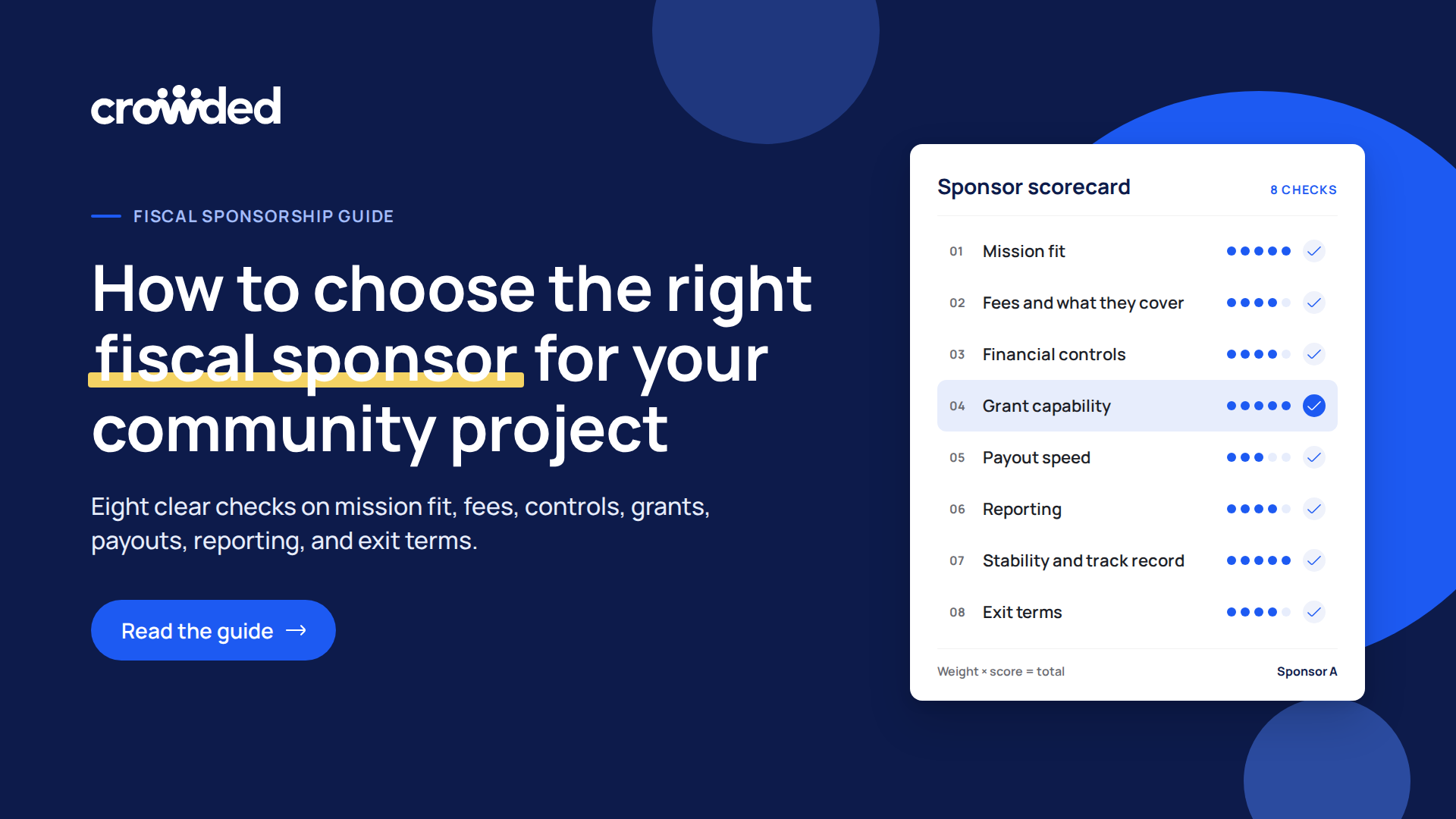
Step 1: Map Your Financial Complexity Before You Shop: Document every entity type (chapters, affiliates, committees), every fund type (dues, grants, reserves), and every approval rule your bylaws require. This becomes your vendor scorecard.
Step 2: Test the Workflow: Ask vendors to walk through three scenarios: a chapter reimbursement request requiring board approval, a restricted grant deposit tracked through to disbursement, and a year-end export for your auditor. If they can’t demo all three cleanly, that’s your answer.
Step 3: Verify Compliance Posture: Confirm FDIC or NCUA coverage, ask how the platform handles mid-year signatory changes, and verify Form 990 support. These are annual requirements.
From Banking to Financial Infrastructure
The question associations should be asking isn’t “where do we hold our money?” It’s “what system governs how our money moves, who can touch it, and how we prove we used it correctly?”
A bank account is a commodity. Financial infrastructure, account structure, access controls, approval workflows, and audit-ready reporting are a governance tool. The best bank for associations is the one that closes the gap between holding funds and governing them.
Why Platforms Like Crowded Are Emerging as the Best Option for Associations
Traditional banking options keep forcing associations to adapt their workflows to fit products never designed for them. Here’s what sets platforms like Crowded apart.
- Built for the Way Associations Actually Operate: Platforms like Crowded are built from the ground up for organizations with chapters, committees, and layered financial relationships, treating multi-entity structures and fund separation as core functionality.
- Governance Built Into the Financial Layer: Approval workflows embedded directly in the platform replace email chains and paper check requests. Board officers approve or decline disbursements within the system, creating a native audit trail.
- Reduced Reconciliation for Volunteer Treasurers: Most association treasurers are volunteers. Platforms that automate fund categorization and chapter reporting eliminate the manual overhead left by traditional banking solutions.
- What to Evaluate Before Committing: Ask about data portability, AMS integrations, and mid-year signatory transitions. The right fit, whether you’re looking for the best bank for associations or the best bank for nonprofits, always comes down to governance model first, transaction volume second.
Final Takeaway
The best bank for associations in 2026 is the one built for how your organization actually operates, including chapter structures, fund separation, and governance controls. Traditional banks require too much manual workaround. Online banks offer flexibility without the depth of association-specific offerings. Platforms like Crowded treat financial governance as a feature.
The same logic applies if you’re evaluating the best bank for nonprofits: native fund separation, board-level controls, and clean audit exports are non-negotiable.
Ready to Compare Your Options?
Before locking in any banking relationship, run your three most operationally complex workflows through every platform you’re seriously considering. How does it handle a mid-year chapter split? A grant with multi-year restrictions? A board officer transition in the middle of a fiscal year?
If you’re evaluating purpose-built platforms, Crowded is worth exploring alongside your other shortlisted options, specifically to compare how approval workflows, fund structures, and chapter oversight features work in practice. The best bank for associations is the one that holds up when your governance requirements get complicated.
* Crowded Technologies Inc is a financial technology company and is not a bank. Banking services provided by i3 Bank; Members FDIC. The Crowded Technologies Inc. Visa® Debit Card is issued by i3 Bank pursuant to a license from Visa U.S.A. Inc. and may be used everywhere Visa debit cards are accepted.
Your questions, answered.
Can an association have multiple signatories on one bank account?
Yes, but signatories expand access; they don’t enforce spending rules. Platforms like Crowded embed approval thresholds into the payment workflow, requiring authorization before any transaction is released
What happens to our bank account when board officers change?
Traditional banks require paperwork that can temporarily freeze payments. Platforms like Crowded handle transitions digitally, reducing disruption from volunteer board turnover.
Do associations need a separate EIN to open a bank account?
Yes. Banks require a valid EIN issued to the association. Chapters operating independently may need their own. Verify with your accountant before opening new accounts.
How should associations handle chapter or event-level spending?
Traditional banks have no clean solution. Platforms like Crowded use sub-accounts and spending controls that let chapter leads manage local budgets within board-approved limits without touching the central account.
Can associations switch banking platforms mid-fiscal year?
Yes. Ensure your transaction history is exportable in a format your auditor accepts, and ask providers for a documented migration process before committing.
What's the difference between fiscal sponsorship and a standard association bank account?
Fiscal sponsorship is when a nonprofit holds funds on behalf of a group without tax-exempt status. A standard association account is held directly by the legal entity. If you sponsor unincorporated chapters, clarify with legal counsel which structure applies.