If you’re a grants manager or foundation leader, the term expenditure responsibility either makes you confident or quietly anxious. This guide cuts through the complexity. Whether you’re navigating IRS expenditure responsibility requirements for the first time or tightening up an existing workflow, here’s what you need to know to stay audit-ready.
TL;DR
- Private foundations must exercise expenditure responsibility (ER) when granting to non-public charities, including foreign orgs, for-profits, and other private foundations, or risk excise taxes under IRC §4945.
- ER is a four-part workflow: pre-grant inquiry, grant agreement, progress reports, and 990-PF disclosure, and every piece must be documented.
- For foreign grants, you have two paths: ER or equivalency determination. Choosing the wrong one for your grantee relationship is a fixable mistake, but only if you catch it before the IRS does.
- The most common ER failures are operational misunderstandings: missed reports, weak agreements, and files that can’t survive an audit.
- Foundations that treat ER as a standing workflow make fewer errors, move faster, and extend to a wider range of organizations with confidence.
What Is Expenditure Responsibility, and When Does It Apply?
Under IRC §4945, private foundations are prohibited from making “taxable expenditures”, a category that includes grants to organizations that aren’t public charities unless the foundation exercises adequate control over how the funds are used. That control mechanism is expenditure responsibility.
ER applies when your foundation grants to:
- U.S. nonpublic charities, such as fiscal sponsors acting outside their normal capacity, supporting organizations under certain conditions, or for-profit entities
- Foreign organizations that haven’t obtained a qualifying equivalency determination
- Individuals in some circumstances (though individual grants have their own separate rules)
- Other private foundations (with limited exceptions for certain re-granting)
When ER applies, it isn’t optional. The foundation must satisfy the full four-part compliance workflow or risk an excise tax on the grant amount and, in serious cases, on foundation managers personally.
The Four Core Requirements of an ER Workflow
Think of expenditure responsibility as a contract between your foundation and the IRS: We will control this grant so the public benefit is real. The IRS expects four documented steps.
1. Pre-Grant Inquiry
Before the grant is made, the foundation must conduct a “limited inquiry” into the grantee’s financial condition, governance, and capacity to use the funds for the intended charitable purpose. This doesn’t require a full audit; it generally means reviewing the organization’s financials, leadership, and prior track record.
2. Written Grant Agreement
The grant agreement must include, at a minimum:
- A statement that the grantee will use funds solely for the described charitable purpose
- A repayment clause if funds are diverted or the project fails
- Recordkeeping and access-to-records provisions
- An agreement not to use funds for lobbying, electioneering, or other prohibited activities
- A provision requiring the grantee to return unused funds
This agreement is your primary documentary shield. Don’t treat it as boilerplate.
3. Progress and Final Reports
The foundation must require the grantee to submit periodic reports, at least annually for multi-year grants, documenting how funds were spent and progress toward the grant’s purpose. These reports must be reviewed by the foundation and kept on file.
4. IRS Reporting
The foundation reports each ER grant on Form 990-PF, Part VII-B. You must disclose the grantee’s name, the grant amount, the purpose, and certify that the ER requirements were satisfied. Missing or inaccurate reporting here is a common audit trigger.
Quick Decision Tree: Do You Need Expenditure Responsibility?
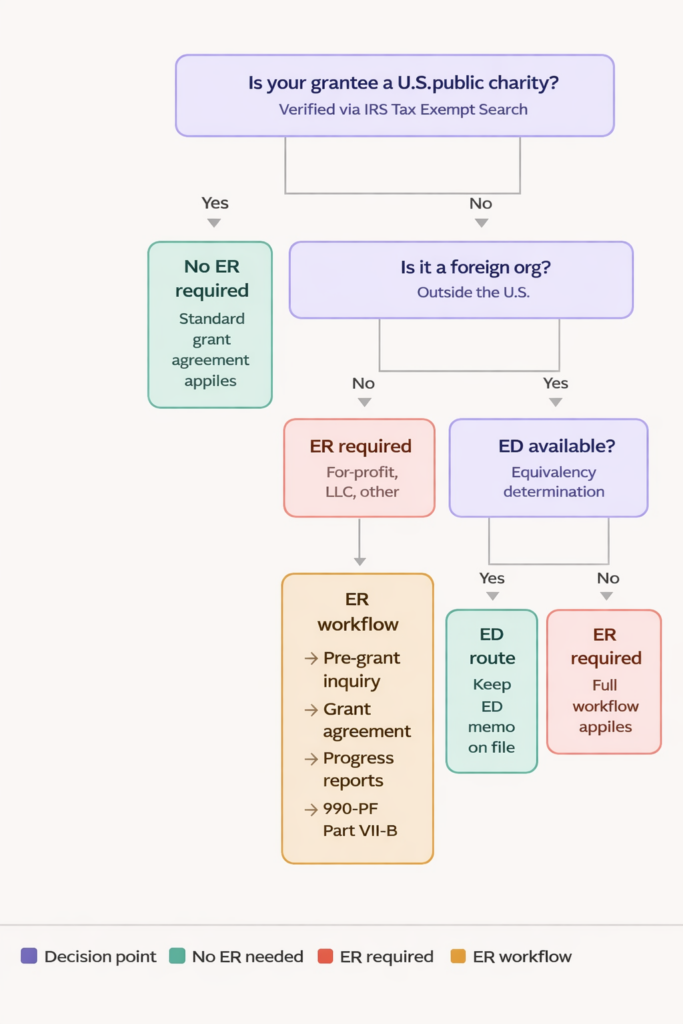
Expenditure Responsibility vs. Equivalency Determination: Which Path Is Right?
For foreign grants, expenditure responsibility and equivalency determination are the two primary compliance pathways. They serve the same goal, ensuring public benefit, but through very different mechanisms.
Factor | Expenditure Responsibility | Equivalency Determination |
How it works | Foundation monitors grant use directly | Foundation determines org is “equivalent” to a U.S. public charity |
Documentation required | Grant agreement, reports, 990-PF disclosure | Written legal opinion or affidavit from the grantee |
Ongoing obligations | Progress reports + annual IRS reporting | Refreshed periodically (typically every 24–36 months) |
Best suited for | One-time or short-term grants; new grantees | Long-term, repeat grantees with strong financials |
Complexity | Moderate — workflow-driven | Higher upfront — requires legal analysis |
Foundation control | High | Lower after ED is established |
Many foundations use equivalency determination rather than expenditure responsibility as a strategic choice, depending on the relationship maturity and grant size. Neither is inherently superior; the right path depends on your grantee’s profile and your team’s bandwidth.
Foreign Grants and Expenditure Responsibility: Extra Considerations
Foreign grants under expenditure responsibility carry additional complexity. When a U.S. private foundation makes a cross-border grant using the ER pathway, it must:
- Ensure the grant agreement references the specific charitable purpose in terms that satisfy U.S. tax law
- Account for currency conversion and potential complications in fund tracking
- Confirm that the foreign grantee understands the repayment and recordkeeping obligations, in their operating language if needed.
- Assess whether OFAC (Office of Foreign Assets Control) screening is required before disbursement.
The IRS has historically scrutinized foreign grant expenditure responsibility documentation closely. Foundations that handle cross-border grantmaking should treat ER compliance as a standing workflow rather than a one-time checklist.
Practical Checklist: Audit-Ready ER Documentation
Use this list before closing out any ER grant file:
- [ ] Pre-grant inquiry completed and summarized in writing
- [ ] Grant agreement signed by both parties, containing all required provisions
- [ ] Grant purpose tied explicitly to a charitable purpose under IRC §501(c)(3)
- [ ] Grantee reporting schedule established and acknowledged in writing
- [ ] All progress reports received, reviewed, and filed
- [ ] Final report or grant closeout memo on file
- [ ] Form 990-PF, Part VII-B, completed accurately for the grant year
- [ ] Any diverted funds documented and addressed per the grant agreement
- [ ] Foreign grantee file includes OFAC screening record (if applicable)
- [ ] ED memo on file if equivalency determination route was used instead
Common ER Scenarios: What Does This Look Like in Practice?
Expenditure responsibility applies across a surprisingly wide range of grantmaking situations. The scenarios below illustrate how ER obligations surface in real grant files and what your team needs in place when they do.
- U.S. LLC grantee: A foundation grants $50,000 to a for-profit LLC running a community solar project. ER is required. A robust grant agreement with milestone-based reporting is essential.
- Foreign NGO, no ED: A foundation grants to a Kenyan nonprofit without an equivalency determination. ER applies. Annual reporting in English is required in the grant agreement.
- Domestic private foundation: A re-grant from one private foundation to another. ER typically applies; the receiving foundation must certify it won’t use funds as taxable expenditures.
- Fiscal sponsor: Grants routed through a fiscal sponsor for a project that isn’t itself a public charity often require ER unless the sponsor confirms it retains full discretion and control.
- Lobbying-adjacent project: Even with ER in place, grant funds cannot support lobbying or voter registration. The agreement must explicitly carve this out.
- Multi-year international grant: A three-year grant to a Southeast Asian educational organization triggers annual ER reporting for each year of the grant term.
- Diverted funds discovered: Mid-grant, the foundation learns that funds were redirected. ER obligates the foundation to take corrective action and document it; failure to act can trigger taxable expenditure status.
How Crowded Supports Expenditure Responsibility Compliance
Managing expenditure responsibility across a portfolio of grants, especially with foreign grantees, multi-year timelines, and rotating staff, is fundamentally a documentation and deadline management problem.
Crowded is built as a workflow infrastructure for exactly this kind of work. Foundations use Crowded to track reporting deadlines, flag overdue grantee submissions, route internal approvals, and maintain audit-ready grant files, all in one place. When an IRS inquiry or board audit arrives, everything is where it should be.
Expenditure Responsibility Is a System
Expenditure responsibility is an ongoing compliance relationship between your foundation, your grantee, and the IRS. When implemented as a consistent workflow, it protects your foundation from taxable expenditures, expands your grantmaking reach to non-public-charity recipients, and demonstrates the institutional rigor that boards and auditors expect.
Build the system once. Maintain it consistently. And when in doubt, consult qualified legal counsel. This guide is educational.
Your questions, answered.
How often should a foundation review its ER procedures?
Annually, at a minimum, tied to the 990-PF cycle. Crowded lets foundations build review triggers into their compliance calendar so gaps don’t form between filings.
Can a foundation delegate ER compliance to a fiscal sponsor?
No. The obligation stays with the originating foundation. Relying on an intermediary without your own documentation is a common and costly mistake.
What records are needed if a grantee dissolves mid-grant?
Document the dissolution, remaining balances, recovery steps, and a written closeout memo. Crowded keeps these multi-document, multi-year files organized and audit-ready.
Is there a minimum grant size below which ER doesn't apply?
No. A $5,000 grant to a for-profit triggers the same four requirements as a $500,000 one. The obligation is categorical.
Can a foundation grant to a DAF avoid ER?
Grants to a DAF sponsor are generally fine, but earmarking those funds for a specific non-public-charity grantee effectively circumvents ER, a legally risky move that warrants counsel.