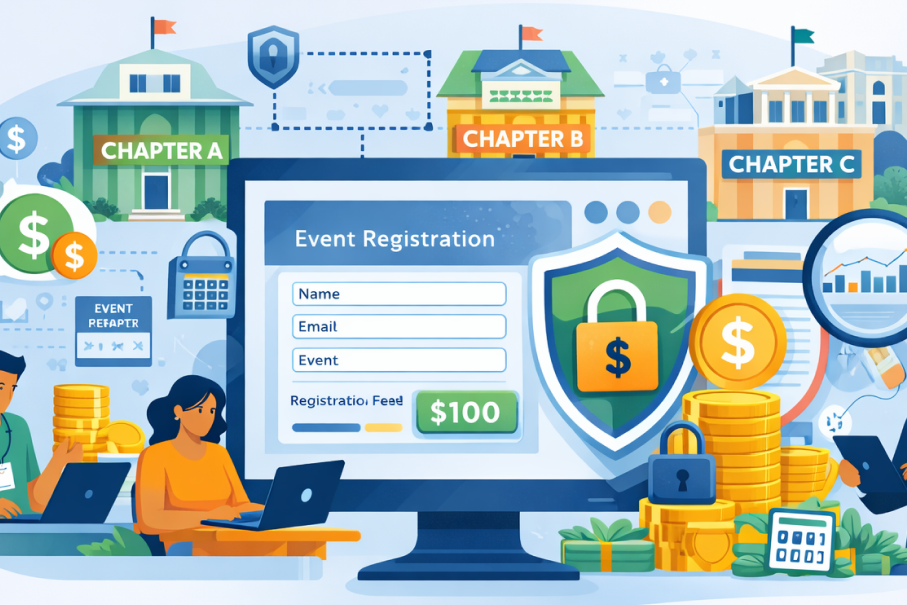
For multi-chapter associations, events are a critical revenue stream. Professional conferences, regional workshops, fundraising galas, and member meetups generate millions in annual income across chapters. But event registration software captures signups and not the financial control.
Most platforms stop at tickets and attendee data, leaving revenue fragmented across payment processors, bank accounts, and manual reconciliations. For associations with dozens or hundreds of chapters, this creates a dangerous visibility gap.
TL;DR
- Event registration software tracks attendees. Most platforms stop at tickets and signups, leaving event revenue scattered across personal Stripe accounts, PayPal wallets, and disconnected bank accounts.
- Fragmented event payments create governance risk. Without centralized processing, headquarters can’t reliably see what was collected, where funds are held, or whether chapters are using approved financial infrastructure.
- The missing layer is centralized payment processing. By routing event payments through Crowded, without replacing existing registration tools, associations gain real-time visibility, standardized controls, and clean audit trails.
- Centralization protects revenue during officer transitions. Funds stay in organizational accounts, permissions update automatically, and chapters avoid the common “lost access” crisis when treasurers change.
- HQ gains real-time insight without micromanaging chapters. Chapters keep autonomy over event planning, while headquarters sets financial guardrails that enable compliance, forecasting, and performance benchmarking.
- The payoff is predictable, auditable event revenue at scale. Associations reduce reconciliation time, simplify Form 990 prep, and turn events from operational headaches into reliable revenue streams.
The Hidden Risk in Event Revenue
Event revenue becomes risky when payments live outside core financial infrastructure. Without centralized processing, associations struggle to confirm:
- What was actually collected from each event
- Where those funds are currently held
- How revenue maps back to specific chapters, programs, or events
- Whether chapters are using approved processors or shadow accounts
Chapter treasurers often mean well when they connect event registration platforms to personal Stripe accounts or chapter PayPal. But every ad-hoc processor creates compliance exposure, lost funds during officer transitions, and reconciliation nightmares for headquarters finance teams.
What the ‘Extra Layer’ Actually Means
The ‘extra layer’ is centralized payment processing tied directly to organizational accounts.
Rather than replacing your event registration software, you integrate it with a unified financial platform. When attendees pay for event tickets through Eventbrite, Ticketmaster, or your association’s custom platform, those payments flow through Crowded’s centralized payment infrastructure into chapter-specific accounts that headquarters can monitor and control.
By routing event payments through Crowded, associations keep their existing registration tools while gaining real-time visibility, standardized controls, and clean financial records. Chapter leaders still manage their events independently. But headquarters finally have governance over where money goes and how it’s tracked.
How Centralized Processing Protects Revenue at Scale
When events scale, financial fragmentation accelerates. A national association might run 200+ events annually across 50 state chapters. Without centralized processing:
- Each chapter connects registration platforms to different processors
- Officer transitions leave funds trapped in personal or defunct accounts
- HQ finance teams spend 40+ hours per quarter reconciling event revenue
- Audit trails are incomplete or nonexistent
Crowded solves this by creating a single financial backbone for all event payments. HQ can monitor collections in real-time, enforce permission controls on who can approve transactions, and prevent ad-hoc accounts or shadow processors from emerging at the chapter or event level.
More importantly, centralized processing standardizes how chapters collect, hold, and report event revenue. This means consistent Form 990 compliance, unified audit trails, and protected funds during leadership transitions.
Turning Events Into Predictable Revenue Streams
Events should be predictable, auditable revenue streams. When associations control event revenue through centralized processing, they transform events from operational headaches into strategic assets.
The combination of event registration software for attendee management and Crowded for financial control creates a comprehensive system that addresses the full lifecycle of event revenue management.
Real-Time Visibility Across All Chapters
With centralized payment processing, headquarters finance teams see event revenue as it happens. No more waiting for monthly chapter reports or chasing down treasurers for updates. When a regional conference sells 200 tickets on Tuesday morning, that data appears in the dashboard immediately, attributed to the correct chapter, program, and accounting period.
This real-time visibility transforms how associations monitor performance, allocate resources, and solve financial discrepancies that previously consumed hours of administrative time.
- Instant revenue tracking by chapter, event type, and date range – HQ can identify underperforming events early, spot high-performing chapters worth replicating, and replicate what works across the network.
- Eliminating the “Where did that money go?” problem – A chapter reports $15,000 in event revenue, but only $12,000 appears. Centralized processing tracks every transaction, fee, and dollar in real-time, no more reconciliation mysteries.
- Performance benchmarking that actually works – When all chapters use the same infrastructure, performance benchmarking becomes accurate. Which chapters convert best? Which formats generate the most revenue? Comparable data finally answers these questions.
Standardized Compliance and Audit Trails
Form 990 compliance depends on accurate revenue categorization and complete documentation. When event payments flow through Crowded’s centralized infrastructure, every transaction is automatically categorized, timestamped, and attributed to the correct revenue stream.
This eliminates the tax season scramble when headquarters tries to consolidate event revenue across dozens of chapters using different systems. Instead of reconstructing financials from incomplete records, associations have audit-ready documentation from day one.
- Every transaction documented for Form 990 preparation – Automated categorization and time stamping eliminates the year-end scramble to reconstruct event revenue. Audit-ready documentation builds in real-time.
- Built-in compliance for multi-chapter structures – Centralized processing maintains legal separation between 501(C)(6) headquarters and 501(C)(3) chapters while giving HQ visibility for consolidated reporting.
- Audit trails that survive leadership transitions – When officers rotate, institutional knowledge leaves, audit trails don’t. Records remain accessible even after every officer has graduated or moved away. Financial history belongs to the organization.
Protected Funds During Leadership Transitions
Officer transitions are where event revenue most often goes missing. The outgoing treasurer had event payments flowing to a personal Stripe account connected to their personal email. They graduated, moved, or simply forgot to transfer credentials. Now the chapter can’t access $8,000 in event revenue from last semester.
With centralized processing, leadership changes don’t affect account access. The chapter’s financial infrastructure stays intact while individual permissions update seamlessly.
- Eliminating the “lost access” crisis – New officers get appropriate access immediately, while former officers lose transaction authority automatically. The chapter’s financial infrastructure stays intact regardless of who’s currently serving as treasurer.
- No more chasing down former treasurers – Event revenue lives in organizational accounts from collection. Former officers never personally controlled the accounts, just delegated permissions that automatically expire with their term.
- Seamless continuity for multi-year events – Signature events often span multiple leadership terms and cross several officer transitions. Centralized processing turns these transitions into administrative updates rather than financial emergencies.
Accurate Revenue Attribution for Budget Planning
Budget planning requires accurate historical data. When event revenue is fragmented across different systems, associations make decisions based on incomplete information. Did the Northeast region really grow event revenue 15% last year, or did they just report more consistently than other regions?
Centralized processing gives headquarters apples-to-apples comparison. Every chapter’s event revenue flows through the same infrastructure, gets categorized the same way, and appears in comparable reports.
- Chapter-level performance that informs strategic decisions – Strategic decisions are based on actual performance rather than guesswork. Standardized infrastructure eliminates questions about whether differences reflect performance or reporting inconsistencies.
- Revenue forecasting based on clean historical data – Real-time processing enables mid-year forecasting. Leadership can adjust budgets with confidence or investigate underperformance immediately rather than discovering shortfalls at year-end.
- Program-level ROI analysis – Not all events generate positive returns. Some are revenue drivers, others are member benefits that break even. Program-level analysis enables strategic decisions about which programs to expand versus optimize for member value.
Reduced Administrative Burden on Chapter Treasurers and HQ Finance Teams
The biggest cost of fragmented event revenue is the ongoing administrative burden. Headquarters finance teams spend 40+ hours per quarter reconciling event revenue across chapters using different systems, incomplete documentation, and manual processes.
Centralized processing eliminates most of this work. Revenue is already categorized, attributed, and reconciled in the system.
- From 40 hours of quarterly reconciliation to under 2 hours – Quarterly close becomes a matter of running reports rather than reconstructing financials from email threads and bank statements. Revenue is already categorized, attributed, and reconciled when it enters the system.
- Volunteer treasurers freed from banking complexity – Volunteer treasurers often lack financial backgrounds. Centralized processing removes the burden of setting up processors and ensuring compliance. Treasurers focus on programs.
- Automated reporting that actually gets used – Manual reporting is time-consuming, so chapters submit reports late or incomplete. Centralized infrastructure automates reporting. Headquarters sees real-time data, and treasurers generate reports with one click.
This is about ensuring growth doesn’t create financial chaos. Associations that control event revenue through centralized processing turn events into predictable, auditable revenue streams that scale efficiently, without overwhelming volunteer leaders or headquarters finance teams.
How Crowded Makes Centralized Event Revenue Control Possible
The benefits of centralized processing are clear, but implementation is where most associations get stuck. Traditional banking infrastructure wasn’t built for multi-chapter organizations. Setting up separate accounts for 50 chapters, maintaining group exemption compliance, and configuring payment routing requires weeks of work and banking expertise most associations don’t have.
Crowded solves this by providing purpose-built infrastructure for multi-chapter associations:
- Chapter-specific accounts with centralized oversight – Each chapter gets its own account, headquarters maintains real-time visibility across all.
- Automated compliance for group exemptions – Maintains legal separation between 501(C)(6) headquarters and 501(C)(3) chapters while providing consolidated reporting.
- Unified payment processing – Collect event revenue through Crowded’s payment links instead of fragmented processors, ensuring funds flow directly into organizational accounts.
- Permission controls that survive officer transitions – New treasurers get access automatically, former officers lose authority. Revenue stays in organizational accounts.
Crowded eliminates the technical barriers that prevent associations from controlling event revenue at scale. The infrastructure is already configured, compliant, and designed specifically for multi-chapter nonprofit organizations.
The Bottom Line
Event registration software handles the front-end experience: signups, tickets, attendee data. But controlling event revenue requires infrastructure that lives beneath these platforms.
That ‘extra layer’ is centralized payment processing through Crowded. It’s what transforms event revenue from fragmented, risky transactions into predictable, auditable income streams that scale with your association’s growth.
For multi-chapter associations, the question is whether you’re willing to accept fragmented financial control, or whether you’ll establish the governance infrastructure that protects event revenue at scale.
Associations that make the governance decision turn events into strategic revenue drivers.
Your questions, answered.
Can centralized event revenue work for associations with both paid and free events?
Yes. Centralized processing isn’t just for ticketed revenue. Even free or donation-based events benefit from standardized financial routing, especially when sponsorships, optional add-ons, or post-event contributions are involved. The infrastructure stays consistent regardless of ticket price.
How does this affect chapters that already have long-standing banking relationships?
Chapters don’t have to abandon existing relationships overnight. Centralized processing can be phased in event-by-event, allowing chapters to transition without disrupting ongoing programs or relationships with local vendors.
Is centralized processing only useful for large associations?
No. Smaller associations often feel the pain sooner because they rely heavily on volunteers and lack redundant financial oversight. Centralized processing prevents problems early, before growth amplifies risk.
Can Crowded handle both 501(C)(6) and 501(C)(3) tax structures?
Yes. Crowded is built specifically for multi-chapter nonprofit associations and supports the compliance requirements for both 501(C)(6) national organizations and 501(C)(3) chapters operating under group exemption. The platform maintains the legal separation required while providing consolidated visibility for headquarters.
What happens when chapter officers change?
Crowded’s permission system allows headquarters to update access controls when officers transition. New treasurers can be granted appropriate permissions while former officers lose transaction authority. Because accounts belong to the organization, there’s no risk of funds being trapped in personal processors or forgotten credentials.
Does each chapter get its own account?
Yes. Each chapter receives its own dedicated account within Crowded’s infrastructure. This maintains financial separation between chapters while giving headquarters real-time visibility across all chapter accounts through a centralized dashboard.