If your association pays vendors, contractors, speakers, or service providers, you’ve likely been asked for—or asked someone else for—a W-9 form. Yet many associations aren’t sure what a W-9 form is, whether nonprofits use it differently, or how to complete it correctly.
This guide explains the W-9 form for associations, including when it’s required, where to get the most recent W-9 form, and how associations should complete and store it for compliance.
TL;DR
A W-9 form is an IRS tax form used to collect a payee’s legal name, address, and taxpayer identification number so accurate reporting (like 1099s) can be done.
Associations both request W-9s from vendors/contractors and may need to provide their own W-9 when they’re paid by others (e.g., sponsors or partners).
The form supports 1099 filing and IRS compliance, it does not prove tax-exempt status.
Always download the latest official W-9 from the IRS and avoid outdated third-party versions.
Key sections to fill out include legal name (matching IRS records), tax classification, EIN (never personal SSN), address, and authorized signature.
Best practices: collect W-9s before first payment, store them securely, keep data updated, and match them to year-end 1099 reporting.
A free W-9 template is available to save time and reduce errors.
What Is a W-9 Form?
If you’re asking what W-9 form means in practice: it’s an IRS form used to request a person’s or organization’s legal name, address, and taxpayer identification number (TIN).
The form W-9 purpose is simple:
- Enable accurate 1099 reporting
- Confirm tax classification (individual, LLC, corporation, nonprofit)
- Reduce IRS reporting errors
Importantly, a W-9 does not mean taxes are being withheld or paid at the time—it’s purely an information-gathering form.
Do Associations Use W-9 Forms?
Yes. Associations interact with W-9 forms in two ways:
- Requesting W-9s
Associations request W-9 forms from:- Independent contractors
- Event speakers or trainers
- Consultants and service providers
- Providing a W-9
Associations may need to provide their own W-9 form for nonprofits when:- Receiving sponsorship income
- Providing services to another organization
- Participating in partnerships or joint programs
Both 501(c)(3) nonprofits and 501(c)(6) associations use the same W-9 form.
Where to Get Your W-9 Form
If you’re wondering where to get your W-9 form, always use the official IRS version.
Best practice:
- Download the most recent W-9 form directly from the IRS website
- Avoid third-party versions with outdated fields or instructions
- Reconfirm you’re using the current form at least once per year
Using an outdated W-9 can cause 1099 errors or rejected filings.
How Associations Should Fill Out a W-9 Form
While the form itself is standardized, how it’s completed matters for associations.
Key fields to pay attention to:
- Legal name (must match IRS records)
- Business name (if different)
- Federal tax classification (e.g., C-Corp, nonprofit)
- EIN (not a personal SSN for organizations)
- Address (used for 1099 delivery)
A sample W-9 for associations will look the same as other organizations—the difference is in the tax classification and EIN.
How to Fill Out a W-9 for an Association
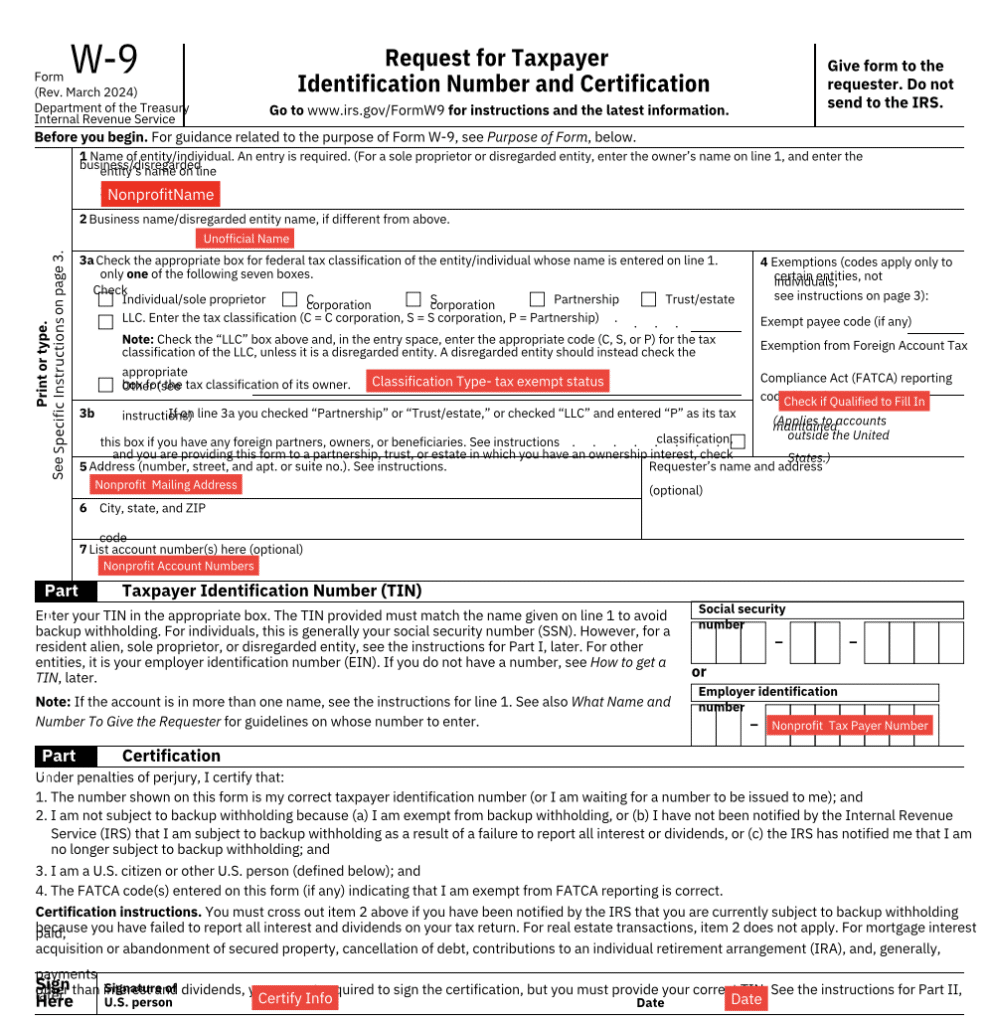
Here’s a step-by-step guide on how to fill out a W-9 for an association:
Line 1 (Organization’s Official Name) | Enter the association’s legal name exactly as it appears in your Articles of Incorporation or other IRS records. This name must match the name associated with your EIN. |
Line 2 (Organization’s Unofficial Name) | Leave this line blank unless your association operates under a DBA or alternate public name that differs from its legal name. |
Line 3 (Federal Tax Classification) | Most incorporated associations should select “C Corporation” or “Other”, depending on how the IRS classifies the entity tied to the EIN.
Always align this selection with your IRS determination and EIN records. |
Line 4 (Exemptions) | If your association is exempt from backup withholding and FATCA reporting, enter the appropriate codes:
Most tax-exempt associations qualify for both, but confirm with your tax advisor if unsure. |
Line 5+6 (Address) | Provide the mailing address for your nonprofit organization. This is the address where 1099 forms should be sent at year-end. |
Line 7 (Account Number) | You may include any account numbers that the third party may need in Line 7, but this is optional. |
Part I (TIN) | Enter the association’s Employer Identification Number (EIN) as assigned by the IRS.
Associations should always use their EIN, even if volunteer-run. |
Part II (Certification) | By signing, the authorized representative of the association certifies that:
All that is required is the signature and date of an authorized officer or financial administrator. |
Association W-9 Example
Using an association W9 example like this as a reference can prevent errors and speed up processing with funders or vendors.
Line / Part | Example Entry |
Line 1 – Name | National Industry Professionals Association (legal name as registered with the IRS) |
Line 2 – Business name/DBA | Leave blank (only fill in if using a different public name) |
Line 3 – Federal tax classification | Check “C Corporation” (for incorporated associations) or “Other” and write “Association” (for unincorporated associations) |
Line 4 – Exemptions | Exempt payee code: 1; Exempt from FATCA reporting code: A (if applicable) |
Lines 5 & 6 – Address | 123 Charity Lane, Kindness City, ST 12345 |
Line 7 – Account numbers | Leave blank (only if requester provides an account number) |
Part I – TIN | EIN: 12-3456789 (never use a personal SSN for a nonprofit) |
Part II – Certification | Signed by Executive Director, 03/01/2025 |
When Associations Need W-9 Forms
Associations should collect W-9s:
- Before issuing payments to vendors
- Before reimbursing independent contractors
- Well before year-end 1099 preparation
Waiting until January to request W-9s is one of the most common compliance mistakes.
How W-9 Forms Connect to 1099 Reporting
The W-9 provides the data needed to:
- Determine whether a vendor requires a 1099
- Populate Form 1099-NEC or 1099-MISC
- Avoid IRS penalties for incorrect filings
If you’re tracking payments but missing W-9s, year-end reporting becomes reactive and risky.
Best Practices for Associations
- Request W-9s before first payment
- Store forms securely (they contain sensitive data)
- Match W-9s to vendors in your finance system
- Reconfirm information if vendors change names or structure
Associations with multiple chapters or programs should standardize this process across entities.
How Crowded Helps Associations Manage W-9s and 1099 Compliance
Collecting W-9 forms is only one step in a broader compliance workflow. For associations that pay multiple vendors, speakers, consultants, or chapter-level contractors, the real challenge is tracking, storing, and using W-9 data correctly throughout the year—not scrambling for it in January.
Crowded supports associations by centralizing financial operations in one system, making it easier to:
- Store vendor information tied to payments
- Track payments that may require 1099 reporting
- Maintain clean records across programs, events, and chapters
- Reduce manual follow-ups and year-end compliance stress
Because associations often operate with rotating treasurers, volunteers, or chapter leaders, having a shared, structured system helps ensure W-9 forms don’t live in personal inboxes or disconnected spreadsheets.
For multi-chapter or multi-entity associations, Crowded also helps keep vendor and payment data organized by entity—so W-9 information aligns correctly with the EIN issuing the payment.
The result: better preparation for 1099 filings, fewer errors, and less reliance on last-minute data cleanup.
Final Takeaway
The W-9 form for associations is a small document with outsized compliance impact. Knowing what a W-9 form is, where to get your W-9 form, and how it ties into 1099 reporting helps associations avoid last-minute scrambles and IRS issues.
Handled correctly, W-9s become a routine part of clean, confident financial operations—not a year-end fire drill.
Free W-9 Form Template for Associations
Our free association W-9 template is designed to save you time and prevent mistakes. Simply download the form, fill in your organization’s legal name, EIN, and mailing address, and have an authorized officer sign it. Keep a digital copy on file so it’s ready anytime a funder, vendor, or partner requests it. Using a standardized template ensures your information is consistent, accurate, and always IRS-compliant.
Get a free + customizable W-9 Template!
Your questions, answered.
Do W-9 requirements differ by state for associations?
No. W-9 forms are governed by federal IRS rules, so the requirements are the same for associations operating in California, New York, Texas, Florida, or any other U.S. state. However, some states may have additional reporting or registration requirements that rely on the same vendor information collected via a W-9.
Does an association need to provide a W-9 when working across multiple states?
Yes. If your association receives payments from organizations in different states, you’ll typically be asked to provide a W-9 using your federal EIN, regardless of where the payer is located. The W-9 does not change based on geography.
Do state chapters need their own W-9 forms?
If a chapter is separately incorporated with its own EIN, it should use its own W-9 form. Chapters operating under the parent association’s EIN should not issue separate W-9s. This distinction is especially important for national associations with chapters in multiple states.
Are W-9 forms required for associations registered outside the U.S.?
W-9 forms apply to U.S. entities with an EIN. Associations incorporated or registered outside the U.S. generally do not use a W-9 unless they maintain a U.S. entity or are required to provide U.S. tax documentation. In those cases, different IRS forms may apply.
Do state regulators or attorneys general require access to W-9 forms?
Typically, no. W-9 forms are IRS documents, not state filings. However, information collected from W-9s may be referenced indirectly in audits, grant reviews, or compliance checks at the state level, especially for associations operating in regulated industries.