Filling out a W-9 form for nonprofits may sound intimidating, but it’s actually straightforward once you know what to expect. For 501(c)(3) organizations, understanding when and how to use the W-9 form ensures smooth transactions with donors, funders, and vendors. This guide walks through what the form is, how to complete it, and provides a nonprofit W-9 example to follow.
TL;DR
- A Form W-9 is used by nonprofits to collect a payee’s legal name, Taxpayer Identification Number (TIN), and certification for U.S. tax reporting requirements.
- Nonprofits must obtain a completed W-9 from vendors or independent contractors before issuing reportable payments to ensure accurate IRS reporting.
- The information on a W-9 enables correct preparation of Form 1099-NEC and other informational returns at year-end.
- Failing to collect a W-9 can lead to backup withholding obligations and IRS penalties.
- A W-9 is not filed with the IRS; it is retained by the nonprofit as part of vendor due diligence and compliance documentation.
- Organizations should maintain updated W-9s for active payees and re-collect when information changes.
- Standardizing W-9 collection into accounts payable workflows improves financial control and reduces year-end reporting risk.
What Is a W-9 Form?
The W-9 form is an IRS document used to collect a Taxpayer Identification Number (TIN) from individuals and organizations. It allows entities that pay you—like companies, grantors, or other nonprofits—to report those payments correctly to the IRS.
Even though nonprofits don’t pay income tax, a completed W-9 for 501(c)(3) organizations ensures the payer has the right information for compliance.
Do 501( c )( 3 ) Organizations Need a W-9?
If your nonprofit receives payments for services, consulting, or other taxable reasons, the payer may request your W-9. This is also common with grants or sponsorships.
Providing a W-9 for nonprofit corporation:
- Avoids backup withholding.
- Provides your Employer Identification Number (EIN).
- Confirms your nonprofit’s tax-exempt classification.
When to Provide a W-9 for Nonprofits
You may be asked to submit a W-9 for non profit in situations such as:
- Receiving a grant or sponsorship.
- Selling goods or services to a business.
- Being paid as a contractor or consultant.
- Establishing a new vendor relationship.
This ensures the payer can issue the correct 1099 form at year-end if required.
How to Fill Out a W-9 for a Nonprofit
Here’s a step-by-step guide on how to fill out a W-9 for a nonprofit:
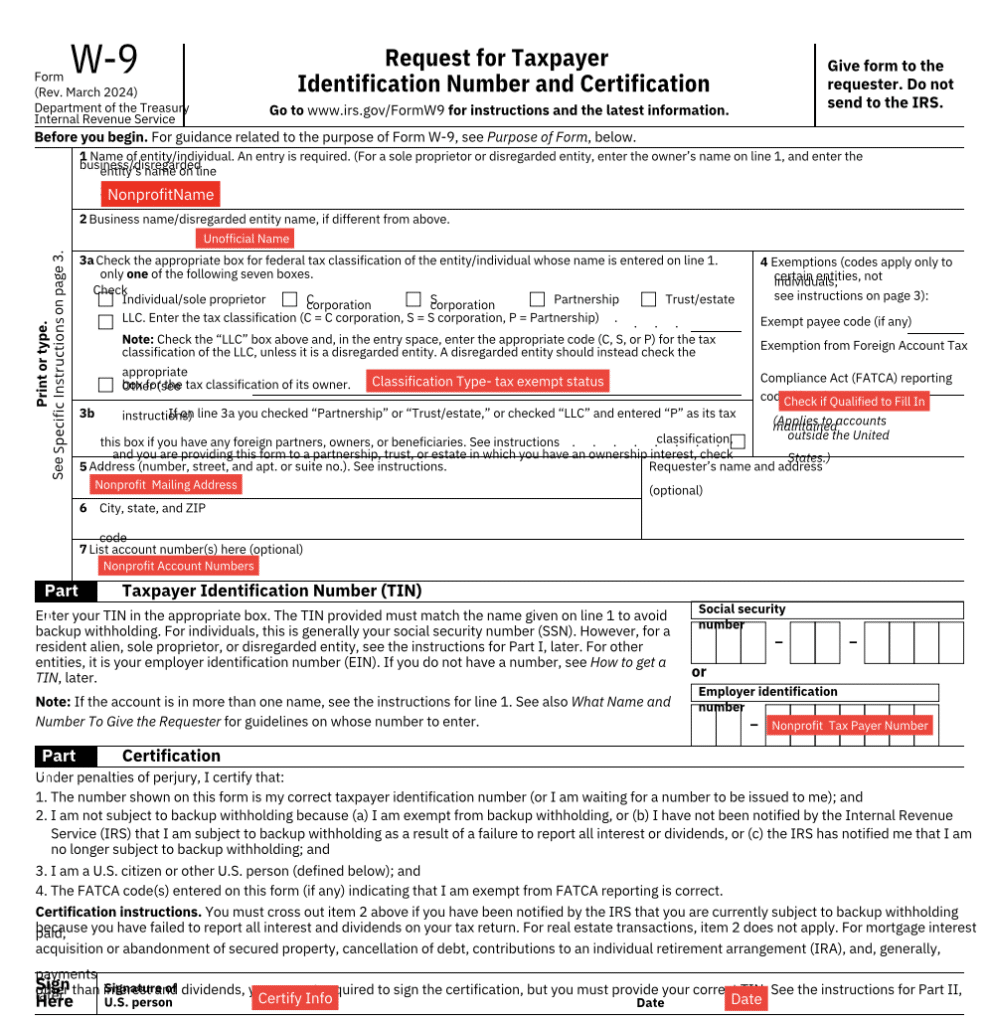
Line 1 (Organization’s Official Name) | Enter your nonprofit’s corporation name as it appears on Article of Incorporation |
Line 2 (Organization’s Unofficial Name) | Leave blank if you operation solely under your corporation name |
Line 3 (Federal Tax Classification) | Most nonprofits are organized as corporations, so they should select this option. Specifically, a 501(c)(3) nonprofit is considered a corporation for tax purposes. If your organization is not structured as a corporation but is still a tax-exempt nonprofit they should fill out ‘other.’ For example, some nonprofits may operate as associations or unincorporated groups. |
Line 4 (Exemptions) | If your nonprofit organization is exempt from backup withholding and FATCA reporting, please enter the applicable codes in the designated area. Here are the relevant codes for organizations exempt from federal income tax under section 501(a): Exempt payee code: 1 Exempt from FATCA reporting code: A |
Line 5+6 (Address) | Provide the mailing address for your nonprofit organization |
Line 7 (Account Number) | You may include any account numbers that the third party may need in Line 7, but this is optional. |
Part I (TIN) | Enter your TIN as assigned by the IRS. Since an EIN is necessary for operating as a nonprofit organization, always provide your EIN in this form and leave the Social Security number field blank. |
Part II (Certification) | Under “Part II,” you must certify the following conditions: The information provided is accurate. You are not subject to backup withholding. You are a U.S. citizen or individual. All that is required in this section is your signature and the date. |
Nonprofit W-9 Example
Using a nonprofit W9 example like this as a reference can prevent errors and speed up processing with funders or vendors.
Line / Part | Example Entry |
Line 1 – Name | Helping Hands Foundation (legal name as registered with the IRS) |
Line 2 – Business name/DBA | Leave blank (only fill in if using a different public name) |
Line 3 – Federal tax classification | Check “Other” and write “501(c)(3)” |
Line 4 – Exemptions | Leave blank (nonprofits typically do not complete this) |
Lines 5 & 6 – Address | 123 Charity Lane, Kindness City, ST 12345 |
Line 7 – Account numbers | Leave blank (only if requester provides an account number) |
Part I – TIN | EIN: 12-3456789 (never use a personal SSN for a nonprofit) |
Part II – Certification | Signed by Executive Director, 03/01/2025 |
Nonprofit Compliance Made Simple with Crowded
For nonprofits, staying compliant isn’t just about filing paperwork—it’s about protecting your tax-exempt status, maintaining funder trust, and avoiding costly mistakes. Yet with changing leadership, multiple funding streams, and complex reporting requirements, compliance can quickly become overwhelming.
Crowded makes the process simple by giving nonprofits the tools they need to stay audit-ready at all times:
Accurate IRS filings – Crowded helps organizations prepare and file forms like the 990 and 8822-B, ensuring the IRS always has the correct responsible party and address on record.
Centralized record-keeping – Every transaction, grant disbursement, or subaccount transfer is automatically tracked, creating a built-in audit trail.
Simplified oversight – Transparent dashboards and subaccount controls keep board members, staff, and auditors aligned without extra spreadsheets.
By automating these steps, Crowded turns compliance from a constant stress point into a seamless part of your everyday financial operations—so your team can focus on the mission, not the paperwork.
Free W-9 Form Template for Nonprofits
Our free nonprofit W-9 template is designed to save you time and prevent mistakes. Simply download the form, fill in your organization’s legal name, EIN, and mailing address, and have an authorized officer sign it. Keep a digital copy on file so it’s ready anytime a funder, vendor, or partner requests it. Using a standardized template ensures your information is consistent, accurate, and always IRS-compliant.
Get a free + customizable W-9 Template!
Your questions, answered.
Is a W-9 required for nonprofit donations?
Typically, no. Donors who give charitable contributions do not need a W-9. However, if a nonprofit is receiving money as payment for services, sponsorships, or grants, a W-9 for 501c3 is usually required.
Do nonprofits ever need to update their W-9?
What’s the difference between a W-9 for nonprofits and Form 990?
The W-9 form simply provides identifying information (like EIN and address) to payers. Form 990, on the other hand, is the annual IRS filing that nonprofits submit to report finances, activities, and compliance details. They serve completely different purposes.
Can a nonprofit submit a W-9 electronically?
Yes. Many vendors and grantmakers accept W-9 forms digitally, either through secure email or online vendor portals. Just make sure the document is signed and dated by an authorized officer.
Does a W-9 prove tax-exempt status?
Not by itself. While the form confirms your EIN and classification, some funders may also request a copy of your IRS determination letter to verify your 501(c)(3) status.
Can nonprofits use their SSN instead of an EIN on a W-9?
No. A W-9 for nonprofit corporation must include the organization’s EIN, not a personal Social Security Number. Using an SSN could create IRS mismatches and liability issues.