

Here is the short answer to what is fiscal sponsorship: an established 501(c)(3) public charity receives and manages money for a charitable project that has yet to earn its own tax-exempt status. Donors give to the sponsor, so their gifts qualify for a tax deduction, and the sponsor sends the money to the project while keeping legal control over how it is spent. Sponsors keep a fee, usually between 1% and 15% of what the project brings in.
This setup suits new programs, seasonal efforts, and groups testing an idea before forming their own nonprofit. We walk through how the money moves, who controls it, what it costs, and how to pick a sponsor you can trust.
TL;DR
- The sponsor legally receives every donation and retains discretion and control, making gifts deductible under IRS Revenue Ruling 68-489.
- Model A turns the project into a program of the sponsor. Model C keeps the project separate and funds it through preapproved grants.
- In the 2023 NNFS Fiscal Sponsor Field Scan of 100 U.S. sponsors, sponsors offering only Model C charged 6% to 8% of revenue, and sponsors offering only Model A charged 8% to 12%.
- In that same survey, 92% of sponsors use a standard written agreement with every project.
- H.R. 9721, a 2026 bill adding reporting rules for fiscal sponsors, cleared the House Ways and Means Committee in July 2026 and remains a pending bill as of October 2026.
What is Fiscal Sponsorship, Legally?
Fiscal sponsorship is a written contract between a 501(c)(3) public charity, called the fiscal sponsor, and a charitable project that operates under the sponsor’s exemption, called the sponsored project. The legal answer to what is fiscal sponsorship comes from Revenue Ruling 68-489. There, the IRS held that a charity keeps its own status when it passes money to groups outside 501(c)(3), as long as it controls how the money is used and keeps records proving it went to charitable purposes.
The phrase “fiscal sponsorship” sits outside the Internal Revenue Code. The practice grew from IRS rulings and custom, and the 2023 Fiscal Sponsor Field Scan from the National Network of Fiscal Sponsors (NNFS) and Social Impact Commons traces it back to at least 1959. Gregory Colvin’s 1993 book Fiscal Sponsorship: Six Ways to Do It Right gave the models the letters A through F still in use today.
How Does Fiscal Sponsorship Work? Money Moves in 5 Steps
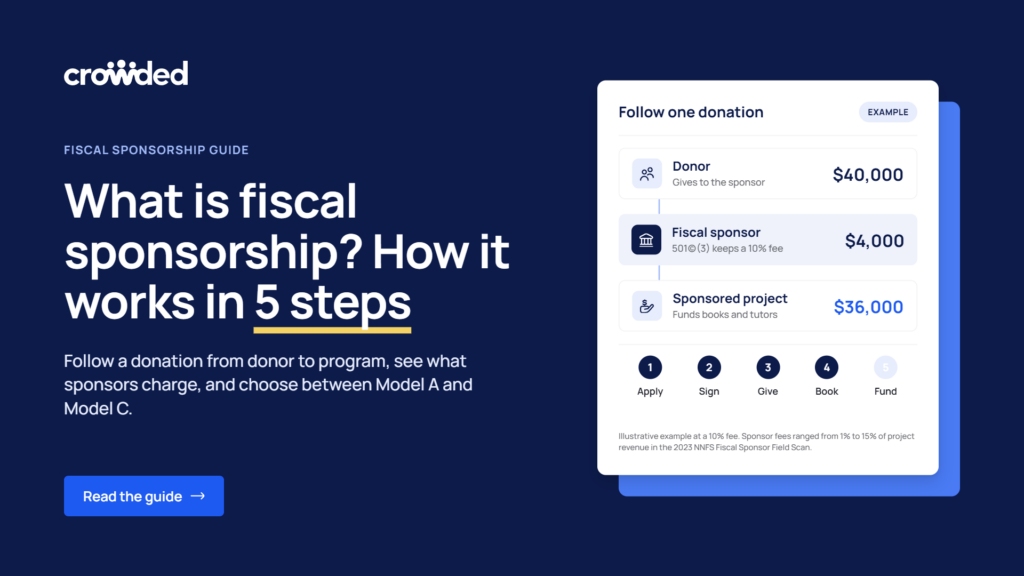
Most people who ask what is fiscal sponsorship want to know where a donation goes first. Every dollar for a sponsored project passes through the sponsor, which receipts the gift, takes its fee, and then pays the project’s costs or grants it the money.
- Apply. The project finds a sponsor whose mission covers its work and completes an intake review.
- Sign the agreement. It sets the model, the fee, reporting duties, and exit terms.
- Donors give to the sponsor. Checks and grants are payable to the sponsor and earmarked for the project.
- The sponsor books the gift. It records the income, acknowledges the donor, and deducts its fee.
- Funds reach the program. Under Model A the sponsor pays the bills, and under Model C it sends a grant. The project reports back in both models.
Here is a worked example. A neighborhood literacy program raises $40,000 at a spring benefit. At a 10% fee, $4,000 stays with the sponsor and $36,000 goes to books and tutors.
Grants follow the same path. Sponsors in the 2023 NNFS field scan stewarded over $575 million in government funding for their projects in one year, usually with the sponsor as the applicant of record.
Can a Sponsored Project Use Venmo, PayPal, or Its Own Bank Account?
Donations belong in accounts the sponsor controls or approves. Tax deductions apply only to gifts made to a qualifying charity, so a gift sent to a volunteer’s personal Venmo or Zelle loses that benefit. A Model C project may hold its own account for the grants it receives. Ask your sponsor in writing which donation pages and payment tools it allows.
Who Controls the Money in a Fiscal Sponsorship?
Any clear answer to what is fiscal sponsorship includes a split of duties: the sponsor holds legal control of the funds, and the project runs the program.
|
Responsibility |
Fiscal sponsor |
Sponsored project |
|
Donated funds |
Owns them |
Uses them for the program |
|
Spending decisions |
Approves them |
Proposes them |
|
Donor acknowledgments |
Issues them |
Thanks donors |
|
Form 990 reporting |
Files it |
Supplies records |
|
Program design and daily work |
Sets policies under Model A |
Leads the work |
Put simply, the project decides what to do and the sponsor decides which costs the money can cover. Our guide to sponsor responsibilities covers each duty in detail.
Settle interest before you sign. In the 2023 NNFS field scan, 68% of sponsors put interest earned on project funds into their own operations by default. If you plan to hold a large balance, such as a capital grant waiting on construction, write the interest policy into the agreement.
Model A vs. Model C Fiscal Sponsorship: Which Fits a New Project?
The models answer the next part of what is fiscal sponsorship: where the project sits. In Model A, the project becomes a program inside the sponsor. In Model C, the project stays a separate person or entity and receives money as preapproved grants. In the 2023 NNFS field scan, 72% of sponsors offered Model A, 68% offered Model C, and 48% offered both. Our breakdown of sponsorship models covers Models B, D, E, and F as well.
|
Feature |
Model A (direct project) |
Model C (preapproved grant) |
|
Project’s legal status |
Part of the sponsor |
Separate person or entity |
|
Who employs staff and pays bills |
The sponsor |
The project |
|
Insurance |
Usually the sponsor’s |
Usually the project’s own |
|
Typical fee (sponsors offering only this model) |
8% to 12% |
6% to 8% |
Insurance often comes with the sponsor. Among sponsors that offer any model besides Model C, 73% carry general liability insurance for their projects.
Our recommendation depends on whether you plan to hire staff. If your project plans to hire and has yet to form a legal entity, choose Model A. The 8% to 12% fee covers payroll and an employer of record while you prove the idea. If you already formed a nonprofit corporation and are waiting on IRS recognition, Model C gives you daily independence at 6% to 8%. Model C suits teams with their own entity and a bookkeeper, since it hands the employer and tax duties back to the project.
A conduit arrangement, where a charity forwards earmarked money without discretion or control, falls outside legitimate fiscal sponsorship. Model C sponsors track each payment as a grant, which grantmaking tools handle per project.
What Fiscal Sponsorship Fees Cost and Cover
Cost is usually the next question after what is fiscal sponsorship. Fiscal sponsorship fees ran from 1% to 15% of project revenue in the 2023 NNFS Fiscal Sponsor Field Scan, and sponsors using one fixed rate charged 5% to 12%. Others use tiered rates, minimum annual fees, or a flat yearly amount.
The fee pays for shared back-office work. In that survey, 73% of sponsors provide finance, HR, legal, insurance, and compliance support, and 49% also help with fundraising.
A low fee deserves a closer look. In the same NNFS survey, 54% of sponsors with expenses under $10 million said their fees cover only part of their costs, which can mean thin staffing on your account. Ask what each rate includes and which services, such as payroll or audits, carry extra charges.
Are Donations to a Fiscally Sponsored Project Tax Deductible?
Yes. For donors, the most useful part of what is fiscal sponsorship is the tax deduction. A gift qualifies when the donor gives to the sponsor, and the sponsor keeps discretion and control over the funds. The sponsor acknowledges the gift and reports it on its own Form 990, so the deduction rests on the sponsor’s 501(c)(3) status.
Reporting rules may change soon. The Fiscal Sponsorship Transparency Act of 2026, H.R. 9721, was introduced on July 16, 2026, and the House Ways and Means Committee ordered it reported by a vote of 23 to 15 on July 22. If enacted, sponsors would publicly report each project’s parties, yearly amounts, activities, managing officer, and dates. The bill would also tax “improper conduit arrangements” at 20% of the amount transferred, rising to 100% if left uncorrected, for tax years beginning after December 31, 2027. As of October 2026, the bill still awaits votes in the full House and the Senate.
Whether the bill passes or stalls, good records protect you today. Keep a note of who approved each disbursement and why.
How to Choose a Fiscal Sponsor
Choosing a sponsor turns what is fiscal sponsorship into a practical decision. Pick a sponsor whose mission covers your work and who puts the model, fee, reporting schedule, and exit terms in writing.
Start early. In the 2023 NNFS field scan, sponsors accepted about two projects for every one they turned away, mostly due to limited staff. Intake times vary as well. Crowded Foundation, a separate 501(c)(3) that offers Model C sponsorship, reviews applications within 5 business days. Sponsors that bring each new project to their board take longer: 72% of sponsors in the 2023 NNFS field scan involve their board in that decision. Those boards also oversee the sponsor’s filings, so a strong board review process signals good governance.
Good places to start include the National Network of Fiscal Sponsors member list and the Fiscal Sponsor Directory. Ask each sponsor who handles state registration when your project raises money across state lines. Look for these green flags:
- A written agreement that names the sponsorship model
- Financial reports for each project
- Clear exit and asset transfer terms
- Donation tools held in the sponsor’s name
- A mission that matches your program
What Happens When You Leave a Fiscal Sponsor?
Most projects leave to become their own 501(c)(3). In the 2023 NNFS field scan, 49% of departing projects went independent, and 28% moved to another sponsor.
Costs shape that timing. Social Impact Commons, a nonprofit research group, found that programs using a fiscal sponsor cut overhead costs by about half. A percentage fee grows with every dollar raised, so many projects revisit the math as revenue climbs.
Your balance moves through a planned transfer. The sponsor grants it to your new nonprofit or new sponsor, and donor restrictions stay in place. Under Model A, the sponsor owns the program’s work product by default, so agree on the transfer of intellectual property and equipment before you sign.
How Crowded Supports Fiscal Sponsors and Sponsored Projects
Crowded, a compliant money movement and banking platform for mission-driven organizations, gives a fiscal sponsor a separate fund account for each sponsored project. Restricted funds sit in their own accounts, and policy controls check each payment against your rules before the money moves. Crowded works alongside your accounting system, including QuickBooks, Sage Intacct, and Xero.
Project leads looking for a sponsor can apply to Crowded Foundation, a separate 501(c)(3) public charity, distinct from Crowded Technologies Inc., that offers Model C fiscal sponsorship for projects.
See How a Fund Account per Sponsored Project Works
If you manage projects for others, see how Crowded gives each sponsored project its own fund account with spending policies set before money moves. If you lead a project, get the sponsorship model, fee, and exit terms in writing before you sign.
This article shares general information for education. Please talk to a qualified attorney or accountant about your situation.
Crowded Technologies Inc. is a financial technology company and is not a bank. Banking services provided by i3 Bank; Member FDIC.
Frequently Asked Questions
What is fiscal sponsorship in simple terms?
It is an agreement where a 501(c)(3) charity accepts donations for your project and manages them under its own tax-exempt status. Your project gains tax-deductible gifts and back-office support, and the sponsor keeps a fee for that service.
Who controls the money in a fiscal sponsorship?
The sponsor owns the funds and approves spending, and the project leads the program. Crowded supports that split with a fund account for each sponsored project, so the sponsor and the project lead see the same balance. That shared view is what Crowded means by See & Control Every Dollar. Finance leads can find more on oversight in our CFO playbook.
How much do fiscal sponsors charge?
Fees in the 2023 NNFS field scan ran from 1% to 15% of project revenue. Sponsors offering only Model C charged 6% to 8%, and sponsors offering only Model A charged 8% to 12%. Ask what the fee includes before you compare rates.
Are donations through a fiscal sponsor tax deductible?
Yes. Donors give to the sponsor, which keeps discretion and control over the funds under IRS Revenue Ruling 68-489. The sponsor sends the acknowledgment and reports the gift on its own Form 990. Our list of common 990 mistakes shows what sponsors check before filing.
How does Crowded help fiscal sponsors and sponsored projects?
Crowded gives sponsors a fund account per project, with policy controls that check payments before money moves. Setup follows the Crowded pillar Customize Crowded, Instantly, so sponsors shape accounts and approvals around their own program structure. Project leads can apply to Crowded Foundation, a separate 501(c)(3) offering Model C sponsorship. Our fiscal sponsorship page covers the full program.
What happens to project funds after leaving a fiscal sponsor?
The sponsor grants the remaining balance to the project’s new nonprofit or new sponsor, and donor restrictions stay in place. Agree on intellectual property and equipment transfers in the original agreement.