

The fiscal sponsorship models differ on five points: who owns the project, who employs the people, who carries legal liability, who controls the money, and what the project keeps when it leaves. In Model A, a sponsored project becomes a program inside the sponsoring 501(c)(3). In Model C, the project stays separate and receives grants from the sponsor, which keeps the final say over how donated funds are spent.
TL;DR
- Six models come from the framework attorney Gregory Colvin first published in 1993, and Models A and C lead in practice: 72% and 68% of sponsors offered them in a 2023 national survey of 100 fiscal sponsors.
- Under Model A, the sponsor employs project staff and carries the liability. Under Model C, the project handles both itself.
- Sponsors offering only Model A reported fees of 8% to 12% of revenue, and sponsors offering only Model C reported 6% to 8%.
- The sponsor holds complete discretion and control over donated funds in every model, and that control keeps gifts deductible.
- Of projects that left a sponsor, 49% became their own 501(c)(3) and 28% moved to another sponsor.
The Six Fiscal Sponsorship Models At A Glance
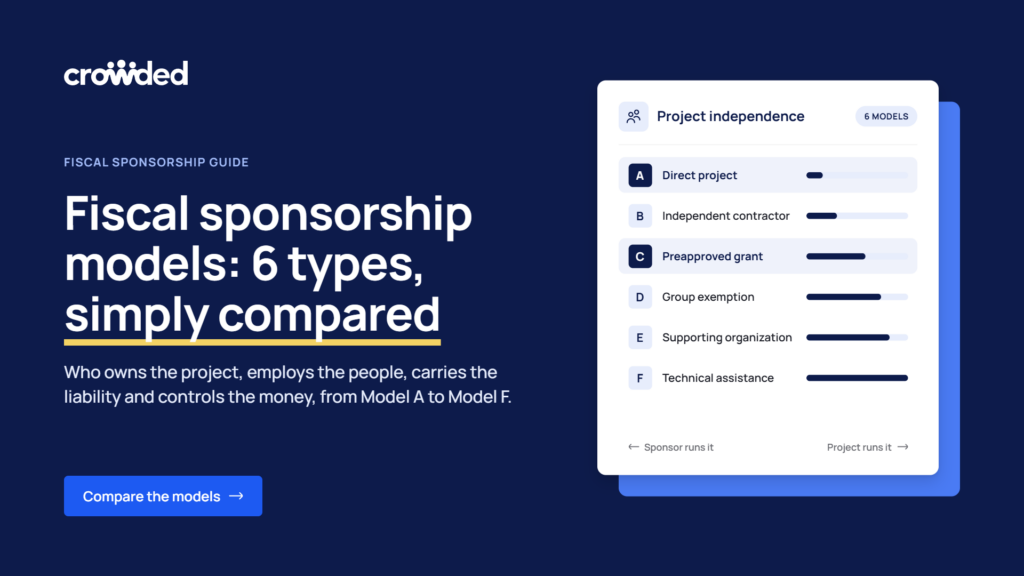
Fiscal sponsorship is an arrangement in which a 501(c)(3) nonprofit receives deductible gifts for a charitable project and keeps control over how that money is used. The six fiscal sponsorship models describe how closely the project ties to its sponsor, from fully absorbed in Model A to fully independent in Model F.
Model | How It Works | Who Employs The People | Project Independence |
A, direct project | The project becomes a program of the sponsor | The sponsor | Lowest |
B, independent contractor | The sponsor owns the project and pays a person or business to run it | The contractor, as their own business | Low |
C, preapproved grant | The project stays separate and receives grants from the sponsor | The project | Moderate to high |
D, group exemption | A central nonprofit’s IRS group ruling covers its subordinate organizations | Each subordinate | High |
E, supporting organization | The project forms its own nonprofit, classed as a public charity through its tie to a supported charity | The project | High |
F, technical assistance | An existing 501(c)(3) buys back office help | The organization itself | Highest |
Read from top to bottom, the table moves from the sponsor handling the administrative work to the project handling all of it. Models D and E existed before fiscal sponsorship became a field, and some attorneys place them outside fiscal sponsorship altogether, as Adler & Colvin note. Sponsors also blend models, so read each sponsor’s agreement closely.
Fiscal Sponsor Versus Fiscal Agent: Why The Label Matters
A fiscal sponsor is a 501(c)(3) charity that controls the money it receives for a project. “Fiscal agent” is the older label, and attorney Gregory Colvin explains that it reverses the relationship: under agency law, an agent acts for a principal who directs it, so calling the charity an agent implies the project controls the charity.
Tax law requires the charity to retain control. The IRS treats a gift to a charity earmarked for a project as a gift straight to the project, so the gift is deductible when the charity has complete discretion and control over the funds, according to Colvin. When a sponsor describes itself as your fiscal agent, ask how it exercises that control.
Model A and Model C Fiscal Sponsorship Side By Side
Model A places your project inside the sponsor, and Model C keeps it outside the sponsor and funds it through grants. That one difference decides who hires, who signs contracts, who carries the liability, and who owns what you build.
Model A | Model C | |
Legal Status Of The Project | Part of the sponsor, as one of its programs | A separate person, group or entity that serves as the sponsor’s grantee |
Staff | The sponsor’s employees, contractors, or volunteers | The project’s own employees or contractors |
Liability For Daily Operations | The sponsor | The project, usually with an indemnity to the sponsor |
Control Of Donated Funds | The sponsor, spending on the project’s behalf | The sponsor, granting against an approved budget and reports |
Bank Account and Books | The sponsor’s, with a restricted fund for the project | The project’s own, with reports to the sponsor |
Intellectual Property During The Agreement | Owned by the sponsor | Owned by the project |
Fee Charged By Sponsors Offering Only This Model | 8% to 12% of revenue | 6% to 8% of revenue |
The fee row comes from the 2023 Fiscal Sponsor Field Scan by Social Impact Commons and the National Network of Fiscal Sponsors. Across the other rows, one pattern stands out: Model C asks the project to carry the work and the risk, and its fees reflect that lighter load for the sponsor.
Model A Fiscal Sponsorship: The Sponsor Runs The Project
In Model A, also called direct project sponsorship, the sponsor has complete authority to run the project and spend its funds, according to Adler & Colvin. Grants and contracts sit in the sponsor’s name, and payroll runs through its books. Model A is also the oldest form: a Boston nonprofit now called TSNE began offering it in 1959.
Anyone paid to run a Model A project is the sponsor’s employee or independent contractor, and volunteers act as the sponsor’s agents. The sponsor’s board keeps final control, and the founder often runs daily work as program director. Our Model A fiscal sponsorship agreement template walks through the clauses that set this up.
Model C Fiscal Sponsorship: The Sponsor Makes Grants To You
Model C fiscal sponsorship, also called a preapproved grant relationship, keeps the project outside the sponsor as its grantee. Incorporation is optional. The grantee can be an individual, an unincorporated association, an existing organization, or a business, according to NEO Law Group. Grants to a business must fund charitable work only, and NEO Law Group rates the private benefit risk in those arrangements as relatively high. Groups exempt under 501(c)(4) or 501(c)(6) sometimes use a sponsor to fund a charitable program, such as scholarships, that donors want to deduct.
Two points deserve attention. Personal liability for an informal group depends on state law; for example, California gives limited liability to members of an unincorporated nonprofit association, while a general unincorporated association leaves its members personally liable. An individual grantee may also owe tax on grants received. The Model C agreement template shows how reporting and indemnity clauses handle the rest.
How Independence Grows From Model A To Model F
Across the fiscal sponsorship models, independence and administrative work grow together. Model A projects hand payroll and insurance to the sponsor. Model F organizations already have their own 501(c)(3) status and buy services such as bookkeeping or check writing; in that model, the organization keeps spending decisions.
Each end suits a different stage. A first-year youth mentoring program run by two volunteers benefits from handing the administration to a sponsor. An established program with its own staff and bank account may prefer the speed of running its own approvals.
What Model A and Model C Fees Cover
Model A fiscal sponsorship fees sit at 8% to 12% of revenue among sponsors offering only Model A, because the sponsor pays for payroll, benefits, insurance and audits. Model C fees sit at 6% to 8% among sponsors offering only Model C, because the project covers those costs itself. Across 100 sponsors and all fiscal sponsorship models in the 2023 Fiscal Sponsor Field Scan, the latest published national survey of sponsors, fees ranged from 1% to 15% of project revenue, and most sponsors charged a fixed percentage of revenue.
For a sponsored project expecting $200,000 in grants and gifts in a year, the numbers look like this:
Model A (8% to 12%) | Model C (6% to 8%) | |
Sponsor Fee | $16,000 to $24,000 | $12,000 to $16,000 |
Payroll, Insurance and Bookkeeping | Covered by the sponsor | Paid by the project |
Model C saves money when the project’s own administrative costs stay within the $4,000 to $8,000 gap at this revenue level. For a project still building its staff and insurance, the Model A fee usually covers the full administrative bill.
Before you sign with any fiscal sponsor, ask:
- What does the fee cover, and what gets billed separately, such as payroll processing or international transfers?
- Does the sponsor charge a minimum annual fee?
- Who keeps interest earned on our funds? In the Field Scan, 68% of sponsors moved that interest into their own general operations, with funder instructions taking priority.
- Does any part of the fee come back on unspent funds when we leave?
Who is Responsible For Grants, Compliance and Liability
In Model A, the sponsor holds legal responsibility for everything the project does. In Model C, the sponsor answers to funders for how each grant is used, and the project answers for its own staff and operations.
Funders treat the sponsor as the grantee in both models, because the gift relies on the sponsor’s 501(c)(3) status. Sponsors in the Field Scan stewarded about $576 million in government funding for their projects. The details differ by model. Under Model A, a project’s lobbying counts toward the sponsor’s federal lobbying limits across all of its projects, NEO Law Group notes, so the agreement may cap it. Under Model C, agreements usually require the project to indemnify the sponsor and carry its own insurance. Among sponsors offering any model besides Model C alone, 73% carry general liability insurance for their projects.
The agreement settles who is liable for what. Our guide to what fiscal sponsors are responsible for covers the sponsor side in detail.
Leaving A Sponsor: Your Funds, Donor List, Website and IP
Under Model A, the sponsor legally owns the project’s money, donor records and intellectual property until a transfer agreement moves them to a successor. Under Model C, you already own your intellectual property, and the sponsor closes your fund and grants what remains to a qualified successor.
Under any of the fiscal sponsorship models, a clean exit usually runs in four steps:
- Read the termination clause. One sample Model A agreement gives both sides 60 days after notice to find a successor 501(c)(3).
- Choose the successor, either your own new 501(c)(3) or another sponsor. The current sponsor vets it, for example by confirming its status in the IRS Tax Exempt Organization Search, because the transfer is a grant made under the sponsor’s own charitable purposes, as NEO Law Group explains.
- List every asset in the transfer agreement: remaining restricted funds, equipment, donor and mailing lists, the domain and website, social media accounts, and copyrights or trademarks.
- Settle the liabilities. Agree in writing whether the successor takes on obligations incurred before the transfer. Some sponsors hold back part of the funds, for example for three months, to cover late bills. In Model A, the old sponsor pays out accrued employee leave, or the new employer assumes it.
Is Fiscal Sponsorship Meant To Be Temporary?
Often, and the agreement sets any time limit. Among projects that left a sponsor in the Field Scan’s reporting year, 49% became standalone 501(c)(3) organizations and 28% moved to another sponsor; others finished short term work and closed. Many projects start under a sponsor because IRS recognition of 501(c)(3) status can take 10 months or longer, according to NEO Law Group.
Signs A Fiscal Sponsor Provides Sound Oversight
Across all fiscal sponsorship models, a sponsor provides sound oversight when it retains discretion and control over donated funds and requests budgets and reports. Donors keep their deductions when the sponsor holds that control. A sponsor that forwards money wherever a donor points can be treated by the IRS as a mere conduit, and those deductions then come into question, as Business Law Today explains.
Picture a neighborhood food pantry project that asks a sponsor to accept a $25,000 gift and send it on the same day, with the budget and the agreement still unwritten. That pattern calls for a pause.
The 2023 Field Scan shows what most sponsors do:
- 92% use a written fiscal sponsorship agreement with every project
- 77% track project funds separately from their own
- 72% involve their board in approving new projects
- About three-quarters send projects budget versus actual reports
- About a third give projects direct access to their financial records
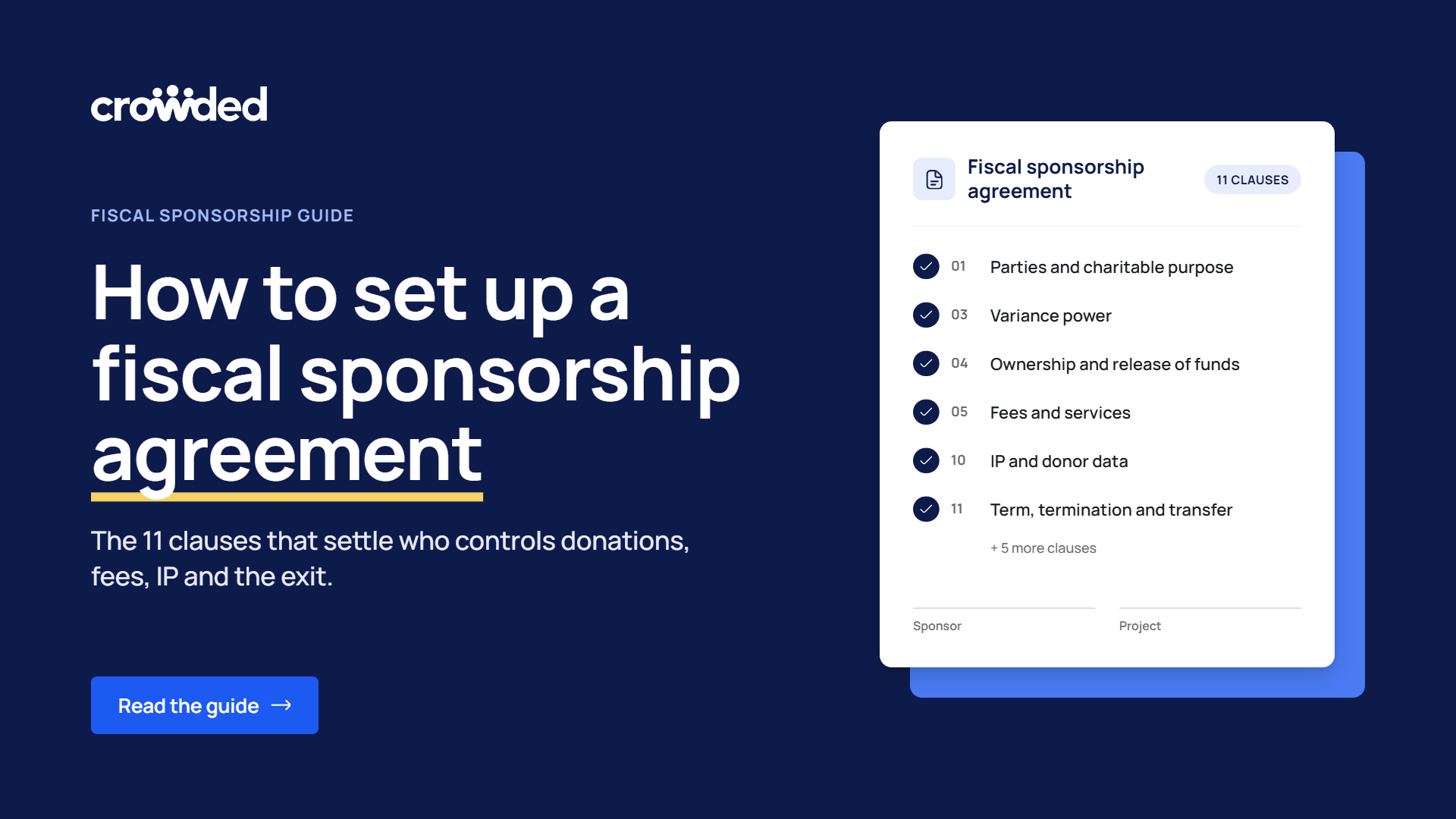
Ask whether the agreement includes variance power, the sponsor’s retained right to make the final decision on how money in the project’s restricted fund is used. Business Law Today lists it among the clauses a written fiscal sponsorship agreement should contain.
How To Choose Between Fiscal Sponsorship Models
Most new projects still building their staff should start in Model A, then move to Model C or their own 501(c)(3) once they can run payroll and file their own reports. Match your situation to a row in this table, then check the last column before you commit.
Your Situation | Best Fit | Consider Another Model If |
Payroll, insurance, and bookkeeping are still ahead of you, and you want to raise money soon | Model A | You want to sign your own contracts and run your own hiring |
Your own team and bank account, and you want to keep running operations | Model C | You prefer to skip regular budgets and spending reports to a sponsor |
A defined piece of work the sponsor wants delivered | Model B | You want to own the result |
Already a 501(c)(3) that wants back office help | Model F | You need another charity’s tax-exempt status to receive gifts |
A network of chapters under one national organization | Model D, a group exemption | Your chapters want separate identities, fully independent of central supervision |
Apply early, whichever row you land in. In the Field Scan, sponsors turned away one project for every two they accepted, 86% turned some projects away during the year, and 28% paused new intake at some point.
How Crowded Supports Fiscal Sponsors and Sponsored Projects
Crowded, a compliant money movement and banking platform for mission-driven organizations, gives a fiscal sponsor one fund account for each sponsored project, under any fiscal sponsorship model the sponsor runs. Restricted money stays separate at the account level, and a sponsored project can have its own EIN and incorporation papers.
Sponsors set approval rules and spending limits before money moves, and they see every project’s balance and transactions in one view. That covers two signs of sound oversight in a fiscal sponsor: project funds tracked apart from the sponsor’s own, and records a sponsored project can view itself.
Crowded Foundation, a 501(c)(3) public charity separate from Crowded Technologies Inc., offers Model C fiscal sponsorship to projects working toward their own tax-exempt status. Nonprofits that sponsor projects themselves can see how fund accounts for fiscal sponsors are set up.
Your fiscal sponsorship agreement and your attorney stay at the center of the legal relationship, and Crowded works alongside your accounting software and donor tools.
Frequently Asked Questions
What is the difference between Model A and Model C fiscal sponsorship?
Model A makes your project a program of the sponsor, which employs the staff, owns the assets, and carries the liability. Model C keeps your project separate as a grantee that runs its own operations and reports to the sponsor on each grant. In the 2023 Field Scan, sponsors offering only Model A reported fees of 8% to 12%, and sponsors offering only Model C reported 6% to 8%.
Who controls the money raised for a sponsored project?
The sponsor holds complete discretion and control over donated funds in every model, and that control keeps gifts deductible. In Model C, the sponsor releases money as grants against an approved budget. Crowded builds that stewardship into daily work: sponsors using Crowded fund accounts approve spending before money moves and see every project’s balance in one view, so each dollar stays visible.
How do donations to a fiscally sponsored project stay tax-deductible?
Across all fiscal sponsorship models, donors give to the sponsor, a 501(c)(3) public charity, and the sponsor uses the gift for its own charitable purposes. The IRS treats the gift as deductible when the sponsor holds complete discretion and control. A sponsor that simply passes money along risks having the IRS treat the gift as a gift straight to the project.
Can a fiscally sponsored project apply for government and foundation grants?
Yes. The fiscal sponsor applies or appears as the grantee, because the funder relies on its 501(c)(3) status. Sponsors in the 2023 Field Scan stewarded about $576 million in government funding for their projects. Check each funder’s rules early, since some ask for the fiscal sponsorship agreement and the sponsor’s approval before you submit.
Are project founders employees or contractors under Model A?
Either, and always of the sponsor. A Model A project is part of the sponsor, so anyone paid to run it is the sponsor’s employee or independent contractor, and volunteers act as the sponsor’s agents. The sponsor’s board keeps final control, and the founder often runs daily work as program director.
Can a business or a 501(c)(4) use fiscal sponsorship?
Yes, within limits. A business can receive Model C grants only for charitable work, and NEO Law Group rates the private benefit risk in those arrangements as relatively high. Groups exempt under 501(c)(4) or 501(c)(6) sometimes use a 501(c)(3) sponsor to fund a charitable program, such as scholarships, that donors want to deduct.
How long does it take to find a fiscal sponsor?
Timelines vary, and demand often outpaces capacity. In the 2023 Field Scan, 86% of sponsors turned some projects away during the year, and 28% paused new intake at some point. Apply to two or three sponsors whose missions match yours, with a budget and a single-page project description ready. Crowded Foundation, a separate 501(c)(3) public charity, offers Model C fiscal sponsorship and explains its application process online.