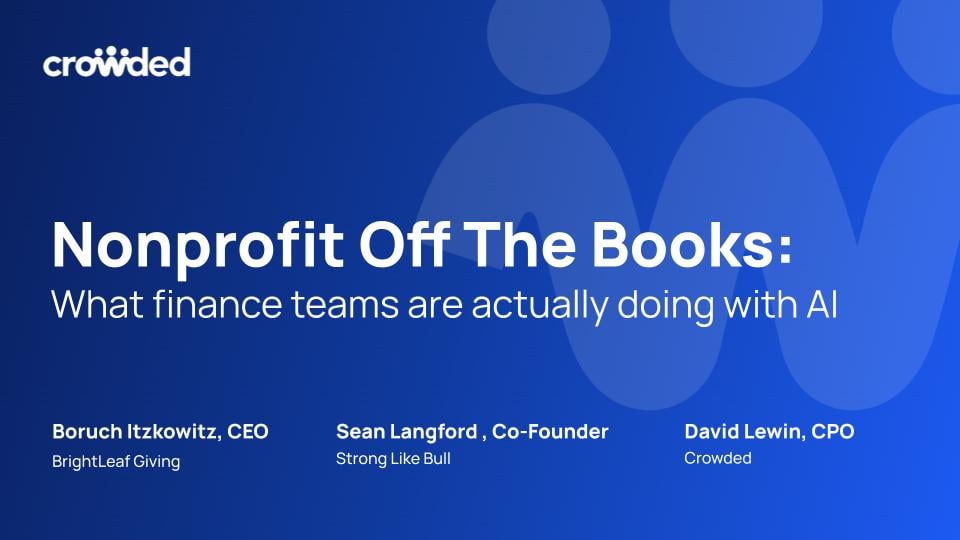
I recently moderated Nonprofit Off the Books, a virtual panel discussion on what finance teams at mission-driven organizations are actually doing with AI.
I was thrilled to have two of our customers join me: Boruch Itzkowitz, founder and operator of Brightleaf Giving, a fiscal sponsor, and Sean Langford, founder of Strong Like Bull, a cycling foundation that serves underserved communities and promotes women in sports.
My summary of our conversation: the teams getting real value started small, kept a person in charge of key decisions, and used AI as a layer on top of the systems they already trust.
Start with a conversation, then pick one small project
I asked both guests what they would tell a hesitant organization. Boruch’s advice was to open an AI assistant and simply talk. He compared it to a 45-minute exploratory meeting with a consultant: share what you do, and ask where it could save you time. In his experience, there is a wide gap between chatting with AI and letting it make changes in your CRM or inbox, so there is no need to fear that first step.
Sean suggested the next step stay small too. Content generation is an easy place to start, such as blog posts, LinkedIn posts, and fundraising appeals, as long as someone reviews everything it writes. From there, his team moved to asking AI for perspective on governance, planning, and strategy, and he recommends running any major decision past your attorneys and advisors before acting.
Where AI earned its spot in finance work
I asked each guest where AI first earned a spot in their finance work. For Strong Like Bull, it was receipt matching. A roving cycling group racks up many small expenses (fuel, food, tools, parking), and AI took over the work of recording and categorizing them. Sean described it as staff augmentation, which prompted the team to ask what else it could handle. Today AI helps them screen grant applications and turn their founders’ chat history into draft board meeting minutes that the team reviews and signs off.
Boruch’s team began with easy work like web design touch-ups and refining tax receipt language for different donor and gift types. It grew into a routine for diagnosing problems: when several donors reported slow tax receipts, he asked AI to review months of receipt activity, summarize the cause, and draft a fix for his developer. He says the time from spotting an issue to shipping a fix has gone from about two months to about two days.
Keep a human in the loop on the final decision
I asked how they balance automation with control, and both panelists were clear that a person stays in charge. At Strong Like Bull, AI narrows the pool of grant applicants, and people make the final call. At Brightleaf Giving, every disbursement from a fundraising campaign runs through an automated check on whether the payout fits that campaign’s stated mission. The check flags anything unusual, such as a recipient who shares a last name with the campaign manager, records its reasoning, and hands it to a person who approves or declines.
Sean’s guardrail for AI-generated advice is the same: most of the time it is useful, so build in a checkpoint for the times it is not. My takeaway: let AI handle the heavy lifting, and keep a hand on the brake for sensitive decisions, especially anything involving money.
Think ten steps ahead and keep your records clean
Boruch shared two rules he lives by. First, any system, AI included, only gives back what you put into it, so you still need a back-end record of what decisions were made and why. Second, think ahead to the questions you will be asked in six months. Donor tax receipt requests tend to flood in around December 31, and a team that tracked the right data all year can answer in seconds instead of spending a day digging for records.
Lead with the mission, and treat data security like any other technology
When a board member or volunteer is wary of AI, Sean grounds the conversation in the mission. If a tool helps you extend your reach, automate routine work, or communicate better, it serves the reason everyone is there. I added a question worth asking: what’s in it for the organization? Letting people try it on a task that used to take hours usually answers it.
On protecting financial and donor information, Boruch’s view was that AI deserves the same diligence as any other tool that touches donor data, such as email, shared spreadsheets, or a payment processor. Paid AI services include account settings that control data sharing, and it helps to state up front that a conversation should stay private. Review your vendors’ settings and policies before you share sensitive information.
AI works as a layer on your accounting software, not a replacement
An audience member asked whether AI can replace nonprofit accounting software like QuickBooks, Sage / Intacct, MIP Finance, or FE, NXT. The panel’s answer was not today. I explained that systems of record are staying in place, while AI assistants connect to them through MCP, a standard that lets tools like Claude and ChatGPT work with the data inside those systems. Sean said he wouldn’t trust AI to run the books on its own yet, but he does rely on it to flag anomalies, categorize receipts, and support grant selection.
Boruch added that an app built over a weekend rarely anticipates the edge cases a mature platform has already worked through. His team’s approach is a custom layer on top of the accounting system.
What’s the best way to get started with AI on your nonprofit finance team?
The advice from both panelists was the same: pick a small task, try it this week, and keep a person in the loop. If you missed our live panel discussion, you can watch it online on our YouTube channel: https://youtu.be/Kmm9Z0cYtjA